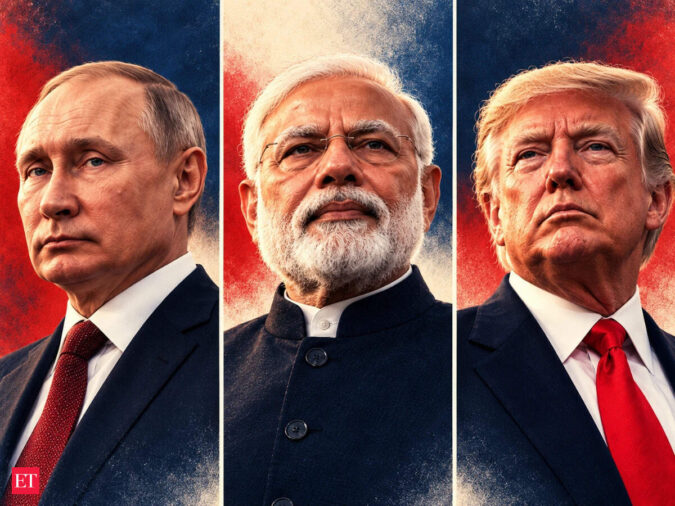
The reversal exposes an uncomfortable truth that when energy costs threaten voters, geopolitical principles become negotiable. The question is whether Trump will now acknowledge India’s argument that affordable energy and the interests of ordinary people cannot simply be sacrificed to foreign policy objectives.
ALSO READ | India awaits how Trump will route diesel buy from Russia
The American consumer comes first
Trump announced the agreement with Putin on October 9 after what he described as a successful conversation with the Russian president. Russia would immediately supply more than 300,000 tonnes of diesel, followed by another 500,000 tonnes in November and 1 million tonnes thereafter. A further 3 million tonnes could follow, depending on refinery conditions.
Diesel powers American agriculture, trucking and parts of the heating sector. Its rising cost feeds into freight charges, food prices and inflation, making it a politically sensitive issue before voters decide whether Republicans retain control of Congress. Trump has described lower fuel prices for farmers, ranchers and truckers as a priority.
ALSO READ | Trump’s diesel deal with Putin may be lots of barrels but little bangThe irony here is difficult to miss. The administration that argued Russian oil purchases helped finance Moscow’s war is now prepared to relax restrictions to secure Russian fuel for Americans. The economic logic is familiar to India, which imports most of its crude oil and cannot insulate its consumers from international price shocks.
New Delhi’s argument has never been that Russia’s invasion of Ukraine is acceptable. It is that energy security, inflation and the purchasing power of hundreds of millions of people must count in decisions about where a country buys its fuel. Trump has learnt his India lesson the hard way when opinion polls suggest his popularity is dipping and high diesel prices just before midterm elections loom as a threat.
ALSO READ | Trump strikes deal with Putin to get diesel in sharp reversal of US policy weeks before midterms
A concession that may not deliver
There is, however, a significant difference between announcing a deal and changing prices at the pump. Analysts doubted Russia could deliver the promised volumes easily, given damage to its refining infrastructure and restrictions on diesel exports. Russian export capacity has been disrupted by Ukrainian strikes, while Moscow has also imposed export restrictions to protect domestic supplies.
The proposed shipments were unlikely to make a substantial difference to American diesel prices. Transporting fuel takes time, and the promised volumes remain small relative to global demand. The arrangement may offer some additional supply, but it cannot quickly reverse the damage caused by disruptions to energy production and shipping.
That weakens the administration’s economic case for taking a politically costly decision that appears to benefit Putin. If the relief for American consumers proves modest, the diplomatic and legislative backlash could outlast any immediate price benefit.
The legal battle could complicate India’s case
Having learnt that people take precedence over geopolitics, will Trump now acknowledge India’s long-held concerns over oil? The biggest obstacle to any American concession to India may now be Trump’s own Congress.
On October 11, seven senators, including Republicans Susan Collins, Lisa Murkowski, Thom Tillis and John Curtis, urged the administration to reverse the decision. Democrats Jeanne Shaheen, Richard Blumenthal and Ron Wyden also signed the statement, arguing that the 2022 ban on Russian energy imports was intended to prevent American money from financing Putin’s war. They accused the administration of failing to consult Congress or provide the explanation required by law.
Tillis went further, saying there was a legitimate case that Trump was not following the law. Representative Brian Fitzpatrick has separately vowed to force a House vote to block Russian oil purchases. The opposition is particularly awkward for Trump because the sanctions legislation signed in September, named after the late Senator Lindsey Graham, allows tariffs of up to 100% on major buyers of Russian energy.
However, Treasury Secretary Scott Bessent insists the administration has sufficient legal authority to proceed. The Treasury has temporarily suspended sanctions on Russian diesel exports until April 7, 2027, for fuel already loaded onto tankers by the specified deadline. But whether that exemption can withstand congressional scrutiny is a separate question from whether the administration believes it is justified.
If Washington needs a special legal interpretation or a narrow exemption to buy Russian diesel, it will be harder to argue that India’s purchases must automatically attract punitive measures. Yet the reverse is also possible — congressional opposition could push Trump towards a tougher public stance on sanctions, even as his administration seeks flexibility for itself.
Will India get a carve-out?
India is watching how Washington structures the exemption. ET reported today that India was reviewing the implications of Trump’s announcement, with officials examining whether the US could create a specific concession for its own purchases without formally violating the Russia and Iran Sanctions Act. The administration has not reached a conclusive decision on a waiver for India, despite a September 30 conversation between Trump and Prime Minister Narendra Modi.
For India, the stakes go beyond the immediate tariff bill. Energy purchases from Russia have provided an additional source of supply and helped Indian refiners manage costs. Some Russian crude is processed in India and the resulting refined products, including diesel, are exported to international markets. That creates a further complication for Washington. Former US diplomat Stephen Mull told The Times of India that India has its own leverage because some of the Russian crude it buys is refined into diesel that subsequently reaches American markets.
Mull argued that India has options to respond if sanctions are imposed and that Trump would have to factor those possibilities into his calculations. Retaliation could deepen the damage to a bilateral relationship already strained by trade negotiations and disagreements over Washington’s approach to Pakistan.
Washington may distinguish between crude oil purchases and a temporary arrangement involving diesel already loaded onto ships. That argument could matter legally but won’t erase the sheer political inconsistency.
The hard lesson Trump may still refuse to acknowledge
Trump’s decision does not necessarily mean he would now accept India’s argument. He could insist that America’s arrangement is temporary, narrowly defined and designed to address an exceptional supply crisis. He could also return to a harder sanctions policy once the immediate pressure on fuel prices eases after midterms.
If fuel prices remain high, the administration will face pressure to find more supplies regardless of their origin. If prices fall, Trump may have greater room to restore restrictions and maintain pressure on countries buying Russian energy. Either way, the principle guiding policy appears less absolute than Washington previously suggested.
Trump need not endorse India’s entire position on Russia to acknowledge that energy security cannot be judged by one standard for Washington and another for New Delhi. But with Republicans and Democrats questioning his diesel deal, a waiver of any sort for India may become politically harder to deliver.