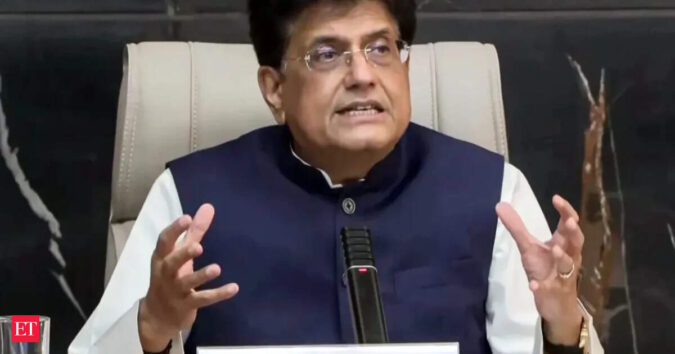
He said that India has finalised nine free trade agreements, “and I include the US, which is almost done and dusted.”
“We just have to find the right comparable competitive advantage over our competitor so that we can quickly execute the agreement,” Goyal said, ahead of his visit to the US for the G20 Trade Ministerial to be held from September 30 to October 1 in Wisconsin.
The minister will also hold a bilateral meeting with US Trade Representative Jamieson Greer, and the progress of negotiations for the pact is expected to be taken up during the deliberations between the two leaders.
Also read | Karnataka to woo Singapore majors; Sats plans expansion
EU, China
Goyal also said India was not part of the original negotiations for the Regional Comprehensive Economic Partnership (RCEP) and the push within the government at the time to join the negotiations would effectively have meant entering an FTA with China.He questioned whether such an agreement would have benefited Indian businesses, manufacturers and workers, citing concerns over Chinese exports, dumping goods, lack of transparency and subsidies to exporters.
He said India could have extracted more concessions from the EU had the pact been negotiated earlier when the bloc didn’t have regulations such as Carbon Border Adjustment Mechanism and deforestation, the number that has increased to 73.
“Even now when they (EU) wanted to restrict steel exports, we have extracted our pound of flesh and safeguarded so many of our agriculture and other sectors and we got a huge extra steel quota. We got another $500 million commitment on climate finance. It is the beginning; there will be much more coming,” Goyal said.
A trade deal with Israel, he said, might take time due to the geopolitical situation.
Semicon, shipping
Noting that India’s annual semiconductor consumption demand was expected to grow to over $150 billion in the next five years,
Goyal said India was looking to participate across the Al technology stack, from large language models to Al agents, as the government seeks to strengthen the country’s position in emerging technologies. He also cautioned businesses against relying entirely on Al-generated information without human verification, citing the possibility of inaccurate responses and the risks associated with using such information in professional decision-making.
He also said that India aims to give one million seafarers to the world.
Export derisk
At the same event, commerce secretary Rajesh Agrawal said India’s expanding network of FTAs can help de-risk export supply chains by enabling Indian exporters to diversify across multiple markets, while predictable tariffs and processes can make the country more attractive for global supply-chain investments.
“If l am an exporter and l am reaching into a geography which is in ASEAN, I can also now go to Australia, and now with New Zealand FTA I can go to New Zealand too, because it’s the same region, same supply chain, but now I have that duty arbitrage, which helps me take risk,” he said.
“Since I am reaching the same product in ten markets, l am de-risking. So that is one way you can de-risk your exports, and that’s important for exports to grow sustainably,” Agrawal said, adding that predictability was a key requirement for companies that FTAs provide.
He said investors need clarity on tariffs and processes when they import inputs from one geography, add value in India and subsequently export to another market.
On state-wise export data, Agrawal said the government was working to make trade statistics more granular and useful for states and industry. Explaining that existing trade statistics are largely collected at the points from where goods are shipped, he said these create difficulties in identifying the state where a product was manufactured.