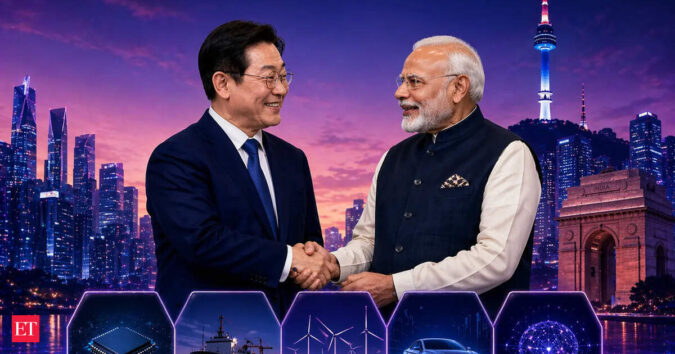
The discussions with PM Modi reflected a clear intent to deepen capital flows rather than just expand trade. What emerged was a structured attempt to position India as a preferred investment base for Korean conglomerates at a time when global supply chains are being reorganised. This engagement also sits within a wider strategy in which India is actively diversifying its sources of FDI across Asia, Europe and emerging trade partners.
Also Read: India, South Korea to upgrade trade pact, deepen tech and supply chain ties
A targeted push for South Korean capital
At the core of the Modi-Lee discussions was a strong emphasis on channeling South Korean investment into high-value sectors aligned with India’s industrial ambitions. The leaders indicated that future Korean capital is expected to flow not only into traditional electronics manufacturing but also into semiconductors, shipbuilding, energy systems and advanced mobility. “We will realise new opportunities for cooperation in every field, from chips to ships, talent to technology, environment to energy, and together we will ensure the progress and prosperity of both countries,” Modi said.
A key proposal discussed was the creation of a dedicated India–Korea startup and innovation investment fund. This mechanism is intended to channel Korean venture capital into India’s fast-growing digital and deep-tech ecosystem. Unlike earlier phases of Korean investment that largely focused on large-scale manufacturing plants, this initiative is designed to bring Korean capital into early-stage companies working in artificial intelligence, semiconductor design, electric mobility software and industrial automation.
Also Read: Cos including Samsung & LG looking to expand in key market, export more
In parallel, there was strong emphasis on expanding large-scale industrial investments by established Korean conglomerates. LG Group’s ongoing and planned expansion in India, particularly in electronics and consumer manufacturing, has already shown growing confidence in India as a long-term production base. The discussions also highlighted potential expansion by other Korean manufacturing leaders in electronics and components, reflecting India’s intention to deepen value chains rather than remain a final assembly hub. Shipbuilding emerged as another strategic pillar. India is actively exploring deeper cooperation with HD Hyundai, one of the world’s leading shipbuilding groups, to develop domestic shipyard capacity and maritime manufacturing ecosystems. The idea is not limited to procurement but extends to co-investment in shipbuilding infrastructure, port-linked industrial clusters and vessel manufacturing within India. This aligns with India’s broader ambition to expand its maritime industrial base and reduce dependence on imported high-value vessels. The summit also reinforced interest in expanding Korean participation in India’s clean energy and industrial decarbonisation sectors.
Senior executives from major Korean conglomerates met PM Modi to explore fresh investment pipelines. This direct interface is increasingly becoming a central feature of India’s investment diplomacy, allowing firms to bypass bureaucratic delays and identify sector-specific opportunities.
India’s broader strategy of FDI diversification
While the South Korean investment push is significant, it is only one component of a wider shift in India’s foreign investment strategy. Over the past few years, India has increasingly focused on diversifying its FDI sources to reduce overreliance on a small set of investor countries and sectors.
One important dimension of this diversification has been the easing of investment rules, particularly through changes in Press Note 5 regulations governing investments from countries sharing land borders with India, mostly China. While scrutiny remains high, India has simultaneously worked on creating clearer approval pathways for sectors deemed strategically important, balancing national security considerations with the need to attract capital in electronics, renewable energy and infrastructure-linked manufacturing.
Also Read: South Korea’s Krafton, Naver, Mirae Asset launch Rs 6,000-crore India-dedicated fund
Japan continues to remain one of India’s most stable and long-term investors, particularly in infrastructure, automobiles and industrial corridors. In recent years, India has actively sought to deepen Japanese participation through expanded cooperation in the Mumbai-Ahmedabad high-speed rail corridor, manufacturing clusters under industrial corridor programmes and renewed interest in semiconductor and electronics supply chains. Japanese firms are also increasingly being positioned as anchor investors in infrastructure financing models supported by Japanese development institutions.
In Europe, India’s FDI diversification strategy is closely linked to ongoing and emerging trade agreements. The India–EFTA Trade and Economic Partnership Agreement is expected to unlock investment commitments from countries such as Switzerland, Norway and Iceland, particularly in precision manufacturing, pharmaceuticals and clean technologies. Similarly, the India-EU trade deal is designed not only to increase trade flows but also to expand European investment in India’s manufacturing and digital sectors. India is also strengthening investment linkages with countries such as New Zealand, where discussions have increasingly focused on agri-tech, food processing and renewable energy collaboration. Although smaller in scale compared to other partners, such engagements reflect India’s broader effort to widen its investor base across multiple geographies.
Why India needs diversified and higher FDI inflows
The push for higher foreign direct investment is rooted in India’s long-term growth and development needs, particularly the scale of capital required for infrastructure expansion, manufacturing upgrading and the clean energy transition. Domestic investment alone is not sufficient to finance highways, ports, industrial corridors, semiconductor fabs and renewable energy systems at the pace required to sustain high growth. FDI therefore plays a central role not only as a source of capital but also as a channel for technology transfer, global integration and productivity enhancement.
At the macroeconomic level, stable FDI inflows strengthen India’s external sector by improving the balance of payments and supporting currency stability. Unlike volatile portfolio flows, FDI is patient capital. Its long-term and less sensitive to short-term financial shocks, which helps reduce pressure on the rupee during periods of global uncertainty. This stability is particularly important for an emerging economy that is increasingly integrated with global financial and trade cycles.
However, equally important as the scale of inflows is their composition and diversification, both in terms of source countries and sectors. India’s FDI profile has historically shown concentration risks. A large share of inflows has come through a limited set of jurisdictions such as Singapore, Mauritius and the United States, often driven by tax structuring rather than direct operational investment from a wide base of global economies. Sectorally, FDI has also been heavily skewed toward services, software, trading and financial sector, with comparatively lower penetration in deep manufacturing and high-technology industrial production.
This concentration creates several structural vulnerabilities. Overdependence on a narrow group of investor countries exposes India to geopolitical and regulatory shifts in those jurisdictions. Any change in tax rules, investment treaties or global capital allocation strategies in a few economies can disproportionately affect India’s inflows. Also, sectoral concentration in services limits the developmental impact of FDI in terms of job creation, industrial depth and export competitiveness. Services-led inflows tend to generate high-value employment but do not build large-scale industrial ecosystems or extensive supply chains.
Diversification of FDI sources is therefore a strategic necessity. India’s ongoing efforts to attract capital from South Korea, Japan, the European Union, the EFTA bloc and emerging partners such as the Gulf economies are aimed at reducing reliance on traditional investment corridors. A broader investor base enhances resilience, improves bargaining power in trade and investment negotiations and reduces exposure to shocks originating from any single geography.
Equally important is sectoral diversification of FDI, which is closely tied to India’s industrial policy objectives. The country is actively trying to shift from a services-dominated FDI structure toward manufacturing-intensive and technology-driven investment. This includes semiconductors, electric vehicles, shipbuilding, green hydrogen, advanced electronics and defence-related technologies. Such sectors require large upfront capital expenditure and long gestation periods, making foreign participation essential for accelerating scale and capability building.
Diversified sectoral inflows also improve the quality of growth. Manufacturing and advanced industrial investment generate stronger backward and forward linkages compared to services, creating employment across skill levels and strengthening domestic supply chains. They also enhance India’s export capacity, which is critical for sustaining external sector stability in the long run.
In this context, targeted partnerships such as those being pursued with South Korea become particularly significant. Korean investment is not only capital-intensive but also technology-rich and manufacturing-heavy, making it suitable for bridging India’s structural industrial gaps. However, it fits within a broader diversification strategy that includes Japanese infrastructure investment, European technology capital and emerging trade-linked FDI from multiple regions.
In short, India’s current FDI strategy is not solely about increasing inflows. It is also about reshaping the architecture of foreign investment so that it becomes more balanced, more resilient and more aligned with long-term industrial transformation. The recent Modi-Lee Jae Myung summit reflects this clear evolution in India’s investment diplomacy.