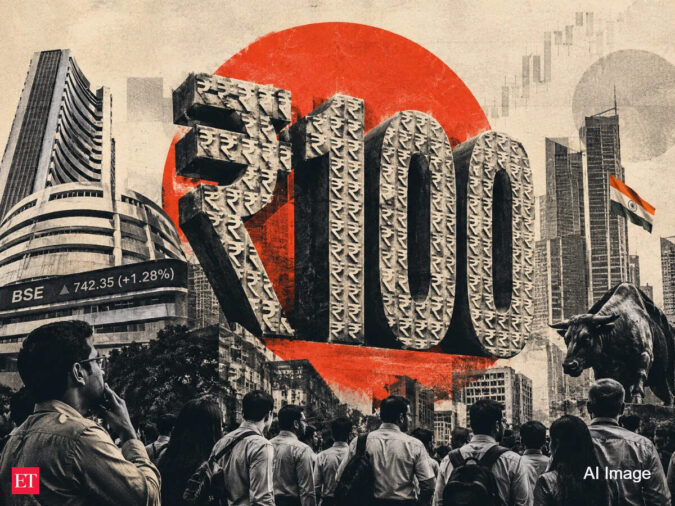
The rupee has slipped through ₹96 to the dollar as high US Treasury yields, oil prices and foreign portfolio outflows have combined to strengthen the dollar.
Also Read: Let exchange rate act as shock absorber: IMF on Fed hike impact on India
Yet the case for allowing some depreciation is not simply that a weaker currency helps exporters. It is also about avoiding the cost of using reserves and increasingly elaborate measures to defend a level that may no longer reflect India’s external conditions. The harder question is where to draw the line between useful adjustment and a disorderly fall.
The IMF is not asking India to abandon the rupee
The IMF’s argument does not mean the rupee should be left entirely to market forces. Its assessment is that India enters this period with strong growth, an inflation-targeting framework, healthy corporate and financial-sector balance sheets and substantial external buffers.
In fact, the IMF has been making essentially the same case for some time. Its 2025 India assessment said exchange-rate flexibility should be the main shock absorber, with intervention restricted to periods of destabilising risk premiums.
Allowing depreciation of the rupee is not the same as abandoning intervention. The RBI can still sell dollars when markets become disorderly, liquidity disappears or panic feeds on itself. What it need not do is spend large amounts of reserves trying to establish that Rs 96, Rs 97 or Rs 100 is an unacceptable number.Also Read: ‘US deal could spur further liberalisation’
The strongest argument for rupee depreciation
The current pressure is not primarily a story of India’s domestic economy suddenly going wrong. Oil is a particularly important part of it. India imports about 90% of its crude oil, so a sustained rise in oil prices worsens the trade balance and increases the demand for dollars. Oil prices, high US yields and foreign outflows are simultaneously weighing on the rupee.
Many argue that there is little economic logic in trying to make the rupee absorb none of this adjustment. If India’s oil import bill rises substantially, something in the external balance has to change. The choices are broadly higher capital inflows, lower imports, weaker domestic demand or a weaker exchange rate that makes exports more competitive and imports more expensive.
A flexible currency spreads that adjustment across the economy instead of forcing the RBI to carry all of it on its balance sheet.
That is the logic behind former RBI governor Duvvuri Subbarao’s argument made a few months ago that the rupee should be allowed to adjust because the current pressure reflects deterioration in India’s external balance. He called a weaker rupee a natural shock absorber.
A weaker rupee makes India more competitive
Columbia University professor and 16th Finance Commission chairman Arvind Panagariya, in a recent interview to TOI, argued that depreciation is not necessarily bad because Indian producers compete not only in foreign markets but also against imported products in India.
Consider an Indian manufacturer selling a product for Rs 1,000. If the rupee falls, imported machinery or components may become more expensive. But an imported finished product competing with that manufacturer also becomes more expensive in rupee terms.
The same applies to exports. A weaker rupee can allow an Indian exporter to offer a more competitive dollar price.
There is some evidence that this adjustment is already improving India’s price competitiveness. The Finance Ministry’s May economic review said India’s real effective exchange rate (REER) had fallen to 92.72 in April, its lowest level in more than a decade, after reaching 108.03 in November 2024. The ministry argued that the earlier appreciation had made Indian exports less competitive and that the subsequent correction had partly reversed this.
It cited the Economic Survey’s estimate that a 1% rupee depreciation improves the merchandise trade balance by about 1.45% over the medium term. But it also acknowledged the catch that import costs rise immediately while exports take time to respond.
A weaker rupee can hurt before it helps
India is not a classic export-led economy that simply becomes richer whenever its currency falls as it has happened historically in the case of Japan, South Korea and China.
A substantial part of Indian production itself depends on imported inputs. Oil is the obvious example. Fertilisers, edible oils, electronics components and capital goods also matter. This creates an awkward sequence. The rupee can fall today, making crude and imported components more expensive tomorrow, while the extra exports that are supposed to benefit from the weaker currency may take months or years to materialise. And this can end up feeding inflation.
Bank of Baroda chief economist Madan Sabnavis has told ET recently that the rupee might depreciate another 3-4% next year and warned that this would keep imported inflation ticking. This is probably the strongest argument against simply welcoming depreciation.
The comparison with 2013 is therefore relevant. Panagariya made it a few months ago, arguing that India is in a better position today because inflation is nowhere near the double-digit levels seen then. That gives the RBI more room to tolerate currency weakness without immediately triggering a broad inflation crisis. But “better than 2013” does not mean “immune to inflation”.
The RBI has another problem
The RBI has accumulated enormous reserves and has used them to slow the rupee’s decline. That is precisely what a central bank should do when markets become disorderly. But using reserves repeatedly to resist an underlying adjustment is a different issue.
The RBI has sold roughly $250 billion to support the rupee since mid-2023, according to an Axis Bank assessment. Axis argues that the external fundamentals may now require further adjustment and sees the rupee at Rs 97 by the end of this year and Rs 100 by June 2027.
Also Read: RBI MPC must raise rates as inflation and external risks rise
The more unusual part of the current episode is the size of the liabilities created while attracting dollars. Reuters reported last week that the RBI’s net forward dollar liabilities reached a record $200 billion in August, after policy measures attracted $143.5 billion of inflows, much of it through FCNR(B) deposits by NRIs. The reserves rose to a record $785.7 billion, but the RBI also acquired future obligations linked to those transactions.
In a recent column in ET, economist Rajeswari Sengupta has argued that the success of the FCNR(B) scheme should not be judged merely by the dollars attracted or the rupee stabilised. There is a cost to absorbing those dollars. Banks received rupees from the RBI in exchange for the dollars, creating surplus liquidity that has to be sterilised. There is also an exchange-rate risk when the deposits eventually have to be repaid. In other words, the RBI can buy time, but time is not free.
The case for defending the rupee remains
A rapidly falling currency can become self-reinforcing. Importers rush to buy dollars, exporters delay repatriating earnings and investors hedge more aggressively.
There is also a balance-sheet issue. Companies with unhedged dollar liabilities suffer when the rupee falls. Imported inflation hurts households. A sharp currency decline can also complicate monetary policy at exactly the time when the economy is dealing with higher oil prices. And a sudden fall would be different from gradual depreciation.
The IMF’s “shock absorber” formulation should not be interpreted as an invitation to stand aside during a panic. The RBI’s intervention can reasonably be aimed at the speed and disorderliness of the fall rather than its direction.
That also largely aligns with the RBI’s stated approach. India’s position, according to its statement to the IMF last year, is that intervention is intended to smooth excessive volatility rather than target a particular exchange-rate level.
What about the 100 mark?
The debate has become centered on the Rs 100 mark as it comes nearer. Panagariya has argued that the rupee at 100 is just a number and should not determine policy. If oil prices remain high for a prolonged period, he argued, defending the rupee would eventually exhaust reserves without eliminating the underlying problem.
That does not mean rupee at 100 is economically irrelevant. It would be a psychologically important threshold and could influence expectations. But it is not a magic line separating economic stability from crisis.
The more useful questions are whether inflation remains contained, whether capital inflows can finance the external deficit, whether reserves remain comfortable after accounting for forward obligations and whether the exchange rate is broadly consistent with India’s external fundamentals.
On all these measures, the picture is mixed. RBI deputy governor Poonam Gupta has taken a more optimistic view. She said recently that the rupee’s 13.1% depreciation between March 2025 and September 2026 could prove temporary and argued that the currency had not fully reflected India’s economic strength. She expects the balance of payments to improve as FDI rises and capital flows become more favourable.
But many economists think differently. Gaura Sengupta of IDFC First Bank has pointed out that much of the recent balance-of-payments support came from FCNR(B) inflows absorbed by the RBI. Excluding those flows, she said, the balance of payments was negative in the first half of FY27. That is an important warning against assuming that every dollar added to reserves represents a durable improvement in India’s external position.
So, should the rupee be allowed to fall?
If one considers views by various experts and analysts, it may appear that the rupee should be allowed to depreciate but the objective should be gradual adjustment, not depreciation for its own sake.
The current circumstances make a hard defence of the rupee increasingly difficult to justify. India is facing an oil shock, high US yields and weak portfolio flows. These are precisely the sort of external pressures for which a flexible exchange rate is useful.
The RBI should therefore be willing to let the rupee move below Rs 96 and, if fundamentals warrant it, materially beyond that level. It should use reserves to prevent disorderly conditions like sudden shocks rather than to defend a psychological threshold.
At the same time, depreciation cannot substitute for economic policy. If the rupee weakens but India’s export capacity does not expand, the benefit will be smaller. This is why Panagariya’s other recommendations on tariffs, quality-control orders and investment barriers are important. A cheaper currency can improve competitiveness, but it cannot fix expensive logistics, weak manufacturing depth or restricted access to imported inputs.
Nor should policymakers assume that today’s weaker rupee will automatically produce tomorrow’s export boom. The Finance Ministry itself has warned that global demand and the composition of India’s exports will determine how much of the competitiveness gain translates into actual export growth.
Based on views of experts and analysts, the sensible policy seems to be neither “defend rupee around 96 at all costs” nor “let the rupee collapse past 100 and call it competitiveness.” It is to allow the exchange rate to absorb a meaningful part of the external shock while keeping enough reserves and intervention capacity to stop a panic. If the rupee eventually settles at Rs 98 or Rs 100 because India’s terms of trade and capital flows warrant it, that would be an adjustment, not necessarily a crisis. The bigger danger may be spending scarce policy ammunition to prove that a particular number on the currency screen cannot be crossed.