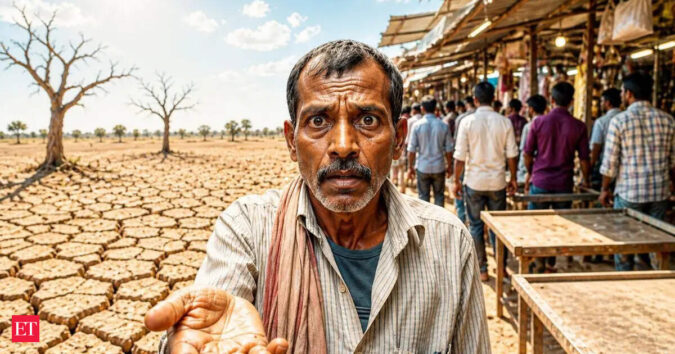
In India, rain isn’t just weather; it’s an economic switch. With a large part of the economy still tied to farming, a good monsoon boosts harvests, supports rural incomes, and keeps food prices stable. A weak one quickly shows up in costlier vegetables, pulses, and cooking oil.
Also Read: W.O.R.R is the worry. A four-way assault pummells Indian macro
Inflation isn’t spiking sharply right now, but it is beginning to creep up again — and weather is often where the pressure starts to build. Consumer Price Index (CPI)-based inflation has risen to 3.4% in March 2026, up from 3.21% in February, marking the third consecutive monthly increase under the revised 2024 base year series.
Economists, however, have struck a more cautious tone, suggesting a potential rise in overall inflation this year.
IMD flags below-normal monsoon
Against this backdrop, the India Meteorological Department (IMD) has projected Southwest Monsoon 2026 rainfall at 92% of the Long Period Average (LPA), placing it in the “below normal” category.
A key variable now entering the conversation is the evolving monsoon outlook, particularly in the context of a possible El Niño weather phenomenon in 2026. It typically brings hotter, drier conditions across large parts of Asia, while increasing rainfall in regions of North and South America.El Niño is driven by unusually warm ocean surface temperatures in the central and eastern equatorial Pacific. It forms when weakening trade winds allow warm water to shift eastward, redistributing heat and disrupting normal atmospheric circulation — which then alters weather patterns worldwide.
Why El Niño matters for India
The relationship between El Niño and India’s rainfall patterns remains one of the more consistent climate signals. As reported by The Times of India, nearly 70% of El Niño years since 1980 have coincided with below-normal rainfall during the June–September monsoon season.
Forecast models from global agencies such as the European Centre for Medium-Range Weather Forecasts (ECMWF) indicate a higher probability of El Niño conditions emerging by May–June, with the possibility of intensifying into a strong episode by the end of the year.
Also Read: West Asia war, rain deficit can hike inflation, drag India’s growth: Finmin
ICRA, in an assessment, noted that this is among the lowest early forecasts in at least 25 years and comes at a time when El Niño conditions may develop during the monsoon season. The agency projected that FY27 CPI inflation could exceed 4.5% under the below-normal monsoon scenario.
It also flagged potential downside risks to agricultural output and rural demand, estimating that FY27 agri-GVA growth could face pressure around its 3% baseline projection
Food inflation risks re-emerge
For India, this raises the risk of uneven or deficient rainfall, which can influence crop output and, in turn, food prices.
Rumki Majumdar, Economist, Deloitte India, said that inflation will be a concern to watch out for, as commodity prices may remain elevated even after the conflict subsides.
“Elevated energy prices, coupled with potential El Niño conditions and an unfavourable base, could also put renewed pressure on food prices, which had only recently begun to stabilise.”
Weaker rainfall can affect sowing and yields, tighten supply in key food categories, and eventually feed into retail inflation, particularly in the second half of the fiscal year.
RBI’s inflation map for FY27
This comes even as the Reserve Bank of India’s Monetary Policy Committee, in its bi-monthly April meeting, laid out its inflation projections for FY27 with unusual granularity.
Headline CPI inflation is expected at 4.6% for the year, with a quarterly path of 4.0% in Q1, 4.4% in Q2, rising to 5.2% in Q3, and easing to 4.7% in Q4.
Now, the projected rise in the third quarter — October to December — is particularly notable. This period typically captures the lagged impact of monsoon outcomes on food prices, along with seasonal demand during the festive cycle.
No straight line
According to SBI Research, the recent uptick in CPI-based inflation was largely driven by housing, fuel, and certain consumption categories, including paan, tobacco, and intoxicants.
On the other hand, the report cautioned against drawing a linear link between rainfall and food inflation outcomes.
“Years with relatively comfortable rainfall have still witnessed elevated food inflation, such as 98% rainfall with 8.43% food inflation in FY09, 102% with 15.2% in FY11, while weaker rainfall years such as 93% (FY13) and 91% (FY19) were associated with much lower food inflation of 6.33% and 0.09%, respectively.”
The report also pointed to relatively comfortable buffer stocks.
“The buffer situation of foodgrains (more so on the rice front at 380 LMT [lakh metric tonnes]) looks sufficient to thwart any untoward disruption on the kharif production front, if it be so.”
It further notes that food production has shown little consistent correlation with rainfall patterns, with even sub-par monsoon years at times delivering strong output. The key variable, it suggests, is spatial distribution rather than headline rainfall.
Parts of the Northeast, Northwest, and South Peninsula may still receive normal to above-normal rainfall.
“Hence, even if the monsoon settles near 92% of LPA, the food inflation implications are likely to remain limited unless rainfall deficiency becomes concentrated in key kharif-producing belts,” the report said.
Overall, the report underlines that the spatial distribution of rainfall, rather than aggregate monsoon performance, is the more critical determinant of crop outcomes.
Growth holds, but risks tilt upward
Despite these overlapping risks, SBI Research maintains that India’s growth momentum remains broadly intact, supported by domestic consumption and investment activity. It expects GDP growth in the range of 6.8%–7.1%, even as inflation risks tilt upwards.
In essence, the macro narrative is shifting into a more nuanced phase: inflation is no longer being driven by a single factor, but by a convergence of weather cycles, global energy shocks, and supply chain fragilities.