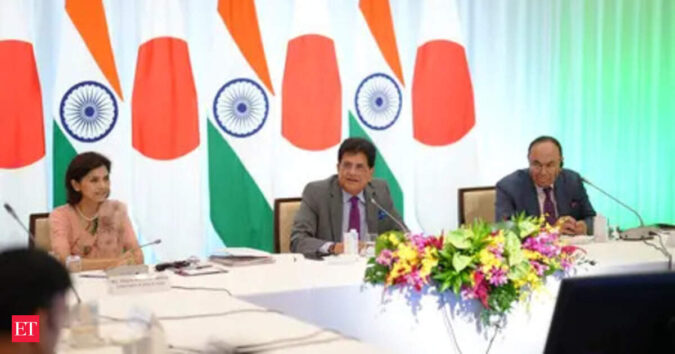
Goyal said there are “big plans” to expand the partnership between India and Japan, noting that 15% of Japan’s ¥10 trillion investment target for India has already come in the last 10 months.
He said that with this pace, the ¥10 trillion yen may be invested in India in the next 3-4 years instead of 10 years.
Japanese textile companies, including Uniqlo, would increase sourcing from and investment in India to export textile goods across the globe from the country, he said. “My meetings with some of the largest importers and marketing companies of textiles give me the confidence that we will see a larger presence in India, both as investment to expand their business in India and to source from India for Japan and for the roughly 4,000 stores (worldwide) which one company has with 4 trillion yen turnover, Uniqlo,” he said.
Goyal met Tadashi Yanai, chairman, president & CEO of Fast Retailing Co., the parent company of Uniqlo, adding that the chairman appeared almost ready to begin sourcing from India immediately.
Trade pact, investment
“The CEPA has to be made more contemporary, and we will work to expand this,” he said, adding that he discussed reviewing the current trade pact with his Japanese counterpart, and both hoped to work towards further expanding its scope. “We haven’t got down to work on terms of reference, but I think once the teams have discussed, we will be open to expanding the scope, scale and the extent of the engagement because Japan today is one of our most strategic partners,” he said.Goyal pointed out on many occasions, these challenges are more about process and language and time, emphasising that the government stands ready to provide support across sectors.
The minister also asked business councils to ensure that exporters are registered so that their concerns can be addressed more systematically.
Noting that previously Japanese companies faced restrictions on foreign direct investments, complicated systems and processes as well as legal barriers while entering India, he said, “In the last decade, we are focused strongly on reforms,” and that bottlenecks related to doing business have been removed to a large extent.
Goyal said India would support Japan in its ambition to double the number of Japanese companies operating in the country to 3,000 from the current 1,580. The minister said the bilateral trade deficit was discussed during his engagements in Japan, and the nature of goods being traded needs to be examined while assessing the trade imbalance. “For the pharma industry, I have also requested to start registrations all across the world… they should all look at registering all across the world, including Japan,” he said.
At a roadshow in Nagoya, the minister said the planned investment has “kickstarted extremely well”, with several large investments already fructifying.
Goyal cited Toyota’s experience in India to illustrate the potential for Japanese companies in building large industrial ecosystems. “Three decades ago, Toyota entered India with quiet caution,” he said.
“Today this region’s engineering runs through nearly every Indian highway,” he said, adding that the next generation of Japanese investment could create similar ecosystems in semiconductors, precision engineering, machinery, chemicals, clean energy and medical technology.
Nagoya: India is open to expanding the scope, scale and extent of its Comprehensive Economic Partnership Agreement (CEPA) with Japan, commerce and industry minister Piyush Goyal said Wednesday, stressing that the pact needs to be made more contemporary. He said the government has asked industry about the challenges faced in exporting to Tokyo.
Goyal said there are “big plans” to expand the partnership between India and Japan, noting that 15% of Japan’s ¥10 trillion investment target for India has already come in the last 10 months.
He said that with this pace, the ¥10 trillion yen may be invested in India in the next 3-4 years instead of 10 years.
Japanese textile companies, including Uniqlo, would increase sourcing from and investment in India to export textile goods across the globe from the country, he said. “My meetings with some of the largest importers and marketing companies of textiles give me the confidence that we will see a larger presence in India, both as investment to expand their business in India and to source from India for Japan and for the roughly 4,000 stores (worldwide) which one company has with 4 trillion yen turnover, Uniqlo,” he said.
Goyal met Tadashi Yanai, chairman, president & CEO of Fast Retailing Co., the parent company of Uniqlo, adding that the chairman appeared almost ready to begin sourcing from India immediately.
Trade pact, investment
“The CEPA has to be made more contemporary, and we will work to expand this,” he said, adding that he discussed reviewing the current trade pact with his Japanese counterpart, and both hoped to work towards further expanding its scope. “We haven’t got down to work on terms of reference, but I think once the teams have discussed, we will be open to expanding the scope, scale and the extent of the engagement because Japan today is one of our most strategic partners,” he said.
Goyal pointed out on many occasions, these challenges are more about process and language and time, emphasising that the government stands ready to provide support across sectors.
The minister also asked business councils to ensure that exporters are registered so that their concerns can be addressed more systematically.
Noting that previously Japanese companies faced restrictions on foreign direct investments, complicated systems and processes as well as legal barriers while entering India, he said, “In the last decade, we are focused strongly on reforms,” and that bottlenecks related to doing business have been removed to a large extent.
Goyal said India would support Japan in its ambition to double the number of Japanese companies operating in the country to 3,000 from the current 1,580. The minister said the bilateral trade deficit was discussed during his engagements in Japan, and the nature of goods being traded needs to be examined while assessing the trade imbalance. “For the pharma industry, I have also requested to start registrations all across the world… they should all look at registering all across the world, including Japan,” he said.
At a roadshow in Nagoya, the minister said the planned investment has “kickstarted extremely well”, with several large investments already fructifying.
Goyal cited Toyota’s experience in India to illustrate the potential for Japanese companies in building large industrial ecosystems. “Three decades ago, Toyota entered India with quiet caution,” he said.
“Today this region’s engineering runs through nearly every Indian highway,” he said, adding that the next generation of Japanese investment could create similar ecosystems in semiconductors, precision engineering, machinery, chemicals, clean energy and medical technology.
Source link
https://www.infinitycompliance.in/product/online-company-registration-in-india/