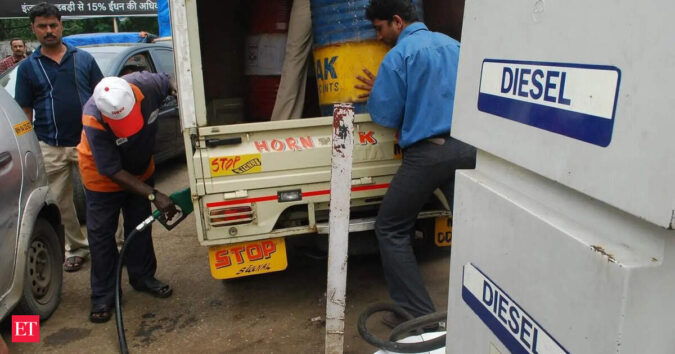
“Blending of diesel has been looked into with great seriousness. Research is underway and the results are very encouraging,” he said at the CII Multimodal Transportation and Logistics Summit on Friday.
“It is quite likely that the blending mandate will start coming in somewhere later this year,” he said, adding that since diesel consumption is almost two times that of petrol consumption, the impact on blending in terms of diesel is concerned will have a far greater impact on our energy security than even petrol blending.
Secretary Umashankar said the ministry is also looking at bringing a draft notification on truck-trailer interchangeability soon to address the issue of battery-swapping, and battery charging for electric heavy duty commercial vehicles.
“What we are looking at is a tractor-trailer interchangeability under which you swap the entire front part of the truck instead of battery swapping,” he said.
CII Knight Frank Report
Cumulative investments of nearly $360 billion in infrastructure development in the country over the last decade has slashed India’s logistics cost to 10-10.7% of GDP in FY 2026, from 13–14% of GDP a decade ago, translating into estimated annual savings of $123–133 billion for the economy, a CII Knight Frank Report said.
The report titled “Fast-Tracking MMLPs to Enable Modal Shift: India’s Multimodal Logistics Transformation: A Strategic Outlook”, released at the event said India will need many more multi-modal logistics parks (MMLPs) to unlock next level logistical efficiency. As a result of these sustained efforts, the country’s logistics ecosystem has improved considerably, contributing to enhanced connectivity, trade facilitation, and supply chain performance, it said, adding India’s position in the global Logistics Performance Index (LPI) improved from 54th in 2014 to 38th in 2023.
“Despite these improvements, India’s logistics supply chain is yet to achieve optimal efficiency,” the report pointed out.
According to the report, India will require 216 MMLPs, each with an average capacity of 16–17 MMT per annum, to achieve its 2047 freight modal shift targets.
“Continued overdependence on road transport for freight movement, delays in the development of integrated Multimodal Logistics Parks (MMLPs), and inadequate first- and last-mile connectivity continue to limit the shift of cargo movement towards rail and other efficient modes of transport,” it said.
“The core challenge is no longer an infrastructure deficit, but a lack of connective nodes,” it added.
The report suggested fast-tracking project implementation, creating anchor demand through industrial clustering and freight aggregation, and addressing critical first- and last-mile connectivity gaps to accelerate private sector participation in MMLPs.