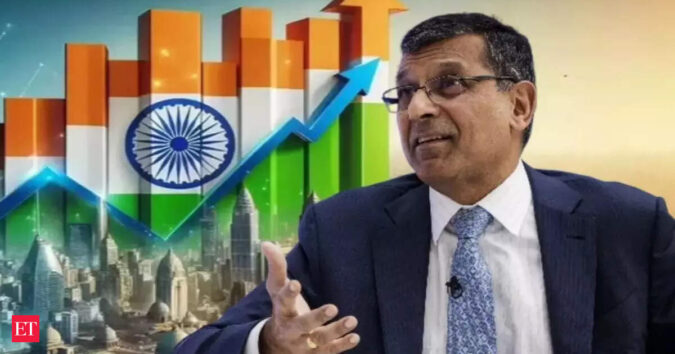
In an interview with India Today TV, Rajan said there remains a persistent disconnect between headline growth numbers and business behaviour.
“I don’t understand it. If the economy was growing at this rate, you would definitely expect investment to be higher. Something is off,” he said.
His remarks come at a time when India is reporting stronger economic growth under a revised gross domestic product series that adopts 2022-23 as the new base year. The changes follow a revision of the inflation basket and include updated back-series data aimed at better capturing shifts in consumption patterns after the pandemic and the rapid growth of the digital economy.
India’s economy expanded 7.7% in fiscal year 2025-26, up from 7.1% a year earlier. Growth in the January-March quarter stood at 7.8%, compared with 8% in the preceding quarter. The fourth-quarter figure exceeded the median estimate of 7.3% in a Bloomberg survey of economists and matched the pace recorded in the previous quarter.
Corporate investment remains the missing piece
Despite those numbers, Rajan said one of the biggest unanswered questions in the Indian economy remains the lack of corporate investment.
“Why corporate investment hasn’t taken off was a puzzle 10 years ago. It is still a puzzle today,” he said. “The only answer to the kind of growth we’ve seen over the last 10 years in the official numbers is that perhaps we are growing less strongly than those numbers suggest.”
Also Read: Why Indian companies don’t want to invest in India
When asked whether he trusted the official GDP data, Rajan said investment decisions made by businesses raise doubts about whether the figures fully capture economic realities.
“The fact that they’re not investing suggests that they’re not seeing the kind of demand that would be consistent with these growth numbers. That suggests the growth numbers aren’t fully reflective of what the economy is doing,” he said.
Addressing the Economic Times Awards for Corporate Excellence in Mumbai in late April, Finance Minister Nirmala Sitharaman said New Delhi remained committed to shielding vulnerable groups such as farmers from higher input costs stemming from the West Asia conflict, while staying on course with its fiscal consolidation plans.
The minister also called on industry leaders to identify obstacles preventing expansion and capacity creation, promising that the government would examine any concerns. “We are certainly willing to hear any difficulty that stops Indian industry from expansion or capacity building or investing in newer technologies, artificial intelligence,” she said.
“Tell us what you (industry) need. Tell us what you want us to do, so that you feel incentivized to further invest and grow equally,” Sitharaman added.
Also Read: Tell us what you need to invest more: FM Sitharaman to India Inc
Rajan on foreign direct investments in India
Rajan also pointed to weakening foreign direct investment and softer capital inflows as signs that both domestic and overseas investors remain cautious.
“FDI is down significantly. They’re not bringing in money to build factories in India. Portfolio investors have been selling and getting out. That’s consistent with a lack of confidence in the Indian economy,” he said.
Rajan also argued that India lacks a clearly defined economic roadmap beyond the aspiration of becoming a developed country by 2047.
Also Read: Indian economy, government finances, see mounting costs from Iran war
“Nobody knows what India’s vision is, other than it wants to be a developed country by 2047. What are you going to emphasise? What is the growth strategy? How much are you going to invest in your people? None of this is particularly clear,” he said.
He also questioned the effectiveness of efforts to boost manufacturing and employment, saying India has yet to establish itself as a major manufacturing powerhouse despite years of policy focus.
Warning that the ongoing Middle East war and rising oil prices could expose deeper vulnerabilities, Rajan said weak investment should not be ignored.
“The lack of investment is a canary in the coal mine. It’s telling us something is not quite right,” he said.
Calling for broader policy changes, he said, “We need the willingness to acknowledge that something is going wrong. A rethink, forced by tighter circumstances, would be very welcome.”
Middle East conflict casts shadow over outlook
The concerns raised by Rajan come as economists and policymakers are increasingly reassessing India’s growth outlook amid rising geopolitical risks and mounting pressure from higher energy prices.
Higher US tariffs, geopolitical tensions linked to the Iran conflict and rising energy prices have emerged as major risks to growth. India remains particularly exposed because of its reliance on imported crude oil and trade flows passing through the Strait of Hormuz.
Concerns over inflation, tighter financial conditions and possible weather-related disruptions are also weighing on the outlook for both urban and rural demand.
Before tensions in the Middle East intensified, Chief Economic Adviser V Anantha Nageswaran had projected growth of between 7% and 7.4% in the current financial year. That outlook has become less certain as the Iran conflict enters its fourth month without any clear diplomatic breakthrough between Washington and Tehran.
After the GDP data was released, Nageswaran said India could return to growth above 7% by FY28 if macroeconomic stability is maintained and supply-side measures continue, even as global uncertainties weigh on the near-term outlook.
His comments came hours after the Reserve Bank of India lowered its FY27 growth forecast to 6.6% from 6.9% projected in April, citing higher energy and commodity prices as well as continuing supply disruptions linked to the conflict in West Asia.
Oil prices pose inflation and fiscal risks
Rajan warned that prolonged disruptions in energy markets could create fresh challenges for policymakers.
“There is a limit to how much hit you can take on the fiscal,” he said, referring to government efforts to absorb part of the impact of rising fuel costs.
According to Rajan, maintaining such support indefinitely could increase debt levels, put pressure on public finances and divert resources away from sectors such as healthcare and education.
“In the short run, almost surely, we have to pass it on. Maybe not in one jhatka, but in steady increases in the prices of all manner of energy,” he said.
He said allowing prices to rise would help consumers and businesses adjust demand while ensuring subsidies remain focused on the poorest households.
Rajan also warned that higher oil prices could fuel inflation across the economy because energy costs feed into a broad range of goods and services.
The RBI’s key challenge, he said, would be preventing inflation expectations from becoming entrenched.
“If oil prices move much higher, then you’re seeing both prices go up, and also expectations of prices going up. That is the killer as far as inflation goes,” he said.
He also warned of the risks posed by disruptions to shipping routes in the Gulf region.
“If the Strait stays closed for much longer, towards the end of summer, I think we will have to absorb significant pain because we import so much oil from that direction,” he said.
Foreign inflow push offers support amid rising uncertainty
India’s government and central bank took coordinated steps recently to spur foreign inflows, providing an immediate boost to the beleaguered rupee. The challenge for policymakers now is sustaining those flows in the face of economic risks beyond their control.
The measures were hailed by investors as significant enough to spur as much as $50 billion into Indian bonds and stocks this year and reverse an outflow that has dragged the rupee to a record low, Bloomberg reported. The currency and bond markets both gained following the announcement.
However, Bloomberg reported that India’s broader economic backdrop remains challenging. The Iran war is continuing to strain energy supplies, fuel and fertiliser costs have climbed sharply, food prices face upside risks and a trade agreement with the United States, India’s biggest trading partner, remains elusive.
Those factors are prompting economists to cut growth forecasts despite India’s stronger-than-expected performance in the previous quarter.
Fitch Ratings this week lowered its FY27 growth forecast to 6.4% from 6.7%, saying the US-Iran war would weigh on economic activity during the September and December quarters.
The ratings agency said higher prices would erode household purchasing power and damp consumer spending, even as capital expenditure remains resilient.
Fitch said the slowdown would be most visible during the second and third quarters of FY27 as rising prices linked to the conflict reduce real incomes. Fuel prices have risen by around 4% to 5% in recent weeks.
The World Bank has also projected moderation in growth, forecasting India’s economy will expand 6.6% in FY27, down from 7.7% in the previous year. Even so, it expects India to remain the world’s fastest-growing major economy.
The institution said reductions in Goods and Services Tax rates should provide some support to consumer demand and projected growth to recover to 7.2% in FY28.