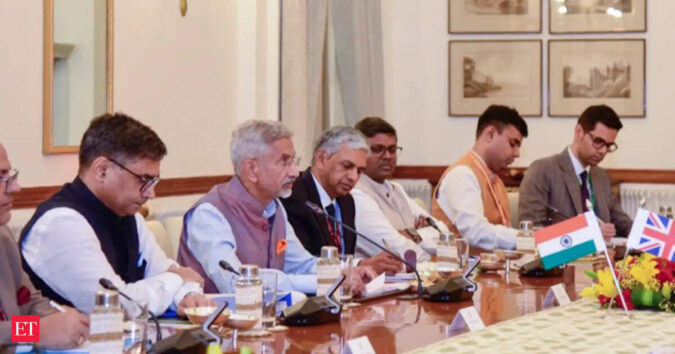
He made the remarks during a meeting with visiting British Foreign Secretary Yvette Cooper.A
Also Read: India-UK trade deal moving forward, though steel issue may delay launch
In new initiatives, the two sides concluded a memorandum of understanding (MoU) on setting up the Regional Maritime Security Centre of Excellence, which will help Indian Ocean states to build capacity to address non-traditional maritime security threats. The centre will be set up by King’s College London and the National Maritime Foundation.
India and the UK also announced the launch of Critical Minerals Global Supply Chain Observatory (GSCO) to boost cooperation in critical minerals and support the creation of resilient and secure global supply chains.
Cooper also met Prime Minister Narendra Modi.
“Appreciated the deepening of the India-UK partnership in recent times that has unlocked unprecedented growth opportunities for both our countries. India-UK Vision 2035 will continue to guide our partnership and strengthen our joint efforts for global good,” Modi said on social media.After the meeting, Jaishankar said both sides “reviewed ongoing progress in our cooperation focusing on trade, technology, supply chains, defence, climate, education and people to people ties. Also spoke about new opportunities in clean energy, AI and critical minerals”.
Also Read: India, US reaffirm commitment to conclude mutually beneficial trade pact
The two sides also exchanged views on global developments including in Ukraine, West Asia and the Indo-Pacific.
In his remarks, Jaishankar highlighted the “remarkable developments” in the bilateral ties in recent months while pointing to Modi’s visit to the UK last July, followed by UK Prime Minister Keir Starmer’s trip to India in October.
Jaishankar highlighted the finalisation of the India-UK Comprehensive Economic and Trade Agreement (CETA), the adoption of comprehensive strategic partnership and the defence industrial roadmap as major achievements.
“We are today well positioned to build a new future-oriented and mutually beneficial partnership,” he said.
Jaishankar said CETA addresses many concerns about creating resilient supply chains and addressing concerns in areas of trade, energy, food and economic security.
“Our relationship has moved from being a historical and perhaps cultural connection to being a forward-looking highway of shared economic ambitions and high technology,” he said.
The external affairs minister also made a mention of India-UK Vision 2035 and its five pillars such as growth, technology and innovation, defence and security, climate and clean energy, and education.
He also referred to University of Liverpool‘s decision to open a campus in India.
In his remarks, Cooper, said the India-UK partnership has gone from “strength to strength” in recent years and cited CETA as one of the key pillars of economic growth.
Crucially our commitment to economic security reflected in work on critical minerals, she said.
The India- UK Critical Minerals Global Supply Chain Observatory (GSCO) was formally launched by Minister of Coal and Mines by G Kishan Reddy and Cooper.
The launch marks a “significant milestone” in the growing India’ UK partnership on critical minerals and supply chain resilience, reinforcing cooperation in securing the resources essential for clean energy transitions, advanced manufacturing, electric mobility and emerging technologies, according to a statement issued by India.
The initiative is expected to serve as a valuable platform for strengthening India’ UK cooperation in critical minerals and supporting informed decision-making for resilient, secure and sustainable global supply chains, it said.
Speaking on the occasion, Cooper underscored the importance of India-UK collaboration in developing resilient, diversified and sustainable critical mineral supply chains.
She stated that greater access to critical minerals and improved information-sharing are in the mutual interest of both nations and can contribute significantly to economic growth and supply chain security.