Officials said India remains committed to the agreement but given the changed circumstances around the tariffs, it has to be seen how the deal is structured and what issues are to be addressed.
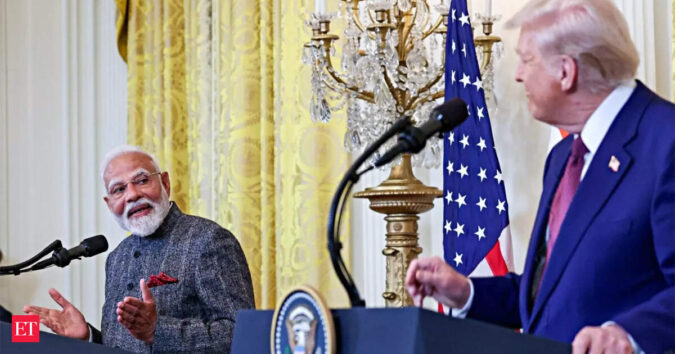
“So the agreement will have to be recalibrated, redrafted…that amount of change will take place from their side,” said an official. “We are engaging with them on the contours, limits and commitments which the US will give us and the comparative advantage and commitment we get. The trade-off from the other side is something that we like to hear from them,” the official added. The visit to Washington follows a 40-minute phone call between Prime Minister Narendra Modi and US President Donald Trump on Tuesday.
Also Read: India, US review next steps in trade pact talks
Another official said the team is going with an “open mind”. “Every other country is now recalibrating its earlier agreement, so India is also looking at what will be a legal agreement and the trade-offs,” said the official, adding that “In our case, since the agreement has not been signed and announced, we have got the option where we can right now change whatever needs to be changed…and if we sign it, it will not be proper”.
On February 7, the US removed a 25% penal tariff on India for buying Russian oil and announced to cut the reciprocal tariff to 18% from 25%. The US Supreme Court on February 20 struck down tariffs imposed under the International Emergency Economic Powers Act. However, on February 24, Washington imposed a 10% blanket tariff on all countries for 150 days after the court invalidated the earlier levies.
“We are looking at finalising the legal pact, which is a logical follow-up of the joint statement released on February 7. There is a need for further discussions and follow-up engagement to take this forward,” commerce secretary Rajesh Agrawal said.

India-US to have larger BTA discussion
Section 301 Issues
India on Wednesday rejected allegations by the US Trade Representative in its Section 301 probe into excess structural capacity in sectors such as petrochemicals and textiles. On its $42 billion bilateral trade surplus with the US in 2025, New Delhi said such imbalances are a “macroeconomic phenomenon” arising from a “concatenation of circumstances”, including the role of certain non-market economies.
Also Read: India-US BTA: Zero-duty access to $46 billion US market to boost farmer incomes
It added that, given its “significantly smaller trade share with the US compared with other partners”, it cannot be held responsible for widening the US trade deficit. The notice, it said, provides no cogent rationale or prima facie evidence to support the allegation that India has structural excess capacity in its major industries, leading to a trade surplus with the US.