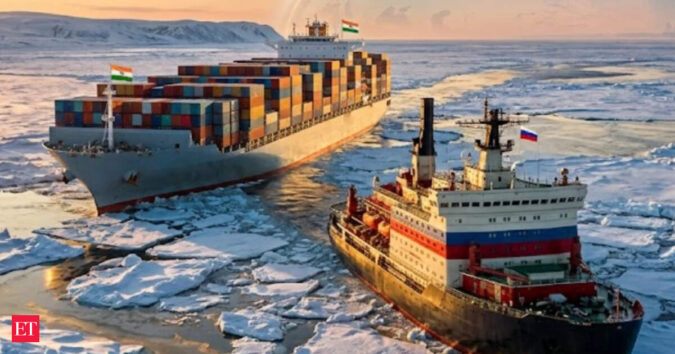
A few days ago, Russian Prime Minister Mikhail Mishustin approved Rosatom’s proposal to sign a memorandum with India on maritime cargo transportation on the Northern Sea Route, bringing the two countries a step closer to operationalising an Arctic trade corridor that could significantly alter the movement of goods between Asia and Europe. The Arctic could also see the unfolding of a Great Game in the future, where global powers vie for influence and control.
Also Read: Less Gulf, more Russia: RIL diversifies crude sourcing amid market turmoil due to Iran war
The route offers India a potential alternative to the Suez Canal, with estimates suggesting savings of up to 40% in distance and nearly two weeks in travel time for some shipments to northern European markets. Concerns over disruptions in key maritime chokepoints, including the Strait of Hormuz, and the risk of the Houthis closing the Bab el-Mandeb Strait, thereby disrupting Asian traffic to Europe through the Suez Canal, have reinforced the search for alternative corridors. This will also align with the goal of expanding India-Russia bilateral trade to $100 billion by 2030.
Small agreement, big ambition
The memorandum will be signed through Russia’s state-owned nuclear energy corporation Rosatom, which functions as the infrastructure operator of the route and oversees navigation services, nuclear icebreaker support and port-related infrastructure.
The NSR runs along Russia’s Arctic coastline from the Barents Sea to the Bering Strait. For decades, it remained a niche route used largely for domestic Russian shipping and Arctic resource projects. As Arctic ice cover has declined and Russia has invested heavily in infrastructure, Moscow has increasingly promoted the route as an alternative Eurasian trade corridor linking Europe and Asia.
Also Read: 100% tariff threat over Russian oil could roil India-US tiesThis latest memorandum does not create a shipping corridor overnight. What it does is formalise India’s entry into a project that Russia considers one of its most important long-term economic and geopolitical bets.
The backstory
The announcement of the Northern Sea Route MoU may be recent, but India and Russia have been discussing the NSR for several years. The subject gained prominence during Prime Minister Narendra Modi’s visit to Russia in 2024. Rosatom publicly stated that it was discussing the Northern Sea Route with Indian partners, particularly in connection with shipments of Russian oil, coal and liquefied natural gas. At the same time, Russian and Indian entities explored cooperation in shipbuilding and maritime infrastructure.
The relationship deepened further in 2024 when the first meeting of the Russia-India working group on Northern Sea Route cooperation was held in New Delhi. Discussions covered training Indian sailors in polar navigation and the possibility of joint projects in Arctic shipbuilding. That development was significant because it suggested that the conversation had moved beyond cargo transportation. Russia was beginning to see India as a potential long-term stakeholder in the Arctic logistics ecosystem itself.
The latest memorandum, therefore, looks less like a sudden initiative and more like the next step in a process that has been unfolding quietly in the background.
Why Russia is pushing NSR so hard
Russia’s motivations are rooted in both economics and geopolitics. Since the Ukraine war and the subsequent sanctions regime, Russia has accelerated its economic pivot towards Asia. The Kremlin needs new markets, new logistics chains and new partners capable of supporting trade flows that once moved primarily towards Europe.
Also Read: India and Russia set $50 billion investment target by 2030
The Northern Sea Route occupies a central place in this strategy. Moscow wants the Arctic corridor to evolve into a major commercial route carrying energy, minerals, containers and industrial cargo. To make that happen, Russia needs customers, investors and shipping partners. China has already become deeply involved. Chinese logistics companies have operated Arctic voyages, China and Russia have established a dedicated NSR cooperation mechanism, and Rosatom has partnered with Chinese firms to develop container shipping services along the route.
Yet this is precisely where India becomes important.
Russia benefits enormously from Chinese participation, but it also has an incentive to avoid excessive dependence on a single partner. A route financed, utilised and shaped primarily by China would leave Moscow with fewer strategic options. By bringing India into the picture, Russia broadens the commercial base of the NSR and gains another major Asian stakeholder.
This does not mean Russia is trying to balance China against India in a traditional geopolitical sense. But Moscow wants the Northern Sea Route to become a genuinely multinational Eurasian corridor rather than a project whose success depends overwhelmingly on Chinese participation.
India’s Arctic calculation
For India, the NSR is not primarily about Europe-Asia container shipping. India’s geography does not give it the same direct advantages from Arctic transit that China enjoys. Instead, India’s interest lies in energy security, strategic access and future positioning.
Russia has emerged as one of India’s most important energy suppliers. Large volumes of Russian crude already flow to Indian refineries. As Arctic resource projects expand, the Northern Sea Route could become increasingly important for transporting oil, LNG and other commodities, including critical minerals.
There is also the question of Arctic access. India has maintained scientific and diplomatic engagement with the Arctic for years, but its economic role has remained limited. Participation in NSR development gives India a practical stake in the region’s emerging commercial architecture. Another attraction is industrial. Reports and discussions over the past two years have touched on the possibility of Indian participation in Arctic shipbuilding and specialised maritime services. For a country seeking to expand its shipbuilding sector and maritime capabilities, Arctic cooperation offers exposure to a niche but strategically valuable domain.
In that sense, India is not simply seeking a transport route. It is seeking a place in a future economic geography that may become far more important by the 2030s.
The shadow of Suez and the Red Sea
The agreement also reflects changing realities in global shipping. The disruptions witnessed in the Red Sea previously, and now the latest possibility of the closure of Bab el-Mandeb by the Houthis, have reminded governments and businesses that global trade remains dependent on just a few narrow corridors. Alternative routes that once seemed commercially marginal now receive far greater attention.
The Northern Sea Route is often promoted as a shorter connection between parts of Europe and Asia than the traditional Suez route. While the economic advantages vary depending on destination, vessel type and seasonal conditions, the appeal of route diversification has become increasingly evident.
Neither India nor Russia expects the NSR to replace established routes anytime soon. What they do recognise is that countries which help shape the corridor today may enjoy advantages if Arctic shipping becomes more commercially viable in the future, especially when global warming is leading to the gradual melting of ice in the Arctic.
It’s a long shot
Despite the enthusiasm surrounding the agreement, significant obstacles remain. The Arctic remains a difficult operating environment. Large parts of the route still require icebreaker assistance. Seasonal constraints continue to shape navigation patterns. Infrastructure gaps remain substantial. Insurance, financing and sanctions-related complications add further uncertainty. There is also a simple commercial question: for the NSR to become a major global trade corridor, cargo volumes must rise dramatically. That requires shipping companies to change long-established patterns, a process that rarely happens quickly.
As a result, the India-Russia agreement should not be viewed as a transformational economic breakthrough. It is better understood as a strategic investment in a possible future.
More than a shipping deal
The most interesting aspect of the Northern Sea Route agreement is that it reveals how both countries are thinking about the next decade rather than the next year. Russia wants to anchor its economic future more firmly in Asia while ensuring that the Arctic corridor does not become dependent on any single partner. India wants deeper access to Arctic opportunities, stronger maritime capabilities and a larger role in shaping emerging trade networks.
The memorandum itself may be modest, but the strategic logic behind it is not. As Arctic shipping slowly moves from the margins of global commerce towards the mainstream, both Moscow and New Delhi appear determined to secure their place early.