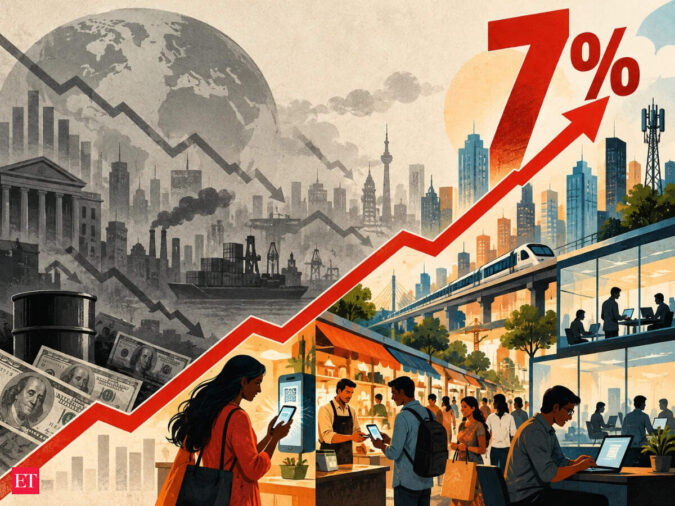
The IMF’s latest assessment also sets India apart from several energy-importing emerging economies facing a weaker medium-term outlook.
Also Read: World Bank raises India FY27 growth forecast to 7.1%, flags oil, El Niño risks
It adds to a growing consensus among global forecasters that India’s growth is proving more resilient than expected, following stronger-than-anticipated Q1 performance. The World Bank and OECD have raised their outlooks, while other major agencies also project growth around 7%, signalling confidence in India’s economic momentum.
The Fund said India’s longer-term prospects had improved on the back of sustained momentum, favourable demographics, a large and expanding domestic market, and continued structural reforms.
“India stands out with upward revisions,” the IMF said in its October 2026 World Economic Outlook, pointing to growing evidence of stronger growth potential.
Domestic demand drives latest upgrade
The IMF raised its 2026 growth forecast by 0.6 percentage points from its July outlook and by 0.5 percentage points from April. Its projection for 2027 also rose to 7%, up 0.3 percentage points from July and 0.5 percentage points from April.The Fund attributed the stronger outlook to resilient domestic demand and robust services activity, which helped sustain growth despite higher global oil prices.
The World Bank, in its latest revision, similarly cited resilient domestic consumption as a buffer against the energy-price shock, while flagging elevated oil prices and El Niño risks.
The upgrades come against a more subdued global backdrop.
The IMF projected world growth at 3.1% in 2026 and 3.4% in 2027, while growth in emerging and developing Asia was expected to ease from 5.6% in 2025 to 5.1% in 2026 and 4.9% in 2027.
China’s growth was projected to slow to 4.5% in 2026 and 4% in 2027, as higher oil prices, prolonged uncertainty and structural headwinds weighed on activity.
“The region (Asia) has been incredibly resilient, even though its economies are net importers of energy and other commodities. The AI boom has more than offset the headwinds from commodity markets, with China and India emerging as the big engines of growth,” said Silvana Tenreyro, IMF economic counsellor and director of the Research Department.
Tenreyro said growth forecasts for China and India had been revised upwards, with India seeing a sizeable upgrade.
India bucks weaker medium-term trend
The IMF projected global output to expand at an average annual pace of 3.2% in 2028–31, below the pre-pandemic average of 3.7% recorded during 2000–19. It said medium-term downgrades were concentrated among economies directly affected by the Middle East conflict and energy-importing emerging and developing economies, with India an exception.
Also Read: After S&P & Fitch, ADB raises India’s growth aim to 7% but El Nino clouds food story
The Fund linked India’s improved outlook to sustained economic momentum and stronger growth potential, supported by favourable demographic dynamics, a growing domestic market and structural reforms.
However, the brighter projections do not remove the risks facing the economy. Higher oil prices remain a vulnerability for India, while persistent global uncertainty could weigh on demand and growth.