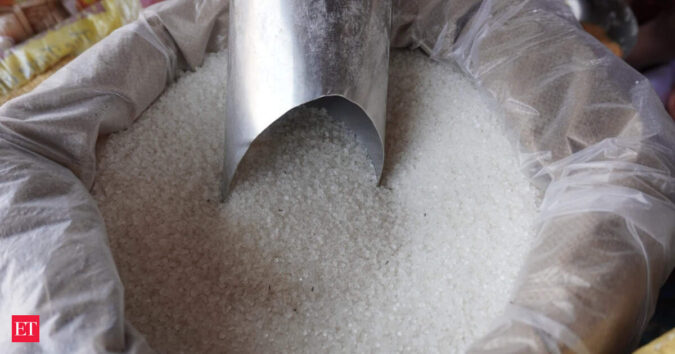
This marks a sharp U-turn in the government’s sugar policy. Just nine months ago, in November 2025, the government approved 1.5 million tonnes of sugar for export, later increasing it to 2 million tonnes, amid the expectation of a bumper crop. However, even before the trade barely moved, with only 800,000 tonnes shipped, the government curbed exports as domestic stocks tightened. The policy reversal has now raised questions over the estimate for sugar production and stock in 2025-26.
According to a senior industry executive, warning signs had emerged by early 2026. “Yet, in February, when the crushing season was already several months old, the government permitted an additional 500,000 tonnes of exports over and above the earlier 1.5 million tonnes,” he said.
He said the episode suggests the system was “misled” into believing fundamentals were strong, even as production lagged consumption.
“We have information that the crisis in supplies started in March itself, when mills were struggling to meet their monthly domestic sale quota. The alarm bells should have started ringing then when prices were inching upwards,” the executive said.
In two months, sugar prices in the domestic market have jumped by nearly 40%. Ex-mill prices across the country, led by Maharashtra, are currently at Rs 5,400-5,560 per quintal, with S-grade at Rs 5,750 and M-grade at Rs 5,850-5,900, excluding GST, by market estimates.
Following the government’s recent action, which signifies a major shift in its sugar policy, the debate now centres on the wide gap between the initial production forecasts and subsequent estimates.The Indian Sugar & Bio-energy Manufacturers Association (ISMA), in its initial forecast issued on July 31, 2025, projected India’s production at 34.90 million tonnes for the sugar season 2025-26. But subsequent estimates were sharply lower. On March 6, 2026, the All India Sugar Trade Association (AISTA) lowered its net sugar output forecast by 4.4% to 28.3 million tonnes.
Former Agriculture Secretary Siraj Hussain said the divergence raises questions about the reliability of production forecasting. “What it shows is that agri-tech is still not able to make a credible assessment of production,” he said.
The industry executive quoted earlier said the eventual production was below 28 million tonnes, with around 3 million tonnes of sucrose diverted towards ethanol and other uses. That, he argued, meant the sugar balance was considerably tighter than what the industry and policymakers had assumed at the beginning of the season. He said the higher initial production estimates had also influenced the decision to permit exports. “The fundamental problem was, therefore, a combination of an incorrect production estimate and a lack of timely policy action,” he said.
Meanwhile, Hussain said, “The assessment of production did not prove to be accurate, but the data of stock and exports is not incorrect. Allowing export under the circumstances of lower production may have been a case of wrong judgement.”
 ET Online
Source: Directorate of Sugar
What the sugar balance tells us
Industry estimates peg net sugar production in 2025-26 at 27.9 million tonnes, after diverting 2.4 million tonnes for ethanol. With opening stocks of 4.7 million tonnes, total availability was 32.6 million tonnes. Against domestic consumption of 28 million tonnes, closing stocks initially looked comfortable. After the 800,000 tonnes of exports, stocks fell to 3.5-3.9 million tonnes by some estimates, well below the normative buffer of 6 million tonnes—three months’ consumption. Experts say that the volume of imports now announced is almost the same as what was exported earlier.
Reports also indicated that mills also have been advised to advance crushing to improve availability, but that alone may not bridge the gap before the new season begins.
Industry divided over what went wrong
The sugar industry itself is divided over the reasons behind the price surge. ISMA Director General Deepak Ballani rejected the argument that inaccurate initial stock estimates were responsible for today’s high sugar prices.
ET OnlineSource: Directorate of Sugar
“It wasn’t just ISMA. Almost everyone expected better output. No one factored that weather would hit yields in Maharashtra. The government also has Agriculture Ministry and Cane Commissioner data. Everyone, in India and globally, was bullish on production,” said Ballani.
The fundamentals, as per Ballani, are still strong. “We had projected a closing stock of around 40 lakh tonnes. It could be 35-40 lakh tonnes, which still covers October and half of November. Mills normally start in the third or fourth week of October, so sugar will be available by month-end. There is no scarcity. What we are seeing is speculative and panic buying. The market is pricing in a weak monsoon and El Niño impact on next year’s crop, but there is no evidence of crop damage yet. It is sentiment driving prices.”
“Second, there were quota violations early in the season. About 8 lakh tonnes were sold over the quota in 4-5 months. That extra supply pushed prices in Maharashtra below Rs 35-36 per kg, below the cost of production, but it also meant that sugar got sold early. If that had not happened, prices would not have fallen so low or risen so high,” he added.
There is also panic buying ahead of festivals, with buyers stocking up for two months instead of 10-15 days and holding it in warehouses, he said.
An email has been sent to the Directorate of Sugar, seeking its response. The story will be updated once a response is received.
Stock limits tighten ahead of festivals
The government has moved to curb stock accumulation as sugar prices rise. Earlier on Thursday the government notified the Sugar (Stockholding Limit of Bulk Consumers) Order, 2026, under which bulk consumers using more than 10 tonnes of sugar a month as raw material will be restricted to holding stocks equivalent to a maximum of 15 days’ consumption. The order will take effect from September 1 and remain in force until November 30, 2026.
The government has also directed mills to dispatch sugar within seven days of sale, according to Ballani, to prevent transactions from being recorded without the physical movement of sugar. The objective is to stop buyers from accumulating stocks for several months merely because they expect prices to rise further.
Another industry stakeholder questioned the government’s measures aimed at controlling sugar inventories, including stock verification and restrictions requiring mills and traders to sell stocks within specified periods. He argued that such measures can create the impression that the authorities are responding to a shortage without addressing the underlying supply situation. In his view, these interventions can have the opposite effect by increasing uncertainty in the market.
Farmer groups point to a deeper problem
Maharashtra-based farmer leader Anil Ghanwat, however, believes the issue goes beyond market speculation. He argued that India’s sugar production estimates do not adequately capture the movement of sugarcane between sugar mills, jaggery units, and ethanol plants.
iStockThe government has moved to curb stock accumulation as sugar prices rise.
Sugarcane estimated to be available for crushing does not necessarily reach the sugar mills. A portion can be diverted to jaggery production, while another portion is used for ethanol. This makes it difficult to determine how much cane will actually translate into sugar.
Ghanwat also pointed to declining sugar recovery rates at some factories. Mills that previously recorded recovery rates of around 12-12.5% are now, in some cases, seeing rates closer to 11-11.5%, he said.
He linked part of the change to the evolving economics of ethanol, arguing that the growing value of ethanol and other by-products makes the traditional sugar production calculations less straightforward.
Is monitoring really the problem?
Ballani rejected criticism that the government lacks a monitoring mechanism. He said mills are already closely regulated and are required to report production, monthly sales, and other relevant data through government systems. The bigger gap, in his view, lies in monitoring the trade rather than the mills.
“The government has a very good monitoring system,” Ballani said, adding that mechanisms should be strengthened to track what is happening in the market, particularly among traders.
Some in the industry, however, opposed the idea of excessive physical monitoring of warehouses and shops.
A sector expert argued that creating a centralised system to physically track every warehouse and retail outlet could result in excessive administrative intervention and disrupt normal supply chains. Instead, he favoured better digital reporting and market-level data.
The bigger policy dilemma
The crisis underlines how hard it is to manage a weather-dependent sector while balancing farmers, mills, consumers, ethanol, exports, and food security. Initial optimism made room for exports. As estimates fell, exports were curbed. With stocks tightening and prices rising, imports are now allowed.
Allowing exports despite lower eventual output may have been a judgement error rather than proof of a broken monitoring system, stakeholders said. For the industry, the bigger question remains—can India build a credible, real-time sugar balance sheet covering opening stocks, cane availability, crushing, recovery, ethanol diversion, jaggery, exports, and consumption?
Source link
https://www.infinitycompliance.in/product/online-company-registration-in-india/