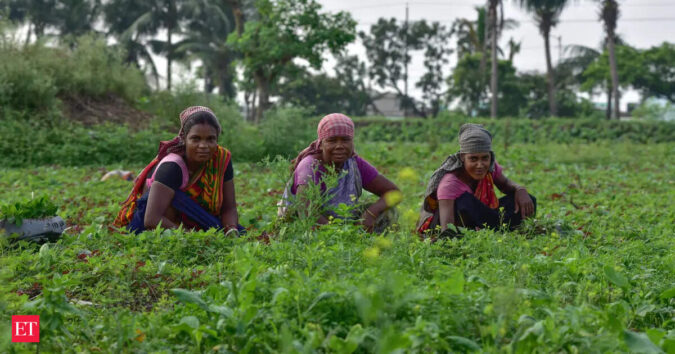
According to the paper “Enhancing Efficiency and Sustainability of Farmer Producer Organizations in India: Challenges and Strategies”, released in April 2026 by the National Academy of Agricultural Sciences (NAAS), FPOs are key to integrating smallholders into modern value chains by aggregating produce, strengthening bargaining power, and improving access to inputs, credit, and markets. They create scale economies that enable participation in formal markets and alignment with shifting demand. Notably, there are over 44,000 registered FPOs in India.
Despite rapid growth, long-term viability is uncertain, the paper says. Only a few are economically sustainable, while most face structural constraints, such as low equity, limited credit, small scale and membership, and weak value-addition infrastructure, the research paper notes. “The fragmented stakeholder approach, limited technical support, inadequate market access, governance issues, limited scale of operations, lack of member participation, and infrastructure gaps are some of the important challenges faced by FPOs,” says the paper.
The small membership base restricts their ability to mobilise equity and working capital, which in turn limits aggregation, investment in infrastructure, and access to formal credit, the research paper highlights.
Rise in the number of FPOs over the years
Source: NAAS

This lack of scale also reduces their competitiveness in high-value markets. Market access remains fragile, with many FPOs dependent on promoting institutions to identify buyers. Only a handful, typically those with strong leadership, are able to build independent and sustainable market linkages. Weak market intelligence, limited branding efforts, and gaps in logistics infrastructure further constrain their ability to compete effectively, the paper says.
Financial constraints, infra gaps pose hurdles
Inadequate technical support exacerbates the challenge. While FPOs often perform well during the initial handholding phase provided by promoting agencies, they tend to struggle once the support is withdrawn, the paper notes, adding that a lack of expertise in business planning, financial management, and market analysis leaves them ill-equipped to navigate competitive markets. The typical support period of around three years is often insufficient to ensure long-term sustainability, especially for organisations still in their formative stages, paper mentions.Financial constraints and infrastructure gaps continue to pose major hurdles. The absence of collateral, weak business plans, and low turnover limit access to institutional credit. In many cases, FPO leadership is either unaware of the existing government schemes or unable to meet eligibility requirements. At the same time, inadequate infrastructure, such as cold storage, processing units, grading facilities, and efficient transport systems, restricts their ability to undertake value addition or access distant and export markets, it says.
Governance and participation issues further undermine the effectiveness of FPOs. Weak internal systems, lack of transparency, and irregular compliance practices erode member trust and reduce active participation. Leadership gaps and social heterogeneity across caste, religion, and political affiliations can complicate collective decision-making. As a result, many FPOs remain confined to low-margin activities, such as input distribution or basic aggregation, with limited progression toward higher-value functions like processing, branding, or direct marketing.
FPOs key to raising farm incomes: Jat
ML Jat, President, NAAS, Secretary, Department of Agricultural Research and Education (DARE), and Director General, Indian Council of Agricultural Research (ICAR), says, “The Government of India has made significant efforts on establishing FPOs, which are playing a critical role in improving small farmers’ incomes through collective action, cost reduction, and better access to markets with a large number of successful examples while others are progressing towards success. FPOs help reduce costs and get better prices, but some also face challenges due to a low membership base, small scale of operations, and inadequate storage and processing infrastructure.”
“The NAAS report notes that only about 21% of FPOs are engaged in value-addition activities like processing and branding, which affects their long-term profitability. It recommends key measures such as simplification of compliance and creation of a single-window system, strengthening financial awareness and credit access, digitisation of FPO data, promotion of FPO-industry linkages, diversification into emerging areas like climate-smart agriculture and digital technologies, differential support based on developmental stages, linking institutional buyers with FPOs, enhancing member participation, and strengthening linkages with R&D institutions to make FPOs more efficient and sustainable,” adds Jat.
Strengthening FPOs is key to higher farm incomes, rural jobs, and a more resilient agri-system, says Jat.
The paper urges regular buyer-seller meets, quality training, easier credit, relaxed collateral, better financial literacy, and stronger internal capital.
Stronger industry linkages needed
The paper proposes focusing on post-harvest activities, grading, sorting, processing, and branding to cut losses and boost prices. Strong agribusiness tie-ups can add tech, finance, markets, and capacity support, it says.
“Stronger industry linkages would help FPOs connect with untapped markets, access capital and finance, and adopt advanced technology. The industry may guide FPOs in operational management and compliance at the FPO and member levels and help build capacity for FPOs and members across different standards and certifications,” the paper says.
Digital tools, blockchain, data analytics, and fintech, can boost FPO transparency, efficiency, and governance, while digitised records can help in planning and monitoring. The paper also calls for simpler compliance, rationalised taxes, scheme convergence, and targeted capacity building to make FPOs market-driven and sustainable.