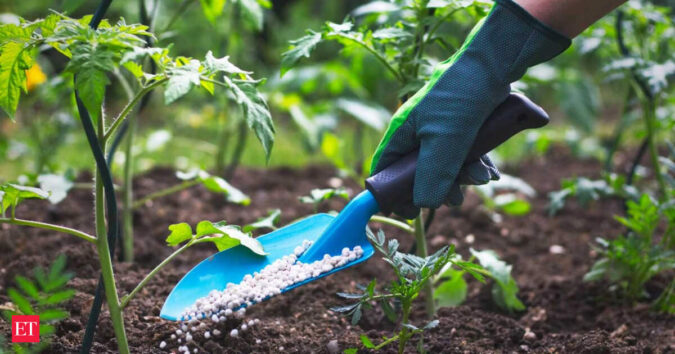
In April, the government approved a Rs 41,534 crore subsidy for Phosphatic and Potassic (P&K) fertilisers for the upcoming 2025-26 kharif season, up by 12 per cent from the year-ago period.
For the kharif 2026 season, the government fixed the subsidy rate for nitrogen at Rs 47.32 per kg, phosphate at Rs 52.76/ kg, potash Rs 2.38/kg and sulphur at Rs 3.16/kg.
According to sources, top executives of fertiliser firms like IFFCO, Coromandel International, Paradeep Phosphates, Indian Potash Ltd and Indorama, on Wednesday met under the aegis of the FAI to review the impact of the ongoing Middle East crisis on the availability of key raw materials and its potential implications for domestic fertiliser production.
The raw material prices have jumped sharply by 100 per cent to 200 per cent, with several key input costs multiplying 3 to 4 times.
Manufacturing at current raw material price levels under the prevailing subsidy structure is completely unviable for domestic producers, sources said.
The FAI has sought an urgent revision of NBS rates specifically for the Kharif season (effective April) to compensate for post-season price increases, they added.India’s total fertiliser production stood at 517.49 lakh tonnes during 2025-26.
The meeting also examined the viability of NP and NPK fertilisers, which have come under strain owing to a sharp spike in key raw material prices.
Industry leaders noted that the existing subsidy rates have not kept pace with the changed cost environment, raising concerns over the sustainability of domestic production of these complex fertilisers, sources said.
The association sought intervention to address the viability gap and safeguard uninterrupted domestic production of NP and NPK fertilisers.
“Maintaining uninterrupted domestic production throughout the Kharif season is critical to ensure adequate stock buildup for the ensuing Rabi season,” a source said.
The industry said that any increase in the market prices for NP and NPK fertilisers is unfeasible as it would negatively impact consumption.
The retail prices of DAP (di-ammonium phosphate) have been fixed at Rs 1,350 per bag. Therefore, any further price increase in NP/NPK fertilizers would widen the price gap and distort demand toward DAP.
India’s urea imports jumped 83 per cent last fiscal to 103.50 lakh tonnes to meet rising domestic demand, according to government data.
In a written reply to the Rajya Sabha on Tuesday, Minister of State for Chemicals and Fertilizers Anupriya Patel shared production and imports of major fertilisers during the last five fiscal years.
As per the data, urea imports increased to 103.50 lakh tonnes in 2025-26 fiscal from 56.47 lakh tonnes in the preceding year.
In the 2020-21 fiscal, urea imports stood at 91.36 lakh tonnes, while imports were 75.80 lakh tonnes in 2022-23 and 70.42 lakh tonnes in 2023-24.
Further, the imports of di-ammonium phosphate (DAP) also rose to 61.94 lakh tonnes last fiscal from 45.69 lakh tonnes in 2024-25.
The imports of DAP stood at 54.62 lakh tonnes in 2020-21, 65.83 lakh tonnes in 2021-22 fiscal and 55.67 lakh tonnes in 2022-23.
Urea production fell to 293.26 lakh tonnes in 2025-26 from 306.67 lakh tonnes in the preceding year. However, the DAP output rose to 39.14 lakh tonnes last fiscal from 37.72 lakh tonnes in 2024-25.