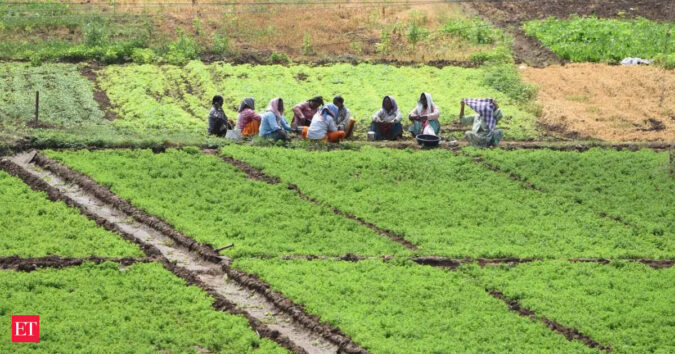
This kharif season, backed by years of training from the family-owned trust Dr Reddy’s Foundation, one of the beneficiaries of CSR funds of pharma major Dr Reddy’s Laboratories, he is trying something different.
Read more: From dry lands to thriving farms: How one farmer from Andhra transformed dry land into productive crops worth crores
“Last year, rains had arrived in May itself. This year it has not yet come. I have heard that the rainfall will be less due to El Nino,” Satyam told PTI.
“So I have decided to try DSR.”
DSR – Direct Seeded Rice – skips the nursery entirely. Seeds go straight into the field. No transplantation, no waterlogging, no standing puddles.
For a farmer staring down a lean monsoon, it is an attractive proposition.Satyam is not alone. Across Srikakulam and Vizianagaram districts, where the Dr Reddy’s Foundation works with farmers in over 1,500 villages covering roughly 10 lakh acres of paddy area as part of the Action for Climate and Environment (ACE) programme, a generation of cultivators is being quietly nudged away from water-intensive methods.
State agricultural departments and Krishi Vighyan Kendras, with whom the foundation works closely, are reinforcing the message – advising farmers to reduce paddy acreage, switch to short-duration crops, or move to pulses and cereals.
“If El Nino gets severe, we will cultivate paddy for house consumption only,” Satyam said.
R Sanyas Rao, 50, from the same village, did not wait for a bad year to make the switch. Associated with the Foundation since 2014 – three years before Satyam joined – he tried wet DSR on five acres last kharif and found it worked. Labour costs dropped. Nursery management vanished as a headache. Transplantation costs disappeared.
This year, Rao is going further: dry DSR on two acres, maize on three.
“With the borewell facility, I will be able to manage,” he said.
The numbers make the case bluntly. Conventional paddy cultivation is an extraordinarily water guzzling method. DSR and Alternate Wetting and Drying – AWD, a technique where fields are flooded and drained in cycles rather than kept continuously submerged – dramatically cut that demand.
“Dry DSR method saves around 11-12 lakh litres of water per acre. Wet DSR saves around 4-5.5 lakh litres AWD saves roughly 3-5 lakh litres of water compared to traditional methods,” said Suman Saraswathibatla, Director (Rural Livelihoods and Climate Action) at Dr Reddy’s Foundation.
Last year, farmers in two districts adopted DSR across 3,667 acres and AWD across 21,963 acres, saving more than 3,000 crore litres of water and reducing over 50,000 tonne equivalent carbon dioxide. With El Nino back in the forecast, those numbers are expected to rise significantly, he said.
For both techniques to work well, soil moisture must remain consistent in the upper 30-40 cm of the field – a critical condition that shapes when and how farmers decide to sow.
Being a cyclone and rainfed belt, Srikakulam’s sowing calendar has already changed. Traditionally, paddy went in at the end of June. Over the last three to four years, sowing has shifted to July, with peak transplantation moving to August.
To bridge the gap, the Foundation has been encouraging farmers to plant short-duration cover crops – black gram, green gram, sesamum – in the May-June window before kharif begins. Green manuring crops like sun hemp and napier help retain soil moisture in the interim.
Last year, cover crops were grown across 2,372 acres; agro-forestry -mixing timber and fruit plants in coconut orchards – covered 1,508 acres. Both are set to expand this season.
Underlying all of this is a quiet crisis in Srikakulam’s soil health. The foundation through its own state-of-art Hyderabad facility launched in January 2025 is providing soil health test results quickly along with actionable crop advisories.
Over 5,000 soil health cards were issued last year and the findings are consistent: organic carbon levels are very low. Micronutrients like sulphur, zinc, and boron are deficient. Potash is in excess.
“Site-specific nutrient management is one of our major interventions this year, especially given the combination of El Nino effects and the fertilizer crunch. We’re pushing hard to bring in as many samples as possible,” Suman said.
For the past five years, the Foundation has been running awareness campaigns – bulk SMS messages, posters, farm extension meetings – urging farmers to apply fertilisers more precisely, based on what their specific soil actually needs rather than what habit or convenience suggests.
Read more: Andhra Pradesh’s Naidu pitches state as semiconductor hub to global chipmakers
It is slow work, changing practices that have been handed down across generations. But in a district where water is becoming an annual gamble, farmers like Satyam and Rao are finding that the old ways may no longer be the safest bet.
“There is more awareness being created to adopt DSR instead of paddy transplantation,” Rao said. “I will decide on the sowing operation in July.”
The monsoon, as ever, will have the final word.