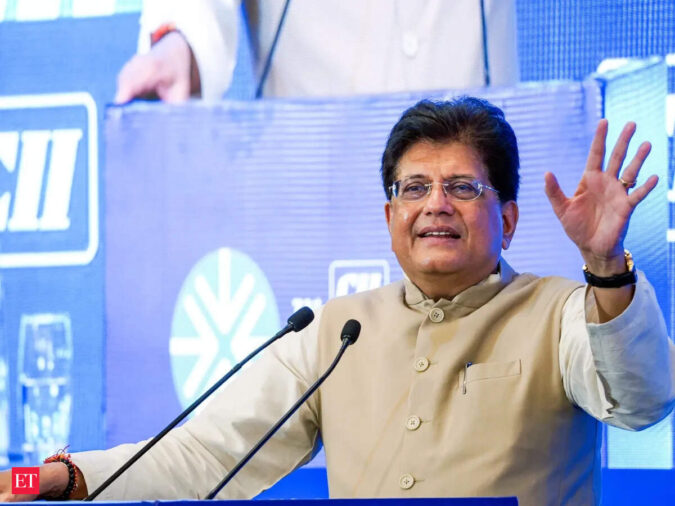
Speaking at the Bloomberg New Economy Forum 2026, Goyal said the relationship between the two countries extended beyond trade to defence, technology, critical minerals and people-to-people ties.
“I think the U.S. and India have a very, very consequential relationship, and it’s only going to get better,” Goyal said during a panel discussion on supply-chain resilience and technology partnerships.
The minister said the United States was India’s largest trading partner and that economic, political and security considerations would continue to underpin bilateral relations, regardless of changes in political thinking in either country.
Seeking to allay concerns about the wider implications of the partnership, Goyal said, “It’s a safe relationship, I dont think the rest of the world needs to worry about it.”
His remarks came amid broader discussions on shifting geopolitical equations, global trade uncertainties and the need for countries to build more resilient supply chains.
India open to rebuilding ties with China
While expressing confidence in the India-US relationship, Goyal also signalled that New Delhi was willing to strengthen economic engagement with China, provided the relationship was based on fair terms and geopolitical stability.“We are open to all countries around the world as long as we get a fair deal, as long as we are ensured continuity in the engagement, and as long as the geopolitical situation does not deteriorate,” he said.
The minister indicated that efforts were underway to improve relations with Beijing, although the future course of engagement remained uncertain.
“We are working to develop the relation with China once again, but the last word has not yet been scripted on this journey,” Goyal added.
His comments highlighted India’s approach of maintaining economic engagement with multiple countries while seeking to safeguard its strategic interests.
India seeks trusted partners for critical technology supply chains
Goyal also stressed that international cooperation would remain essential as countries attempt to strengthen their domestic technological and manufacturing capabilities.
He said developing alternatives to supply chains concentrated in a handful of economies would be difficult without countries pooling their resources and capabilities.
“It may not be possible that we can replicate what one or two countries have been able to do at really big scale unless we join hands, unless we work together,” he said.
The minister maintained that India was not seeking to isolate itself from international markets but wanted to strike a balance between domestic capabilities in critical sectors and cooperation with trusted global partners.
He also emphasised the need to identify areas where excessive dependence on overseas suppliers could expose domestic production to changes in government policies or geopolitical developments.
Singapore, Canada eye deeper economic ties with India
The panel discussion also featured Singapore Deputy Prime Minister and Trade and Industry Minister Gan Kim Yong, who said Singapore was working with India to develop its semiconductor industry and train workers to support the sector’s expansion.
He highlighted the importance of cooperation between countries as global trade and technology networks face increasing fragmentation.
Canadian Minister of International Trade Maninder Sidhu, meanwhile, said Ottawa was looking to diversify its trading relationships and was negotiating a trade agreement with India.
Sidhu identified energy as an important area for cooperation, noting that India’s energy requirements were expected to rise by 70 per cent by 2035 and that Canada’s resources could help meet that demand.
The discussion underscored the importance of international partnerships in trade, technology and critical resources as countries navigate geopolitical uncertainties and changing global supply chains.