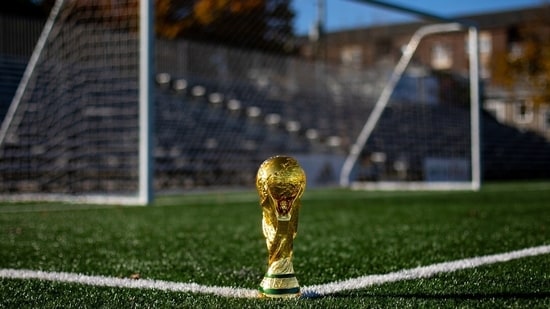
The most tempting column for an economist to write about the World Cup is the teardown, and I had it drafted before the opening match. The argument is simple: The benefits of hosting are oversold and the costs barely counted.
When the tournament last came to America in 1994, boosters promised host cities $4 billion in gains. Economists later reported up to $9.3 billion in losses. FIFA’s consultants projected this World Cup would add $17.2 billion to American gross domestic product. The receipts are still coming in—card spending jumped; restaurants and bars had their best months in years—but the national picture is what matters, and there the gains wash out against the tourists who stayed home and the jobs that never came. The economist Victor Matheson put it plainly: “The World Cup is making us happy. There’s not a lot of evidence it’s making us rich.”
Consider what else we could buy. Closing the racial-achievement gap in math is achievable with targeted investments of approximately $1,700 a child each year over a three-year period. The intervention raised math achievement by 0.184 standard deviation a year in elementary school and 0.146 in secondary school. Economists estimate each standard deviation of achievement is worth $110,000 to $230,000 in lifetime earnings, so $10 billion buys roughly three years of that gain for two million children, about a $200 billion increase.
But to get to the truth, I have to leave my bubble for the real world. When I was reforming public schools I sat in them every week. So I went to a match with my family and friends—Norway vs. Iraq—to see the traffic and overpriced hot dogs for myself.
I found much less traffic than expected. I saw canopies of Iraqi flags, bodies out every window, everyone dancing to a faint hip-hop pulse. The walk in was a collision of cultures that seemed to enjoy each other. I struck out looking for one of those ridiculous horned Viking hats and settled for a green Iraqi trucker cap. I put it on and instantly made new friends.
My generation has lived through two American wars with Iraq, but I’d never met Iraqis, danced to their music or heard their anthem. And that distance does something quiet and dangerous: It sets the price of our credulity. Tell us tomorrow that Canada is a threat and we’d laugh—we know Canada, we’ve stood in it, we can see the faces. Tell us the same about Iraq and it goes down easier.
In minute 39, while I was doing the Norwegians’ Viking row in my Iraqi hat, Iraq scored. It tied the game; Norway would pull away, and the goal will appear in no history of the tournament. But it is the most important goal I saw all summer. The man in front of us dropped to his knees, threw his hands to the sky, and screamed that he never thought he would live to see his country score in a World Cup. His face was wet and gushing with joy. I couldn’t make the old story fit what was in front of me, and I wondered something an economist isn’t supposed to wonder: If two peoples could meet like this before their governments narrated them to each other, might peace have a little more room to work?
Borders don’t dissolve because a stadium sang together, and no treaty was signed in Foxborough, Mass., that night. But governments answer, eventually, to publics—and a public that has stood shoulder to shoulder with the people it was taught to fear is harder to march to war.
Years ago, Matthew Jackson and I built a model of how the mind sorts information into categories for cognitive efficiency. We found that prejudice needs no hatred. You sort the people you meet often into fine categories; the rest get lumped into coarse blocks. “Iraqi,” for an American who has met Iraq only through two wars, is a coarse sorting—40 million people in a bin or two. The cure is more interaction.
I watched it happen at the World Cup. A stadium takes the coarse block and, for a few hours, forces the finer sort my model said was missing. My wife, a proud Austrian, felt it too and asked what it would be like not to witness this but to feel it—to stand in a section, for your own country.
So I dusted off my lederhosen, and we traveled to Kansas City, Mo., for Austria vs. Algeria. The Algerians had the better music, but the Austrians were more committed—belting “I Am From Austria” for what felt like hours, swaths of my wife’s countrymen in full voice. Austria and Algeria are separated by language, religion, history and the Mediterranean. None of it seemed to matter.
Still, I did what a social scientist does—I went to the barbecue joints to ask my questions. Was the traffic more intense than usual? Was the pit master busier than a normal Saturday? Did they find us outsiders annoying? A man ahead of me in line at Slap’s BBQ, a former professional barbecue judge, ignored all of it and told me instead that he was proud the world finally got to see Kansas City—that they aren’t flyover country, that the folks here are kind and well-educated. He wasn’t answering my question; he was correcting it. Then he sent me home with two bottles of his favorite sauce—one spicy, one sweet.
Multiply that man by a stadium, then every stadium, across 39 days, and you start to see what the typical economic analysis was never built to count. America’s two decades in Iraq and the war on terror cost somewhere between $2 trillion and $8 trillion, depending on who’s counting. If everything we just witnessed made one such war 0.2% less likely, FIFA’s $17.2 billion is the smaller number.
I can’t estimate how much a tournament moves the odds of a war, but the evidence is at least suggestive. Emilio Depetris-Chauvin and his co-authors found that Africans surveyed just after a national-team victory identified less by ethnic group and trusted other ethnicities more—and that countries barely qualifying for the Cup of Nations saw about 9% fewer civil-conflict episodes in the months after. Two-tenths of a percent is a rounding error on a rounding error, and I wouldn’t bet against a stadium full of Iraqis and Norwegians sorting one another more finely to clear it.
I went to my first World Cup to price it—to see if the benefits were oversold. They are. But that measures the wrong thing. The real return isn’t in hotel occupancy or pounds of ribs sold; it’s in the 90 minutes when 40 million Iraqis narrowed to one—a man weeping over a goal that meant nothing and everything.
Nobody can put that in a spreadsheet. We ended up, for a few hours at a time, seeing one another in higher resolution.
Mr. Fryer, a Journal contributor, is a professor of economics at Harvard, a founder of Equal Opportunity Ventures and a senior fellow at the Manhattan Institute.