Cognitive warmup. It just had to be a Meta product, didn’t it? Apple is making significant disk access changes after many Meta Muse users complained that the AI agent was accessing messages on the iMessage app without permission. Of course Meta denies it, I’ll get to that in a moment. The complaint highlights a serious privacy issue with the Muse agents, impacting Macs because Apple had allowed for a bit more leeway with the macOS’ foundational structure (but flexibility is often misused, and then gets taken away).
On the iPhone and iPad, no app can access data that’s inside another app—and this is a process called sandboxing. This was part of a significant privacy push by Apple a few years ago around iOS and iPadOS, and that’s also why apps such as Facebook and Instagram now struggle to find targeted advertising context from your browsing history on the Safari web browser for instance. On the Mac, there was a bit more flexibility with the ‘Full Disk Access’ option that allowed apps to access all the data on the Mac’s local storage. Relevant for cloud storage apps, for instance.
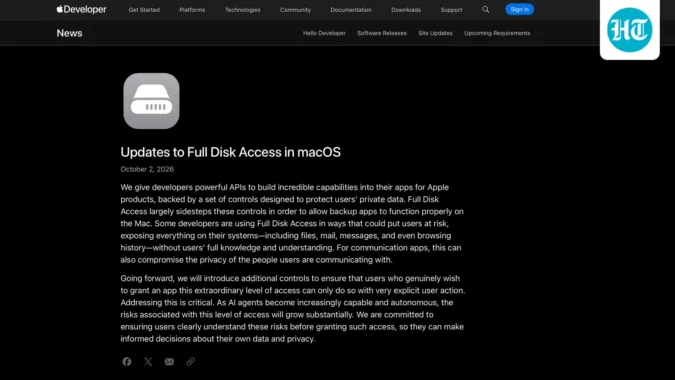
Apple has heard the complaints and, while not naming Meta, notes that AI agents are the reason for implementing this change now. “Going forward, we will introduce additional controls to ensure that users who genuinely wish to grant an app this extraordinary level of access can only do so with very explicit user action. Addressing this is critical. As AI agents become increasingly capable and autonomous, the risks associated with this level of access will grow substantially. We are committed to ensuring users clearly understand these risks before granting such access, so they can make informed decisions about their own data and privacy,” Apple says in a statement.
Meta’s Andy Stone of course denies those claims, in a post on X. “Let’s set the record straight: the Messages integration in the Muse app for Mac is entirely opt-in. You have to enable both Full Disk Access and the Messages connector for Muse to be able to read your Messages content. It can’t read your Messages unless you do this. And it can be revoked at any time,” he wrote. Not sure how many people are buying any defence Meta puts forth now on anything related to privacy negligence.
Previously on Neural Dispatch: Chatting with Articul8’s Arun Subramaniyan, and Meta Muse inevitably messes up
SPARK OF HUMANITY
“ In this era of artificial intelligence, it is becoming urgent to distinguish human art from what machines produce. There is an ontological difference, even before an aesthetic one, between art and what a machine can generate through statistical calculation based on millions of images created by others. Algorithms lack the spark of humanity. For this reason, the Church wishes to renew an alliance with artists and cultural institutions to safeguard our humanity” – Pope Leo XIV, in a post on X.
- There is a reason why Pope Leo XIV put AI companies in their place, this past week. Our regular readers would know I never intersect religion with any technology conversations, but there has to be a commentary on Anthropic’s attempts to somehow get the Vatican to recognise AI as a ‘conscious’.
- The play here is really very simple: if AI is classified as a conscious entity, it stops being a mere tool; they want the Pope to recognise that AI has consciousness. Anthropic’s cofounder Christopher Olah is reportedly leading the charm offensive.
If AI remains a technology tool as it is now, Anthropic and other AI companies would be legally liable for everything their models do or don’t do. But, if AI is classified as something that possesses skills that define a human and has emotions such as joy or grief, then lawyers at any AI company can say “the AI did it”. Anthropic and other AI companies simply become ‘creators’ of a conscious being, with no legal responsibility.
If a human commits a crime, God isn’t held responsible, but that human is. AI companies want to play God. They know it fully well that AI will create a right old mess at some point, and want to be immune from lawsuits. Alongside the fact that algorithms absolutely cannot replace human intuition or creativity, and cannot replicate human emotion, another reason why AI companies cannot be trusted to play God, is because they tend to spew a lot of nonsense, a lot of the time.
Take OpenAI’s Sam Altman this week, for instance. He says in an interview that “the world should accept some bad things happening for the benefits of this technology.” This is the same AI bro who had previously equated how much food a human eats with how much energy AI needs to train (and seemed to suggest AI is more frugal). To this, I simply have another quote from Pope Leo XIV — “AI can process information quickly, but it cannot replace human intelligence. And don’t ask it to do your homework for you.”
The latest, on Wired Wisdom: Decoding Apple Pay, Vi’s international roaming, and Xiaomi’s new power banks
COSTS ARE ADDING UP
The joyride seems to be over. Or close to over. A few days ago, Google announced that starting later this week (October 9, mark your calendars if this really matters to you), Gemini model access will be linked to the subscription tier—without a plan, AI Plus, AI Pro and AI Ultra users. Flash-Lite class model will be available to all tiers, while Flash will not be available for the ‘without a plan’, while that demographic as well as those on the more affordable AI Plus plans will not have access to the Pro class Gemini models. Basically, these are downgrades if you aren’t on the top-tier plans.
To give you a pricing perspective, the Google AI Plus plans are priced at ₹399 per month with 400GB cloud storage, the AI Pro plan is priced at ₹1,950 per month for 5TB cloud storage whereas the top-tier AI Ultra will cost ₹6,500 per month with 20TB cloud storage. Mind you, Google aren’t the only ones, seemingly facing the pinch of the incredible infrastructure expenditure done over the past 12 months, often without much direction in terms of revenue streams or a roadmap for how to earn that back. Often, it was purely a race—just to be the fastest, but not exactly clear where the finish line actually is.
Anyway, last month, OpenAI temporarily stopped accepting new users for its flagship $200 per month ChatGPT Pro tier and when that resumed, it was with usage allowance reduced by half for new subscribers (from 20x to 10x the Plus allowance) and introduced a new $500/month tier for top-end users.
Anthropic meanwhile tried to keep costs down without raising the core $20/month Pro subscription price, with a strict dual-limit structure. Basically, you get a set amount of messages every 5 hours. If you type a lot, Claude locks you out until that rolling 5-hour window resets. Apart from the 5-hour rule, Anthropic also tracks overall usage across the entire week.
If you use external developer tools or browser extensions to run Claude in the background using your flat-rate subscription, Anthropic has severely throttled or shut down those pathways. They want heavy automated workflows moving to pay-as-you-go API developer accounts.
Microsoft has also split the Copilot workspace into a dual pricing system. Everyday chat remained covered by a flat monthly licence, but advanced agent features (Cowork, Code, and persistent Autopilot) were shifted to consumption-based billing. Yet another brilliant determination that background, autonomous AI agents cannot run sustainably under flat subscription models