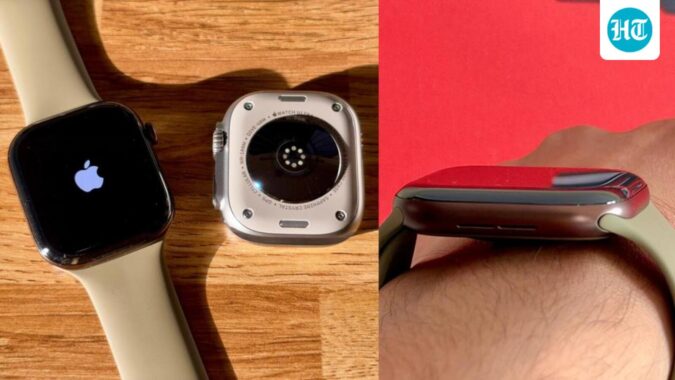
No spoiler alerts or unnecessary complications: the biggest upgrades in the Apple Watch Series 12 and Watch Ultra 4 are the ones you cannot see. Powered by a new health-sensing architecture, a 5-second-interval optical heart rate sensor, Siri AI, and the S10 silicon chip, the beating heart of the puzzle delivers a substantial leap for the overall experience while keeping a familiar exterior design.
Some people loudly called for a new design, but to be fair, there was no pressing need. Materials have changed a bit again, and you’ll like the new colour options, too. While we are on that point, the Watch Series 12 is available in Aluminium (Dark Bronze photographed above is a favourite), Titanium (I’d recommend Natural) and the high-end Ceramic (of course, the Pearl White will get the attention) material choices—prices start ₹56,900, ₹99,900 and ₹1,24,900, respectively. The Watch Ultra 4, with its focused, evolved appeal, keeps the 49mm aerospace-grade titanium case in Black and Natural finish options—and I’d prefer the depth of Black over Natural because a darker watch face blends better with the case. Nitpicking, but some would appreciate this insight.
I’ll say it again, the big changes with the Apple Watch Series 12 and Watch Ultra 4 are grounded in the new Health Sensing System. Both watches now have a larger array of sensors on the underside, including a new optical sensor, new electrical sensors, and larger, more power-efficient green LEDs. The Apple Watch Series 12 and Watch Ultra 4 can monitor Heart Rate Variability (HRV) ratings every 5 minutes and heart rate readings every 5 seconds—that’s 24x more than the Series 11 and 60x more than the Series 11, respectively. Despite much smaller tracking intervals for two key metrics, the battery stamina of both watches has improved generationally.
Much of that efficiency comes from the 2-nanometer S11 chip, which also boosts performance and makes the watchOS 27 interface feel incredibly responsive and smooth. Not that any previous Apple Watch generation felt sluggish with their watchOS iterations, but this feels a notch above. Paired with more data for the Health app to use, existing clearances for being classified as over-the-counter medical devices for tracking ECG, for instance, will add substance not just to the logs but also to the resulting suggestions.
Shorter intervals for heart rate logging are particularly helpful because now, it’ll have data across moments of activity and when the wearer is stationary. You will notice better insights and guidance as time passes, particularly with sleep tracking measured too, something I’ve not been able to do due to an inability to wear anything around my wrist while sleeping. The Health and Fitness apps on iOS 27 have received design changes as well—but a bigger Health update refresh arrives later this year. Don’t miss the Vitals aspect, which now includes a full-day view and granular summaries that flag when something is off.
The Apple S11 chip is a substantial generational upgrade, and it shows in the overall performance experience of the Watch Series 12 and Watch Ultra 4. It also feels like a bigger step forward because the Series 11 continued using the Series 10 chip, which itself evolved from the generational upgrade delivered with the Watch Series 9. The CPU, GPU and Neural Engine are all more powerful, and there is broader inspiration from the A20 Pro chip in the iPhone 18 Pro. Snappiness and responsiveness is also helped by the fact that it has double the memory now—4GB, up from 2GB. No Apple Watch felt sluggish with 2GB memory, and you can imagine how much more performance headroom watchOS 27 and apps get now.
In terms of battery stamina, the Watch Series 12 does get a slightly higher capacity battery and improvements elsewhere mean workout logging can be about 2 hours more than in the previous generation. That said, the faster charging is a huge benefit, with up to 12 hours of wear time from a 15-minute charge session—great for a top-up before bed for sleep tracking. It is the Watch Ultra 4 which gets a bigger leap in terms of stamina, with up to 18 hours of wearable time with a 15-minute fast charge and, in my experience, lasting almost 3 days with mixed usage before it needs to be charged again. The Watch Ultra 3 easily got 2 days, and Apple has now added an entire day of mixed use. Great!
The Watch Ultra 4’s more activity-focused positioning gets its gravitas from Backtrack, which can retrace your route using GPS to create a path, extensive diving tracking and advanced metrics such as running power and cadence. Training load data should be particularly useful, because it will provide a sense of how workouts are impacting your body over time, and guide forward training plans.
Consumers will get access to Live Recap and Siri Recap at some point in the near future. The full-fledged Siri experience includes personal context, summarisation, a chatbot and even useful daily utility features such as sound recognition (auto Shazam song recognition and doorbell notifications are great). The Live Recap feature, for instance, can invoke a text-based transcription of the previous 15 seconds of a conversation you were having. Great if you missed something. But what about the privacy concern—is your Apple Watch listening to you all the time, and where is that audio recording data going? Apple execs explained to HT on the sidelines of the recent keynote that the Live Recap feature relies on the hardware-isolated Secure Enclave in the Apple S11 chip, which processes microphone and audio intelligence data on the device. That’s irrespective of whether the audio data is generated by an Apple app or a third-party app. This is encrypted data, which is temporary and constantly overwritten without any file being saved.
It is fair to weigh the Apple Watch Series 12 and Watch Ultra 4 as significant upgrades. For each demographic, there is substantive progress across the board, be it health tracking scope, overall performance, battery stamina and the choice of materials as well as finish. Even from the Watch Series 11 and the Watch Ultra 3, these are a leap forward, which is often difficult to achieve with smartwatches. Not much has changed on the outside, but the real upgrades are in the new hardware, watchOS 27, and Siri AI functionality alongside Audio Intelligence. Both the Watch Series 12 and Watch Ultra 4 are decidedly more meaningful as a smartwatch experience, more in-depth as a health tracker and as AI devices if you need them to be that.