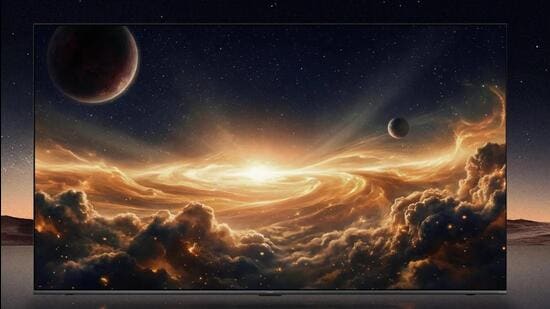
Two still relevant and prevalent themes continue to underline TV purchases. Foremost, these splurges tend to be event or time-linked, usually coinciding with a major sporting event the family aspires to watch on a larger screen (unless of course, the current TV has actually conked off suddenly). Secondly, and no less important, is an intent to future-proof this upgrade for years to come. Many will contemplate a similar large screen TV purchase ahead of the FIFA World Cup 2026 (hopefully someone gets the broadcast rights, TV or digital in India). TV makers know this, and perhaps this is why you may have noticed an increasing number of TVs featuring a relatively newer Mini LED as a display technology, at enticing price points forcing you to consider the value proposition. Xiaomi, which has lately been on a roll with TV portfolio updates, now adds the flagship — the Xiaomi TV S Mini LED series, 2026 edition.
Three screen sizes, at ₹51,999 for the 55-inch, ₹71,999 if you prefer the 65-inch or ₹99,999 for the 75-inch canvas, the one we are analysing here. Important to expeditiously explain why Mini LED is an important step for TV display technology as a whole—it bridges that pricing gap between a standard LED TV and a much more expensive OLED display. The QLED panels did well enough in the meantime, but Mini LED has technology advantages, primarily OLED-level brightness which is evenly spread due to the uniform backlight placement, and higher contrast levels interspersed with deep blacks (because each of these backlights can be turned on and off depending on what’s on the screen, with no lingering spillage), which QLED or LED before it couldn’t quite match.
The Mini LED methodology of thousands of individual LEDs providing the backlighting, allows for really fine dimming zones (how well they work depends on the algorithms controlling these zones; the onus is on TV makers), and therefore a three-pronged advantage of better contrast, brightness uniformity and no burn-in risk like an OLED. For once, this spec clearly works with the logic of more is better.
This key spec is where the Xiaomi TV S Mini LED 75, with 512 dimming zones across the width of this display panel, leaves nothing to chance. Proportionally, 65-inch has 384 zones and 55-inch has 308 zones. More is better, for that contrast and those inky black colours, particularly for movies and TV shows. It’s closest competitors in terms of price are Lumio’s 2026 edition Vision 9 ( ₹72,999; 128 dimming zones on the 65-inch) and Samsung which doesn’t disclose these specifics for the Mini LED M2EH 4K Smart TV (2026; 75M2EHAU for ₹1,02,990).
It becomes immediately clear that the Xiaomi TV S Mini LED is absolutely adept at handling a brightly lit living room, with the midsummer afternoon sun streaming in on a day with not a single speck of cloud dotting the sky. There is a non-reflective layer done just right, which keeps most ambient reflections at bay, bar for a really bright artificial lighting fixture somewhere behind as you look at the TV. No washed out visuals or poor viewing angles, just because you decide to use a TV as a TV. The world seems to be healing, and that’s a good thing.
There are three main use-cases that I judged the Xiaomi TV S Mini LED 75 through, and it delivered in flying colours in two, and almost there in one. I’ll start with the latter, noting my surprise that Xiaomi has persisted with 2GB memory instead of a bump to 3GB for better performance headroom, but even within those spec guidelines, all streaming apps respond with consistency and a general sense of urgency, while Google TV’s overall responsiveness leaves little to complain about. It is matter of holding up this level of snappiness over time, when app caches fill up and app updates bloat things further.
Where the Xiaomi TV S Mini LED 75 really shines is with your typical movie or TV show binging on Netflix or Apple TV+ or JioHotstar, and I note this troika because you’ll be making full use of the pixels with 4K streaming, and varying quality of HDR optimisations. This continues the line of the company’s Filmmaker Mode optimisations, the advantages of which I’d explained in detail with the X Pro QLED 75 from earlier this year, and the X Pro QLED Series 2025 Edition.
Weekend and late evening binging on weekdays will expectedly be the most active use case for this TV, and particularly with screen size, and you’ll know exactly why Xiaomi got it absolutely right with the 512 dimming zones. Contrast is, as expected, top notch with a visually gorgeous difference between the brighter and darker parts of a frame makes. It makes for not just beautiful viewing, but is also not something a QLED panel could have matched (though I love QLED as a versatile, cost effective display tech for TVs).
The other big use case in India, would be sports viewing. Run the Xiaomi TV S Mini LED 75 through the paces with cricket, football and Formula 1, both streamed and also linear broadcasts on a TataPlay HD+ set top box (for resolution, bitrate and overall quality variance), and there are fine observations to discuss. First off, in sports, the Screen Backlight default setting of 100 is far too much, and reducing this to half (or even lower) is the way to go depending on room lighting. Secondly, it takes some effort to get the picture just right for sports viewing (too bright or too dim isn’t great at all), but its worth the time you spend to get it locked in.
Here’s another win. Compared with Xiaomi’s 2025 TVs, a perceptible positive tweak in picture processing is that there’s a smidgen more crispness and detailing even at sharpness level set to zero or one. It could also be less aggressive noise cancellation at work, leaving the choice to you in the display settings. I also notice an improvement in fine detail reproduction, but there’s still work to be done. For instance, look at the faces of the batsman, wicketkeeper and often the slip cordon fielders from the bowler camera view in a cricket match. Many TVs in recent years, including my notes from the X Pro QLED Series 2025 Edition, have struggled to get this right—the result is a pixelated mess instead of actual facial features.
The Xiaomi TV S Mini LED 75 does it better than even the X Pro QLED 75, at similar picture and sharpness levels, and with the same source. But as I said, there’s more work to be done. Skin tone accuracy and realism has taken a step back, and the higher you take the backlight slider, the more pronounced and unrealistic caucasian-esque tone to Sanju Samson’s skin colour in an IPL match. Interestingly, this is more pronounced with sports streaming and Live TV, than with movie and TV show content
Important to appreciate the little things done well. The 34-watt built in speaker system is more adequate than many more expensive TVs manage, complete with support for Dolby Audio. I must note that the Xiaomi Sound tuning out of the box is much more neutral than the QLED from earlier this year, with good levels of detailing for the spoken work. But chances are, you’ll still want to get a sound bar in place, to really enjoy the movies.
The support for Apple AirPlay 2 standard alongside Google Cast, gives iPhone users as well as those with Android phones, a simpler way to replicate their phone’s content on the larger screen.
Perhaps the Xiaomi TV S Mini LED, particularly in this top-of-the-line 75-inch avatar, could’ve been a strong case for a table-top stand design refresh. Right now, nothing separates this from the lesser priced LED range, at least at first glance. The positive I can draw from this is the dual option of closer stand installation (for tables that aren’t as wide as the TV).
For some reason, I’m often reminded of the Mi LED Smart TV 4, which was Xiaomi’s first LED TV in India (back in 2018—the 4.9mm ultra-thin contours still represent peak TV architecture) with a yearning for something similar to make a comeback at least on the flagship TVs of the future. That said, a design feat isn’t easy to replicate, particularly with more elaborate display backlighting technology at play (at least until this matures and as often is the case with tech, miniaturises).
It is good to see Mini LED becoming a popular smart TV display tech, alongside QLED which has been around for a while. This is where the user has a choice, a preference to work with, and a budget to weave within. The sensitivity of Mini LED does mean it needs to be optimised well, out of the box, for an experience to be what it is supposed to be. If this optimization is inaccurate or lazily done by TV makers (this is a tech’s advance warning), and the promise of inky black disappears faster than fog the moment sunlight breaks through.
In the case of the Xiaomi TV S Mini LED 75 (and I believe that’s the case for the other two screen sizes as well), there seems to be a definite attempt to get things right. And it shows, even more so after you’ve spent some time undoing the out-of-the-box picture as well as audio settings, and getting things more aligned to your viewing preferences. In my book, Xiaomi’s first Mini LED tech TV in India is certainly off to a strong start. On features. With performance. And as a value proposition.