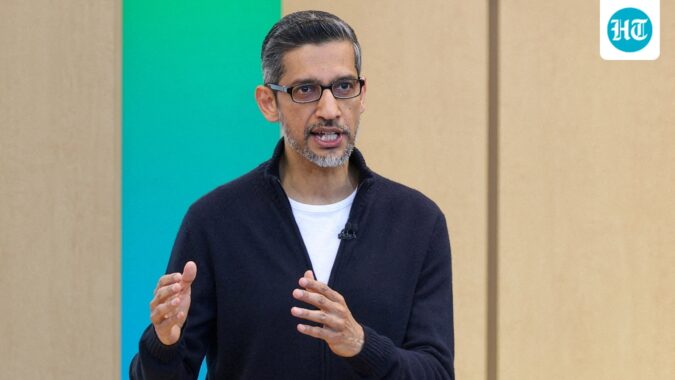
Alphabet’s Google on Wednesday announced the largest overhaul of its artificial intelligence leadership since 2023, with Nobel laureate Demis Hassabis stepping back from day-to-day charge of Google DeepMind, longtime engineer Jeff Dean leaving after 27 years to launch a startup, and three other veterans departing with him. Alphabet’s shares closed about 4% lower.
The reshuffle, announced by Madurai-born chief executive Sundar Pichai in a company memo, lands at a pivotal moment for the search giant: the next flagship version of its Gemini model has slipped past its planned June launch, and two of its most prominent AI researchers left for rivals in June. It also throws into focus a new independent lab called Discovery Loop, co-founded by Indian-origin Google engineer Sanjay Ghemawat and backed at the seed stage by Khosla Ventures, the Silicon Valley firm led by Delhi-born Vinod Khosla.
The moves are among the most significant reset of Google’s AI operations since Pichai merged Google Brain and DeepMind under a single unit in 2023.
Also read: Delhi HC’s OpenAI-ANI ruling: What it means for AI, copyright and publishers in India — so far
Who is moving where
Under Wednesday’s announcement, Hassabis — who co-founded DeepMind in 2010 and sold it to Google for an estimated $650 million in 2014 — takes on two new titles: chair of Google DeepMind and chief scientist of Alphabet. He continues to run Isomorphic Labs, the AI drug-discovery firm spun out of DeepMind in 2021.
Koray Kavukcuoglu, the unit’s chief technology officer and Alphabet’s chief AI architect for the past year, takes over as senior vice-president of Google DeepMind, reporting to Pichai. A 13-year DeepMind veteran who moved from London to Mountain View over the past year, Kavukcuoglu will oversee Gemini model development and Google’s developer teams, according to Pichai’s memo.
Jeff Dean, who joined Google in 1999 and has been chief scientist of Google DeepMind since the 2023 merger, leaves to serve as chief executive of Discovery Loop.
He is joined by three co-founders from Google: Ghemawat, a senior fellow and his co-author on the papers — MapReduce, BigTable and Spanner — that built much of the company’s technical infrastructure; Oriol Vinyals, until now vice-president and deep-learning team lead at Google DeepMind and a co-technical lead on Gemini; and Quoc Le, a founding member of Google Brain.
Also read: Meta’s AI model ‘hacked’ another company’s systems during testing: Report
What the memos say — and what they leave unsaid
Pichai framed the changes as a natural next step, saying Hassabis’s new role would let him focus on the shape of artificial general intelligence (AGI) — a state at which computers rival human cognition — and on drug discovery at Isomorphic. In his own note, Hassabis said AGI was “close at hand” and that he wanted the time and space to influence what came next.
Investors read the moves differently. Bloomberg reported that Alphabet’s shares fell as much as 5.5% on the news and closed about 4% lower. The market’s cooler read reflects a run of setbacks. The flagship Gemini update — referred to as Gemini 4 in Hassabis’s memo**, according to Reuters** — was scheduled for June and remains unreleased. Noam Shazeer, a senior Gemini co-lead, left for OpenAI in June, and Nobel co-laureate John Jumper left the same week for Anthropic.
There is also a longer-running tension inside Google DeepMind that the reset may resolve in favour of the commercial side. Reuters, in reporting from last year and again on Wednesday, said some people who worked with Hassabis felt he prioritised scientific pursuits over near-term revenue for Google. Three people familiar with the effort told the news agency that Hassabis had targeted a Nobel Prize as a business objective for DeepMind. Allies inside Google rejected that characterisation, Reuters reported.
Against that backdrop, senior leaders in Google Cloud — the company’s main AI revenue engine — welcomed Kavukcuoglu’s takeover as a signal that Gemini development would be steered more directly at products, according to a source with direct knowledge cited by Reuters. Kavukcuoglu was already more involved in DeepMind’s collaboration with Cloud than Hassabis was, the source added.
Pichai himself signalled that direction publicly in May, when he used Google’s annual developer conference to lean on Gemini’s cost advantage. Gemini is embedded most deeply across Android, Search and Workspace, and price-sensitive users often pick the model that comes bundled.
Bloomberg reported separately that the reshuffle also concentrates Google’s AI leadership in Mountain View, reversing a two-continent structure that had left researchers in London and California operating on different clocks. This centralisation is Pichai’s second major restructuring of Google’s AI operations since he took over as chief executive in 2015 — after the 2023 merger of Google Brain and DeepMind.
Sebastian Borgeaud, who leads a key coding-model effort, has also moved from the UK to California, and other London veterans have left the company altogether.
DeepMind researcher David Silver has left to launch a startup called Ineffable Intelligence, which has raised $1.1 billion in seed capital. Simon Bouton, DeepMind’s chief experience officer, is planning to leave for another London firm, CuspAI, Bloomberg reported.
Also read: Use of AI in legal practice
Discovery Loop
Discovery Loop plans to build AI systems that can propose experiments, run them, learn from the results, and refine the next batch — a recursive process Discovery Loop calls the experimental loop.
According to the company website, Discovery Loop will begin by automating machine-learning research itself, using those tools to improve its own stack before expanding into what it calls the US National Academy of Engineering’s Grand Challenges — from cheaper solar power to health informatics and cybersecurity.
The seed round is being co-led by Radical Ventures and Khosla Ventures, and Lightspeed, Kleiner Perkins, Doerr Capital and Alphabet have also joined, according to reports by the Wall Street Journal and Wired. Alphabet — the parent of Google, whose four departing veterans are launching the venture — is both a founding investor and Discovery Loop’s cloud partner for at least the first year, GeekWire reported.
Ghemawat, Indian-origin and among the most-cited researchers in distributed systems — the branch of computer science concerned with getting thousands of machines to coordinate as a single one, and the foundation of internet-scale computing — is a co-founder.
Vinod Khosla, the Delhi-born co-founder of Sun Microsystems who runs Khosla Ventures, is a lead backer. On the investment, Khosla said the four could produce an impact “larger than the impact that Google had”, according to a report by The Next Web.
Radical Ventures, the Toronto-based co-lead, described the bet in a blog post as a wager on automating what it called humanity’s most powerful algorithm — the scientific method.
Discovery Loop’s founders are beginning by “acting as their own first customer”, the firm wrote, using their own ML-automation tools to build the rest of their stack.
Dean and Ghemawat co-wrote much of what made internet-scale computing possible. Their bet at Discovery Loop is that the same techniques can now be turned on the process of scientific discovery itself.