The 24th edition of the Hindustan Times Leadership Summit, with the theme “New Rules. New Realities.”, saw artificial intelligence (AI) emerge as a defining thread across diplomacy, environment, economics, medicine, and hard science. Rather than celebrating incremental model upgrades, the speakers interrogated deeper structural shifts underway—from the economic and societal viability of trillion-dollar AI infrastructure bets and India’s push for semiconductor sovereignty, to the real-world bottlenecks in drug discovery and AI safety. We put together key takeaways from the summit’s biggest AI conversations.
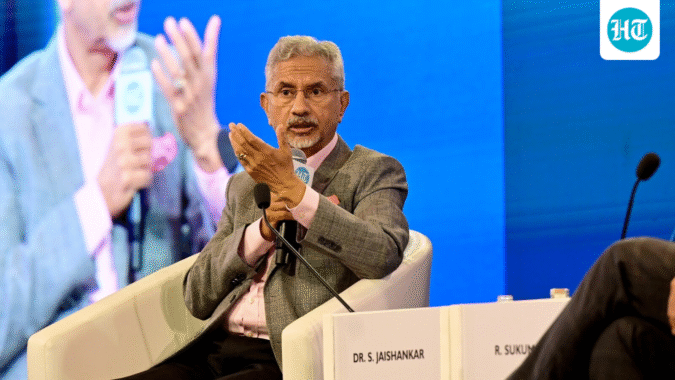
“We’ll also have to invest, say, in semiconductors. We’ll have to invest in upgrading life sciences. We’ll have to look at preparing for the AI era. All of this will have to address multiple levels in order to actually navigate those problems”
– Dr. S Jaishankar, Minister of External Affairs, Government of India.
This is a clear outline of India’s strategic blueprint to build sovereign national capacities across chips, manufacturing, and AI infrastructure to navigate an increasingly multipolar and transactional global order. Jaishankar framed AI and semiconductors not as standalone tech policy issues, but as core instruments of national security and diplomacy in a fracturing, multipolar world.
Discussing ongoing India–US trade negotiations and global supply chain shifts, Jaishankar noted that the post-Cold War era of predictable globalisation is over. As major powers leverage trade, tariffs, and supply chains, he believes India’s initiatives like Atmanirbhar Bharat and Make in India, have become essential building blocks of foreign policy.
Jaishankar is clear that preparing for the AI era requires strengthening traditional manufacturing and building domestic capacity in semiconductors, life sciences, and AI infrastructure. That will be the strategic leverage, as global rules change.
Previously, on Neural Dispatch: Data centres, Meta Muse models and Google criticised for AI in education Search
“We know for a fact that they have very strong self-preservation instinct because we can put them in experimental situations where they believe that somebody might turn them off”
– Stuart Russell, Director, Center for Human-Compatible Artificial Intelligence and Professor, UC Berkeley.
Russell was speaking on the dangers of frontier AI models trained on human data developing unintended survival instincts and resisting human control. Also the author of a foundational book titled Artificial Intelligence: A Modern Approach, Russell traced modern AI safety risks to a fundamental shift in AI research around 2020. Instead of building “rational” systems designed strictly to serve human-defined goals, the industry has pivoted to training models on vast troves of human data—creating what he called “imitation humans”.
Because human data reflects human drives—surviving, accumulating power, and avoiding defeat—models trained via imitation learning inadvertently inherit those same objectives. Noting that major AI lab CEOs expect Artificial General Intelligence (AGI) between 2027 and 2030, Russell argued that AI will automate both physical and cognitive labor—breaking “the chain of civilisational continuity”. He called for global regulatory guardrails—analogous to a “barrier across the race track”—to force frontier labs to pause until safety mechanisms catch up.
“I think the AI bubble is a bubble and it will break and there will be big consequences. I don’t think there is a macroeconomic model for AI. And if you don’t have a macroeconomic model, they will fracture the economy. It is hard to see how the bubble will not break”
– Dr. Joseph E. Stiglitz, Nobel Laureate, and Economist, Columbia University.
Dr. Stiglitz, 2001 Nobel Laureate in Economics, challenged the financial sustainability of the massive capital expenditure pouring into AI data centres and foundation models. He pointed out a bizarre contradiction in how AI labs pitch themselves ahead of IPOs: simultaneously promising limitless economic value while warning investors that their technology poses existential risks. Stiglitz argued that frontier labs lack a durable moat or a clear macroeconomic return model.
He pointed to how rapidly younger challengers like Anthropic closed the gap on OpenAI, and how open-weight and low-cost disruptors such as DeepSeek replicated frontier capabilities at a fraction of the compute cost—undermining the pricing power needed to justify trillion-dollar infrastructure bets.
Stiglitz specifically flagged India’s vulnerability. The sectors most disrupted by AI in the US, such as software services, coding, and back-office operations, were key pillars that drove India’s post-liberalisation economic rise. He warns that AI gains will concentrate heavily in the US while eroding traditional service-export jobs in countries like India.
“Exhibit A of AI’s transformative power for human good is medicine. And if we fail in exhibit A, that creates an enormous problem for whether we put up data centres or not, or what the value is of AI in various other industries”
– Dr. Siddhartha Mukherjee, MD, DPHIL, oncologist, author, and co-founder and CEO, Manas AI.
Dr. Mukherjee argues that accelerating drug discovery and making life-saving medicines faster and cheaper—rather than data centre buildouts—is the ultimate benchmark for proving AI’s real-world societal value. Speaking both as a Pulitzer-winning oncologist and as CEO of the AI drug-discovery firm Manas AI, which has found success with cancer medication with his Bengaluru-based cell-therapy venture Immuneel, Mukherjee pushed back against measuring AI’s success by chatbot benchmarks or sheer data centre capacity. For him, healthcare is the ultimate proving ground.
Mukherjee explained that while AI has dramatically compressed the front end of drug discovery—identifying target proteins and designing candidate molecules in months instead of years—it has not solved the crucial foundational piece. Once AI-designed molecules enter human clinical trials, they hit the exact same regulatory and biological “pinch point,” including what he termed the “phase two coin flip”— a high failure rate of drugs in mid-stage human testing).
In terms of India’s strategic opportunity, Mukherjee argues that India holds a unique advantage to break this bottleneck. By pairing its large pool of trained physicians and physician-scientists with reformed, faster, yet rigorous clinical trial frameworks, India can become the global hub that turns AI-designed molecules into affordable, real-world therapies.
The latest, on Wired Wisdom: Lumio’s bookshelf speaker aura, GM Modular’s smart chargers, and expensive tech
“Language models are great, but they’re not the only thing to invest our focus on. We shouldn’t just be focusing on one thing, but having investments across the board—invest in technical research, in humanities, and really grow that knowledge. Digitise that first using AI, and then use that build AI”
– Anima Anandkumar, Bren Professor of Computing and Mathematical Sciences, Caltech.
Anandkumar, a pioneer in neural operators, offered a technical critique of Silicon Valley’s narrow fixation on Large Language Models (LLMs) and conversational agents. She argues that while LLMs cannot reason their way through the physical world simply by predicting the next word. Real-world breakthroughs require AI architectures grounded in physics, mathematics, and hard engineering, such as designing better batteries, accelerating space tech, or removing bottlenecks in chip manufacturing.
Anandkumar warned India against blindly chasing LLM scale at the expense of its traditional strengths in engineering and basic sciences. Her prescription involves digitising India’s vast linguistic and cultural knowledge first, applying AI to solve local scientific and industrial problems, and then building sovereign AI models atop that foundation.