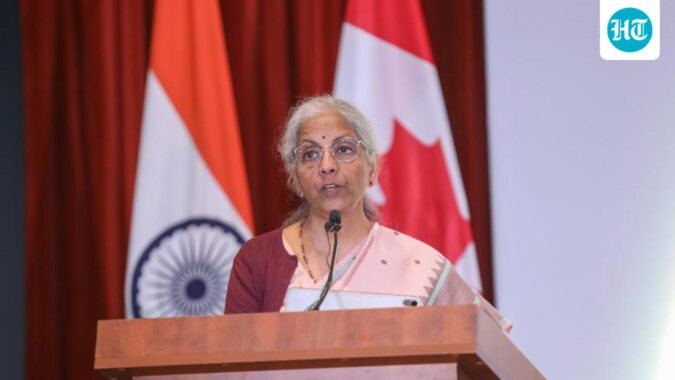
Global growth will be led by countries like India, which does not pose any concentration risk as it is against the weaponisation of the economy, Union finance minister Nirmala Sitharaman said in Toronto, the comment coming even as Canada aggressively seeks reliable economic partners amidst its ongoing trade war with the US.
Replying to a specific question – what commitment Canadian investors and business leaders could expect from India at the moment of global uncertainties – Sitharaman said: “The commitment from the Government of India is, we want you all to come and engage with India. And, when we say that, we know from our side, we will have to… respond to expectations.”
“I mentioned about the concentration risk. We don’t want to become captive to somebody’s weaponising their investments or weaponising the economy. India never had that kind of approach to business,” she added.
Sitharaman said India’s Prime Minister Narendra Modi has embarked on the daunting task of building a developed India by 2047. According to the finance minister, India could have achieved the goal in due course after its Independence, but adoption of a “command and control” approach and “license, quota and permits” acted as roadblocks for nearly 60 years.
The country did open up in 1991, she added, referring to liberalisation under then PM Narasimha Rao, but it was done under compulsion and could not provide the requisite momentum to the economy. India “gained that momentum” after 2014, she said. Post-Covid, India also became the world’s fastest-growing major economy, she said.
Sitharaman said global investors must take interest in India because of its rapidly growing economy with sustained consumption and massive demand.
Sitharaman’s comments came at a time when Canada and the US are locked in a trade war. The Trump administration imposed 50% universal tariffs on about $20 billion Canadian exports, prompting Ottawa to retaliate. People aware of the development said Canada is keen to have deeper economic cooperation with rule-abiding countries like India. The same has been reflected in the Canadian department of finance statement issued on August 21, they added, asking for anonymity.
“In a rapidly changing world, Canada is focused on what we can control. We are building our economic strength at home and diversifying our partnerships abroad,” the statement said with reference to the Indian finance minister’s visit to Canada. “To advance these efforts, the Honourable François-Philippe Champagne, Minister of Finance and National Revenue, will host the Honourable Nirmala Sitharaman, India’s Minister of Finance and Corporate Affairs, to Canada on August 26 and 27,” it added.
As the world’s fastest-growing major economy, India presents extraordinary opportunities. With a population of 1.4 billion, its energy demand is increasing faster than anywhere else in the world, it said. “Its economy is scaling in the very areas that define Canada’s strengths: energy, agriculture, critical minerals, artificial intelligence, and advanced manufacturing,” it added.
Canada and India have had an historically strong, productive relationship, it said. “In 2024, total direct and indirect Canadian investment in India surpassed $110 billion. As both countries embark on parallel missions to build and transform our respective economies and diversify key supply chains, we are forging ahead in this partnership to leverage each other’s strengths and ambition,” the statement said.