How Trump’s Tariffs Really ‘Work’

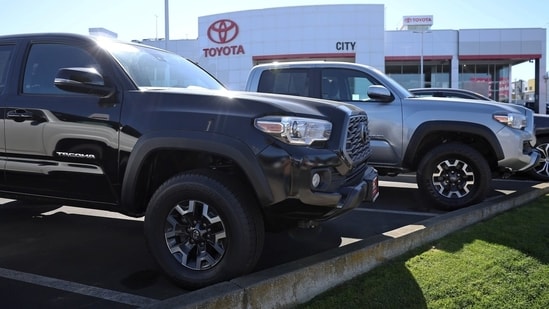
DALY CITY, CALIFORNIA - FEBRUARY 28: Toyota Tacoma trucks are displayed on the sales lot at City Toyota on February 28, 2024 in Daly City, California. Toyota announced plans to recall nearly 381,000 Toyota Tacoma pickup trucks due to an issue with parts falling off the rear axle that could result in a crash. (Photo by Justin Sullivan/Getty Images)


President Trump is grasping for good economic news to rescue his underwater job approval rating. So it’s not surprising that he’s hailing Toyota’s announcement Tuesday that it will expand truck production in Texas. This is a deflection from the dismal reality that his border taxes are raising costs and have failed to usher in a manufacturing renaissance.

DALY CITY, CALIFORNIA – FEBRUARY 28: Toyota Tacoma trucks are displayed on the sales lot at City Toyota on February 28, 2024 in Daly City, California. Toyota announced plans to recall nearly 381,000 Toyota Tacoma pickup trucks due to an issue with parts falling off the rear axle that could result in a crash. (Photo by Justin Sullivan/Getty Images)

Toyota said it plans to invest $3.6 billion adding a second assembly line at a new San Antonio facility to produce its Tacoma truck and will create 2,000 jobs. The Japanese auto maker currently produces the Tacoma in Texas and Mexico, so it will be shifting production from south of the border.

Music to Mr. Trump’s protectionist ears. “Toyota is moving from Mexico to the United States (Texas!). A really big deal. Tariffs at work!” the President wrote on social media. Sorry to curb the enthusiasm, but Toyota may have made the decision for business reasons unrelated to his tariffs.

The Japanese car maker’s press release lavished praise on Texas’s pro-business environment and included statements from the state’s political leaders (Attorney General Ken Paxton excepted). No mention of Mr. Trump or his tariffs. Toyota says the new plant will provide “flexibility” from “advanced manufacturing technologies,” which may offset the relatively higher labor costs in Texas.

But the President is right that his tariffs are at work—in destroying U.S. jobs and raising prices. The U.S. has lost some 75,000 manufacturing jobs since January 2025, including 25,900 in motor vehicle and parts production. Manufacturing jobs have been declining since early 2023, so not all of these job losses stem from Mr. Trump’s border taxes. Some auto job losses are probably an overhang from the electric-vehicle fiasco.

Still, there’s no question his tariffs are raising costs for U.S. manufacturers. At the same time, foreign retaliation has hurt America’s farmers and depressed purchases of agriculture equipment. A slowdown in trade has also dented demand for semi-trucks.

Mr. Trump’s Section 232 national security tariffs on autos and parts have cost $35.2 billion through April of this year, and his steel and aluminum tariffs another $17.5 billion, according to U.S. government data. Mr. Trump and his advisers claim that foreigners pay his border taxes, but the evidence shows that U.S. companies, workers and consumers are picking up most of the tab.

The Anderson Economic Group estimates that auto tariffs on Canada and Mexico alone added about $1,600 to the cost of each car made in the U.S. last year. While auto makers absorbed some of the Trump tariff costs, they also passed on a large share to customers.

A March report by Cox Automotive found that tariffs drove a 10.4% increase in the average suggested retail price of a new car. Sticker prices rose by an estimated $5,000 to $8,900 for imported vehicles and about $1,600 to $2,000 for U.S.-made cars. Auto dealers—most of which are small businesses—absorbed about 4.5% of the manufacturer’s price increase.

Dealers have shed 6,100 jobs since Mr. Trump became President. Cause and effect? Manufacturers have also added fees to avoid raising base prices. Cox says GM and Ford charge “destination fees” of $2,795 for full-size trucks and SUVs. GM has increased such fees by 40% (about $800) on its Chevrolet Silverado. Call it the Trump tax.

Auto makers have also reduced imports, and in some cases discontinued sales, of entry-level models because the tariff costs render them unaffordable. One result is that younger and middle-class Americans are struggling to afford new cars, especially on the heels of the Biden inflation.

Many are driving clunkers for longer—and paying more for repairs if they break down—or buying used cars. New vehicle sales have averaged 15.9 million in the first half of this year, down from the 17 to 18 million in the five years before the pandemic. When people buy fewer cars, auto makers don’t need as many workers.

The uncertainty hanging over the extension of the U.S.-Mexico-Canada trade agreement is delaying some investments since businesses don’t know what the trade rules or tariffs will be in a few years—or even tomorrow with Mr. Trump. His trade oscillations and border taxes are a major reason the economy hasn’t performed as well as during his first term, and why Americans are so unhappy.


Source link

Leave a Reply

Your email address will not be published. Required fields are marked *