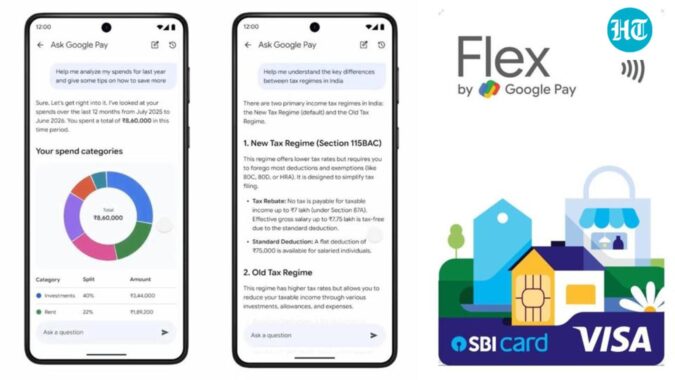
Google India is embarking on a journey underlining the intersection of artificial intelligence (AI) and personal finance, something no other standalone digital payments and UPI (unified payments interface) app has embarked on so far. Google Pay app in India is now integrating ‘Ask Google Pay’, which uses Google’s Gemini models with an intention to navigate a user through personalised financial advice, spend analysis or wealth guidance. Alongside, the Google Pay Flex co-branded credit card now adds SBI Cards as a partner, with a fully digital card accessible on RuPay and Visa card networks.
“The idea is that we want to bring the power of what we’ve done with Gemini in the general purpose outside world to the world of money. As you can understand, that brings with it a lot of sensitivities,” says Sharath Bulusu, Senior Director – Product Management, Google Pay, in an exclusive conversation with HT.
For Google Pay, how this AI layer was delivered to users, was a matter of extensive deliberation. “That is why instead of going the other way where we said, ‘hey how do we bring the context that Google Pay knows about you to Gemini’, we said ‘what if we could take the models and bring them to Google Pay.’ So then what happens is the data, your settings, everything stays within the world of Google Pay where a user understands the choices you’ve made with respect to money and gets to leverage the power of the model to answer questions,” Bulusu explains.
Google confirms to HT that a user must explicitly opt in for the AI-based ‘Ask Google Pay’ feature. Personalisation will not be turned on by default, and those controls will dictate how a user interacts (or doesn’t interact) with Gemini inside Google Pay. As Bulusu explains, it was important for Google to design this in such a way that Gemini is integrated into a user’s Google Pay experience rather than the context from Google Pay being sent to Gemini which has the world’s context. “It is not meant to answer questions about health or something else,” he says.
Bulusu addresses the uncomfortable question that many have, about money and AI models—how does a certain probabilistic behaviour of AI models work with respect to money and financial advice? “Our goal here is not to replace your formal financial advisory. Our goal here is to help you get educated about money and finances. So the outcome is not to go put money in any specific mutual fund. The goal is to understand that if a user is trying to put money in a mutual fund or into gold or something else, how we can simulate it and see the range of possibilities,” he explains.
All Google Pay users will have access to the full suite of Ask Google Pay functionality and do not require a Google AI Plus, AI Pro or AI Ultra subscription. The new features will retain parity across the Google Pay app on iPhone and Android, except for a couple of fine system permission-related differences such as Android having SMS access but iOS not allowing that directly. “The rest of it, like the general quality of the model, version of the model, or as we update models, we’ll update them on both places,” he says.
Regarding localisation, Google confirms that Ask Google Pay will be available in 10 Indian languages at launch, with more slated to be added in the coming weeks. “It is multimodal, which means it’s not just a wall of text, but a mix of text, images, charts, and a combination of things suitable for explaining financial concepts. It can adjust tonality to the sophistication of the question because you can judge the sophistication of the question that is being asked,” explains Bulusu, pointing out that the model can understand a user’s understanding of finances and explain financial terminology or skip that step depending on that.
A credit card play, and steady restraint
In December, Google made a first move in India’s often complicated credit card ecosystem, wherein users demand high rewards. At the time, the Google Pay Flex credit card journey began with Axis Bank, with a lifetime free credit card issued on the RuPay network. The co-branded partnership now expands to bring SBI Cards into the fold. The Google Pay Flex card that will be issued by SBI Cards will be issued on the RuPay and Visa networks, with an annual fee of ₹500. Bulusu says the joining benefits will more than cover that fee in the first year.
There will be parity between the Google Pay Flex credit cards issued by Axis Bank and SBI Cards in terms of the rewards—one star is earned for every cumulative ₹500 spend on the card, with certain tiers of higher rewards on higher spends in a cycle, and each star is worth a rupee when redeemed. Bulusu agrees that Google, Axis Bank and SBI Cards aren’t chasing headline rewards, though he doesn’t rule out a more rewarding card proposition at some point in the future for the more discerning users.
“Our cards appear to be more modest on day one, but as a result, what we’ve seen is the rewards max-ers and the card max-ers on various forums are somewhat disappointed with the card, but regular users are happy. We are seeing that reflect in average monthly spend on the card, which are very healthy. We’re expecting that trend to continue with the SBI card and now we can reach more people as well,” says Bulusu.
That as a core tenet of the Google Pay Flex credit cards will keep it immune for longer, than many other credit cards in the market at this time—previous months have been dotted by devaluations across the board, with many banks either reducing reward earn or redemption rates, or further eliminating categories on which rewards can be earned. This week, Axis Bank has removed gift cards as a reward earning category across its credit cards.
“There’s no card in the world for which a bank can afford to give away 10% in rewards all the time,” he points out.
Google is extending a 50% discount benefit on the Flex credit card for Google One AI Plus plans for the first year—the Google AI Plus (400GB) that costs ₹4,000 annually, and the Google AI Plus plan (2TB) which costs ₹6,500 per year, will be eligible for the outright discount.
Google’s broader vision with Pay in India
Being the first mover with a responsible implementation of AI in a fintech product is certainly a feat, and Google hopes this proves a key milestone in a journey that helps users achieve more from this platform. For Bulusu, the ultimate goal is to, as he defines it, get Google Pay “to a place where people can say that as a result of having Google Pay in my life, I can manage my finances more confidently.” He however admits it is a very long road, and it is important to gain a user’s confidence by helping them with financial decisions they make.
Some key new partnerships that have dotted Google Pay in the last year or so, include the Google Pay Flex credit cards, the personal loans product with L&T Finance that was announced in August, and the UPI Circle implementation in April that allows users to delegate payments to family members who don’t have their own UPI linked bank accounts. Late last year, Google introduced a real-time safety feature that triggers a warning if a user attempts to make a payment on the platform while a screen sharing app is active on their phone—a common method scammers use to steal money from unsuspecting users.
“We don’t force users to give us access to their credit report as part of signup or anything. Many, many players do that,” Bulusu points out, adding, “Google has generally done well in focussing on a few things at a time and polishing the experience until it becomes flawless. That takes time, energy, a lot of investment. And so that is the reason why Google Pay appears to do fewer things than competitors do, not because our ambition for India is any less. Credit has existed forever, even before computers came along, and it will be there in the future. It’s a basic human need. So I think if we operate out of the fear of missing out because a competitor is launching something, we’ll do a half decent job of it and that’s not a good place to be.”
Google Pay continues to lead a strong duopoly in India’s digital payments share, with a reported 32.8% of the total market share of the transactions (by volume) at the end of June. Together, PhonePe and Google Pay process nearly 79% of all UPI transactions. NPCI’s attempts to cap single app market share at 30% hasn’t yielded results, because rivals including Paytm, Navi, Super Money, BHIM, and Cred follow in the distance.