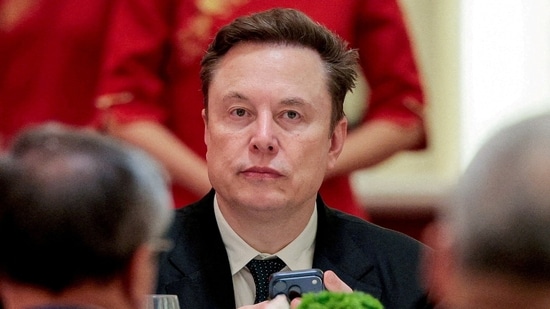
ELON MUSK, in his telling, is a modern-day Cassandra—better than most at predicting the future, but doomed to be disbelieved. “People don’t realise that what I’m saying will come to pass,” he tells The Economist in a 90-minute interview for The Insider , held at a giant Tesla factory in Texas where electric cars drive themselves off the assembly line. That may be because his future-gazing ranges from the unsettling to the downright weird. Mr Musk predicts that, within five years, artificial-intelligence systems may surpass the sum of all human intelligence. Within ten years, robots in the workplace will help usher in an era of such “amazing abundance” that money will become meaningless. And within 20 years, Britain—a country that he has not visited for years—will be engulfed in civil war.
Believe them or not, the predictions of Mr Musk, who last month briefly became the world’s first trillionaire, are worth taking seriously. The driving force behind Tesla and SpaceX, a rocket-maker turned AI conglomerate, is doing more than any entrepreneur to shape the future. His influence—powered by money and feats of engineering genius—stretches from the White House to global trouble spots such as Ukraine. With 240m followers on X, his social-media platform, Mr Musk’s views, especially those that are divisive, have significant repercussions.