
Folding and unfolding an iPhone. It has been a considerable wait, and there is inevitably a lot to unpack from this moment. Apple’s decision to bide its time and spend years refining every element of what is now its first foldable iPhone has sent expectations soaring.
The iPhone Duo is certainly the boldest iPhone in years. I would place it in the same elite category as the iPhone X, launched in 2017. This is designed to be an aspirational iPhone, one that showcases what Apple is capable of today and offers a glimpse of where it is headed. The evolution of iOS 27 for the inner and outer displays is quite something. Apple has even moved away from the rumoured name, iPhone Ultra, in favour of iPhone Duo.
The overall footprint and form factor take some getting used to. You will have to retrain your muscle memory, whether it is the way you pull the phone out of your trouser pocket or the habit of holding it between your ear and shoulder while multitasking. I am referring specifically to its shorter vertical length, a consequence of the passport-style design.
You get the typically exquisite craftsmanship expected of an Apple product. There is a titanium frame, Ceramic Shield on the front and back glass panels, and a precision-engineered hinge that holds the phone at virtually any angle at which you unfold it.
The hinge is exceptionally smooth. As you begin unfolding the iPhone Duo, there is relatively little resistance, which gradually increases as the main foldable display opens out and becomes flatter. This should help protect the screen during everyday use. And, for once, here is a foldable phone that unfolds completely flat, rather than leaving even a barely perceptible gap.
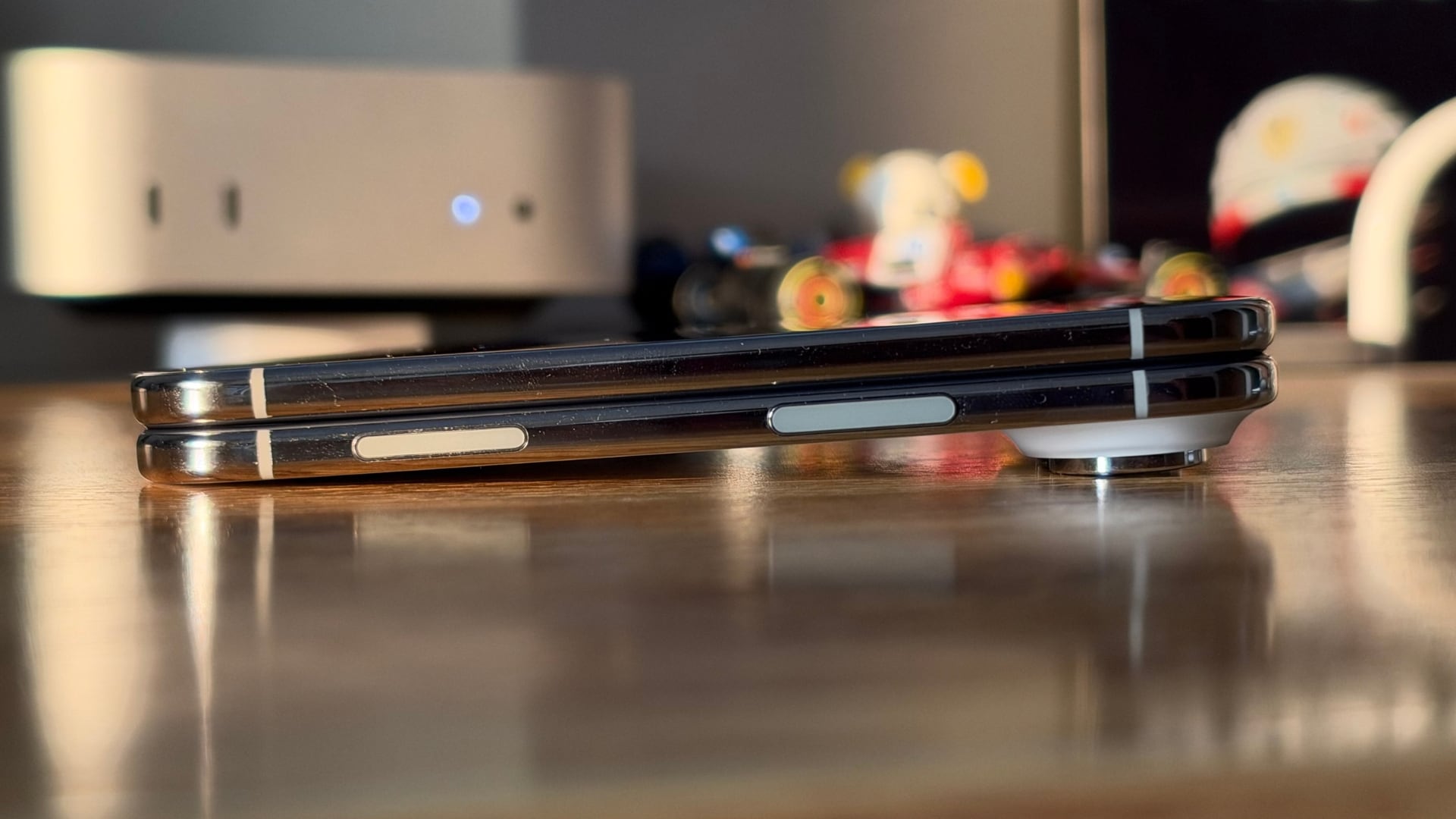
The iPhone Duo is also more pocketable than its form factor might suggest. Apple says the antenna splits are reinforced with ceramic fibre inserts that are three times stronger than the Grade 5 titanium alongside them.
When unfolded, all four corners are rounded, creating the visual symmetry Apple appears to be aiming for. When folded, however, the outer display presents two rounded corners on the right and two right-angled corners on the left, where the hinge sits. Samsung takes a different approach, retaining right-angled corners on all four sides, folded or unfolded, on the Galaxy Z Fold8. Two different approaches to the same design challenge.
This is a first-generation product, something that is easy to forget given the refinement across the board. That, however, does not excuse the areas where the iPhone Duo warrants closer scrutiny. Last year’s iPhone Air, which I had described as a hint of Apple’s future playbook, may well have offered the first clues to the foldable. Look at the camera island and the sculpting of the frame, for instance.
Fusion of perspectives
Since we are on the subject of the camera island, let us talk about the 48-megapixel Fusion main wide camera and the 48-megapixel Fusion ultra-wide camera.
Photography and video recording are excellent, as you would expect from an iPhone. Compared with the Apple iPhone 18 Pro Max, which uses different main and ultra-wide sensors, the iPhone Duo holds its own in daylight, indoors and in low light. That is a testament to Apple’s imaging algorithms.
I set the camera to capture pixel-binned images at 24 megapixels. These retain more detail than 12-megapixel pixel-binned images, making them better suited to editing.
Photographic Styles, now in their third iteration, are fun to experiment with, particularly on the larger 7.6-inch folding display. Smart focus tracking and Dual Preview, which lets subjects see the frame on the outer display, have genuine practical value. I did not need to use Kid Cue, since my child is old enough not to need a visual prompt to hold their attention. For many parents, however, this feature could be invaluable.
That said, the telephoto camera, or rather the lack of one, deserves attention. Not everyone needs a telephoto lens or takes pictures that require significant zoom, but optical zoom can be extremely useful for certain photos and videos, as it is on the iPhone 18 Pro Max.
The iPhone Duo offers 2x optical zoom through its main Fusion camera. Beyond that, up to 10x, the zoom is digitally enhanced. This can work in some situations, but if photography involving distant subjects is a significant part of your usage, it is a compromise you will have to accept.
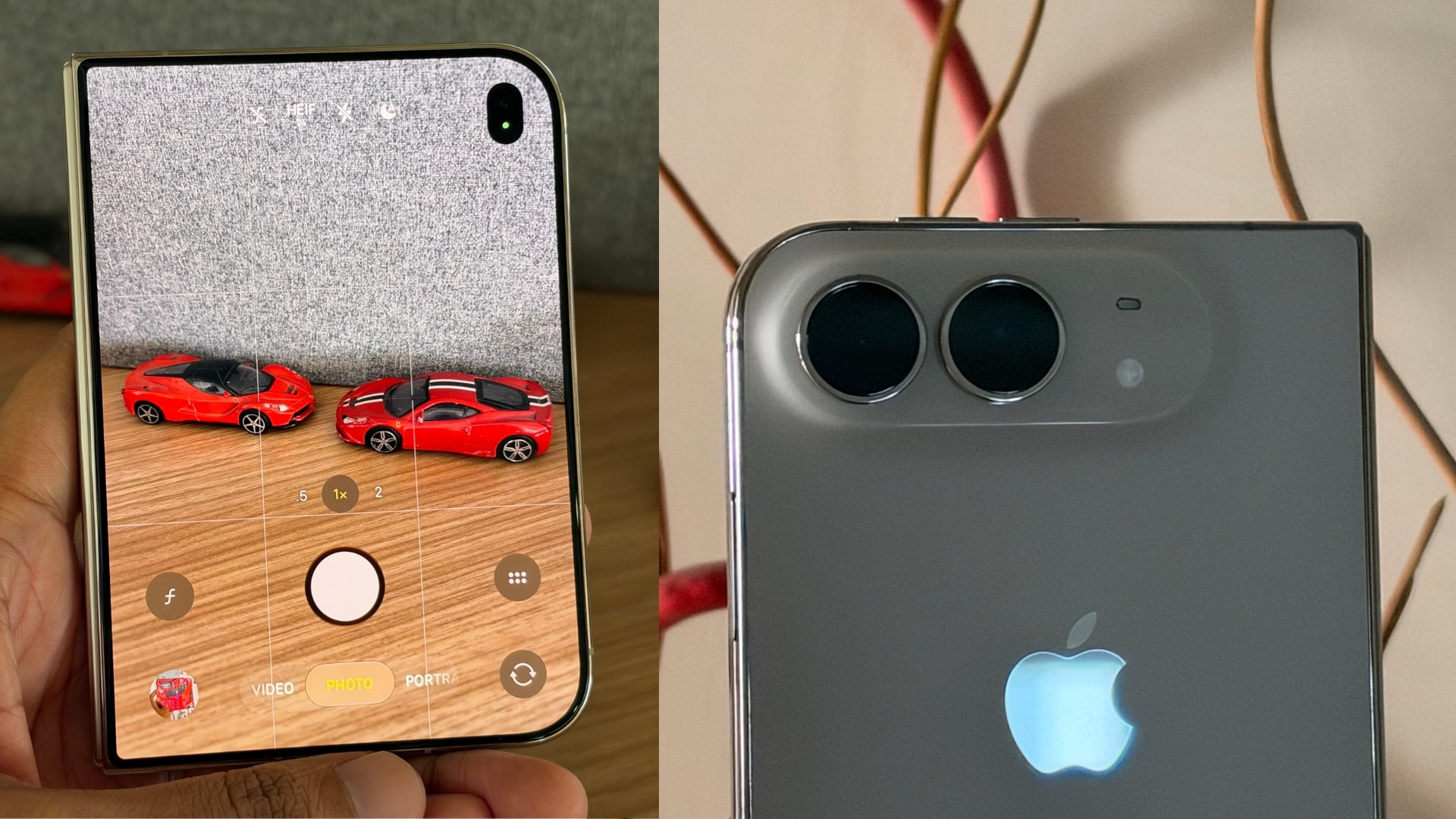
I hope the next-generation iPhone Duo adds a telephoto camera or replaces the ultra-wide camera with one, if space constraints permit only two rear cameras. The primary sensor also offers three focal-length options: 26mm at 1x, 28mm at 1.1x and 35mm at 1.3x. Tap the 1x toggle to switch between them and experiment with different perspectives.
The iPhone Duo has two front-facing FaceTime cameras: one on the outer Super Retina XDR display and another beneath the inner Super Retina XDR display. The outer camera sits within the vertically positioned Dynamic Island. It is a 12-megapixel sensor with Center Stage, which keeps you in the frame during video calls. The camera is positioned towards the top-right corner rather than in the centre.
The camera hidden beneath the foldable screen is another story.
Neither camera supports Face ID, so the iPhone Duo relies exclusively on Touch ID. The fingerprint sensor is integrated into the power button. After a week of using the phone, I still occasionally find myself staring at the screen, wondering why it is not unlocking, before remembering that I need to use the fingerprint sensor.
Hot tip: Disable the Rest Finger to Open setting for faster Touch ID unlocking. It is not as fast as Face ID, but comes close.
Two canvases, real symmetry
Apple’s first foldable iPhone follows what is popularly known as the passport-style design. It offers three distinct ways to use the device: the outer display, the inner foldable display in landscape orientation, and a portrait layout reminiscent of the iPad mini.
iOS 27 does a considerable amount of work behind the scenes to make the two screens, with their different aspect ratios, work seamlessly as apps switch between them. Apple has repositioned interface elements to make better use of the available screen space and keep controls within easier reach.
The dock, for instance, sits vertically on the right, while Control Centre can be accessed from lower down the screen. Users no longer need to stretch their thumbs all the way to the top-right corner.
The passport-style design is a key choice. The inner screen’s landscape orientation is better suited to watching videos in the 16:9 aspect ratio or thereabouts. It is also wider than the book-style foldables such as the Galaxy Z Fold8 Ultra and the Vivo X Fold6. This gives apps that run side by side more room to breathe, making split-screen use more practical.
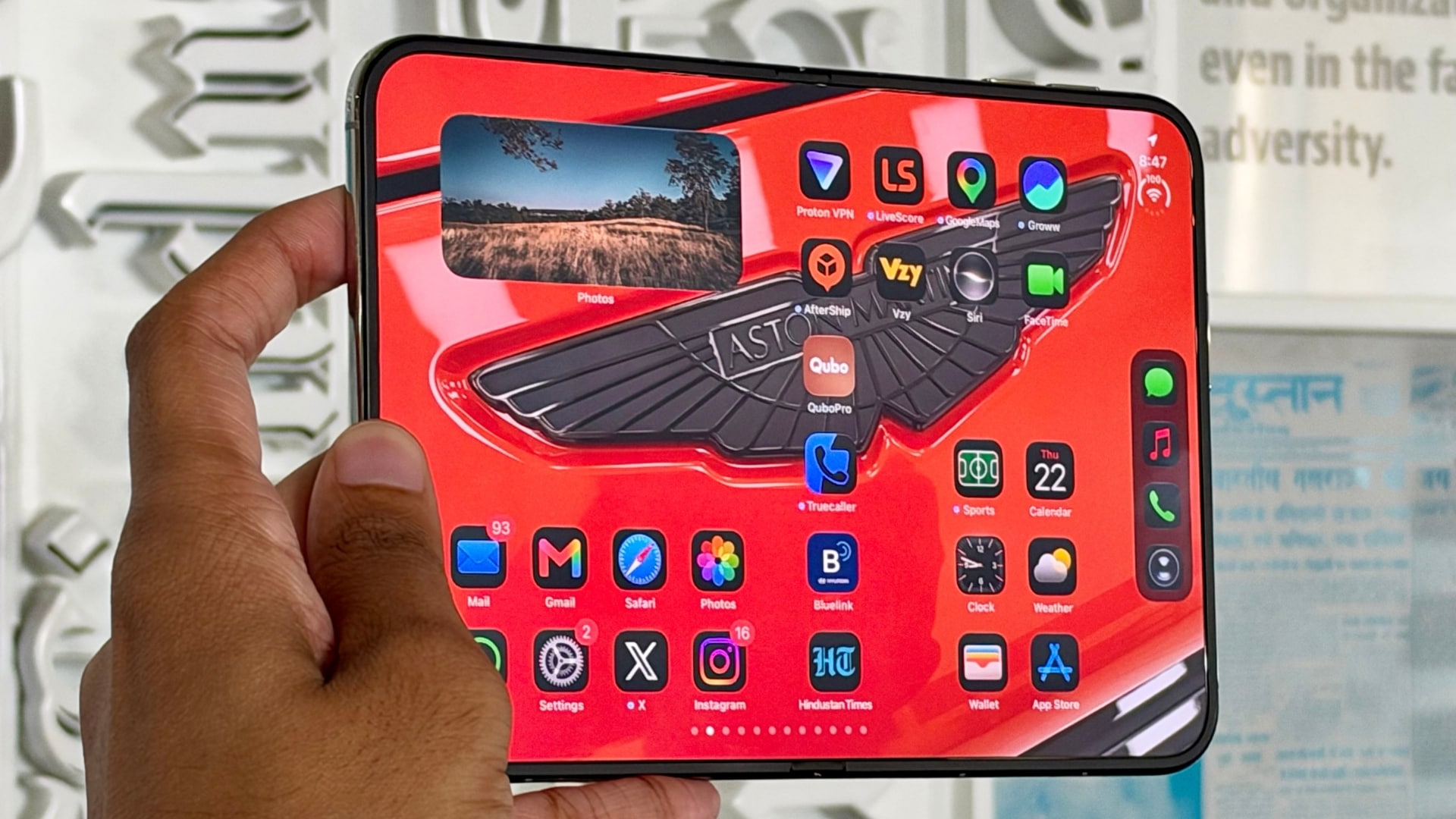
The 7.6-inch inner Super Retina XDR display has a resolution of 2670 x 1878 pixels, higher than the Galaxy Z Fold8’s 2448 x 1848 pixels. Its nano-texture matte coating serves two purposes: it conceals the crease down the middle more effectively than any foldable display I have used so far, and it gives the screen a paper-like appearance while reducing reflections.
Apple has succeeded on both fronts.
The crease is virtually invisible under most viewing conditions. You have to look at the screen from an angle, particularly against a dark background, to make it out. On competing foldables, the crease is often much more noticeable.
My biggest concern with the nano-texture coating is its long-term durability. How well will it withstand daily use, dust particles and the occasional pressure from a fingernail? The coating will face considerably more wear and tear on an iPhone Duo than it might on an iPad Pro. The silver lining is that the cover layer is replaceable, at a cost of ₹5,900.
The 5.4-inch outer Super Retina XDR display has a resolution of 2034 x 1398 pixels, compared with 1972 x 1248 pixels on the Galaxy Z Fold8. It lacks the matte coating but delivers the bright, rich and well-balanced visuals you would expect. It is an inviting introduction to the iPhone Duo before you unfold it and appreciate the larger screen.
The squarer outer display is perfectly usable for many apps. However, the keyboard layout and the positioning of certain interface elements will take some getting used to, even if you are switching from another iPhone.
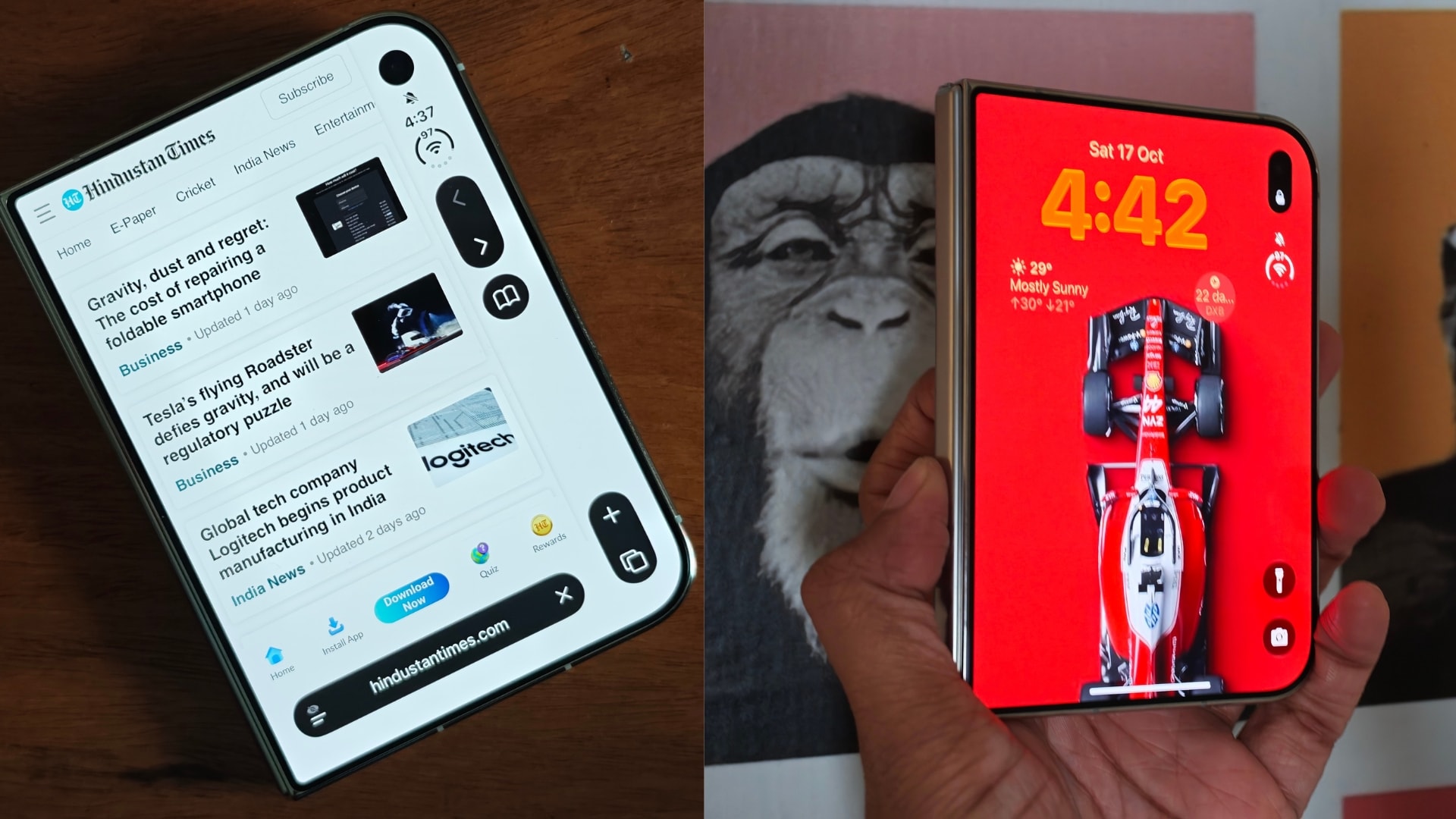
At times, the dock and certain app-specific elements on the right can feel as though they occupy too much space. Safari, for instance, could offer a more immersive browsing experience. Mail could benefit from a floating compose button that leaves more room for the inbox. In Messages, opening the keyboard to type a reply leaves you with, at most, a couple of messages visible in the chat history.
These are largely matters of adjustment. The outer display is certainly not a compromised half-phone, despite what its dimensions might suggest.
The inner display, meanwhile, is fantastic to use. Typing long emails, drafting documents and even working on spreadsheets should be a pleasure.
Both screens follow the same broad approach to aspect ratio: shorter and wider. This is why many interface elements that traditionally sit at the top or bottom of the screen have been moved to the sides, freeing up vertical space.
The trade-off is that buttons are not always where your fingers expect them to be. You will need to retrain your muscle memory, and a few accidental touches are inevitable along the way. That is part of the learning curve.
Performance, battery life and no compromises
The iPhone Duo shares the Apple A20 Pro chip and 12GB of memory with the iPhone 18 Pro series. The chip also appears to be tuned similarly for the foldable.
In synthetic benchmark tests, it significantly outperforms the Qualcomm Snapdragon 8 Elite Gen 5 in single-core and dual-core performance, as well as graphics. It is encouraging to see Apple maintain parity on this fundamental aspect of performance, especially when Android foldables have often lagged behind their conventional flagship counterparts in either camera capabilities or processing power.
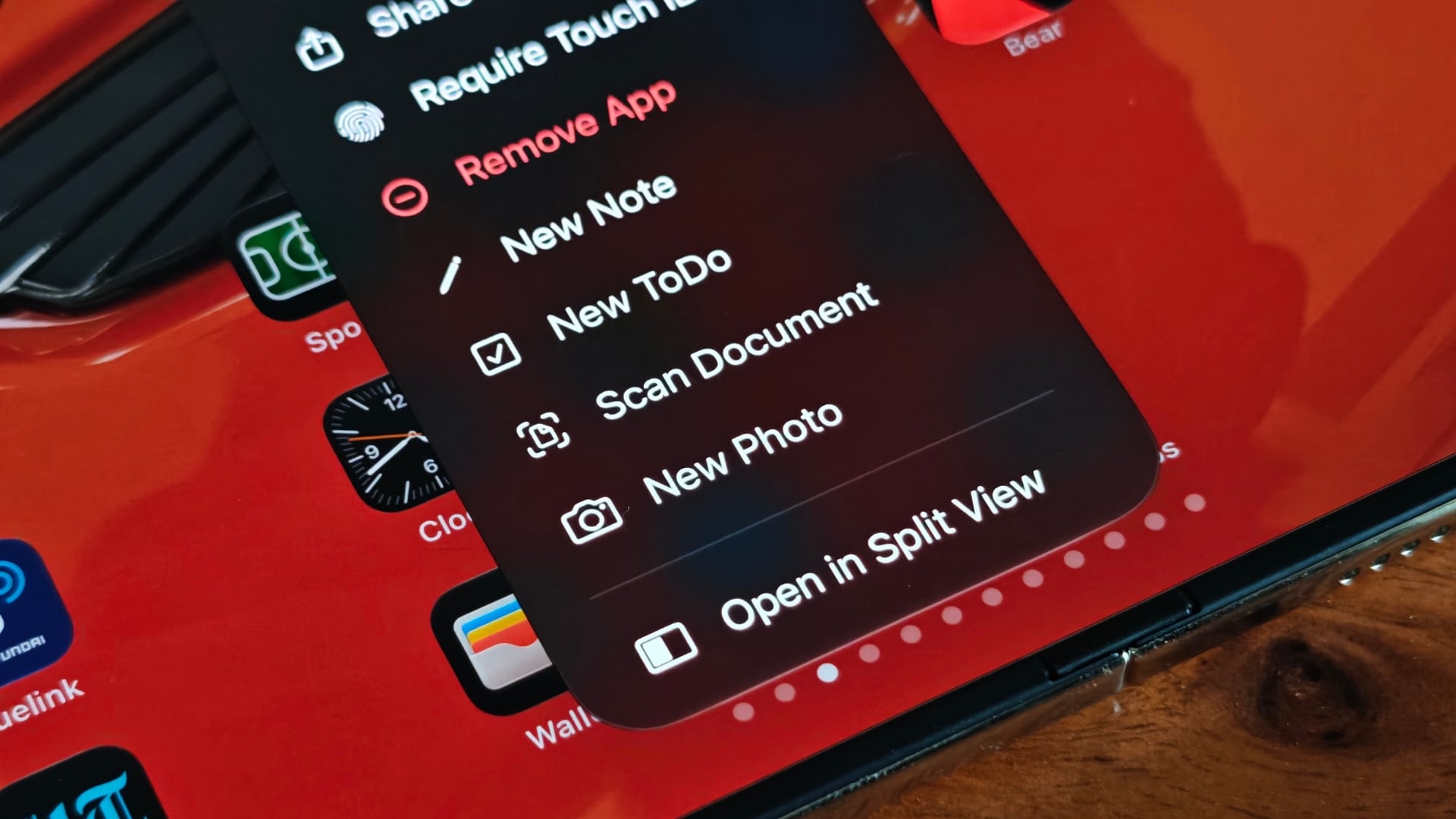
As expected, the hardware and iOS 27 are well optimised to work together. Even apps that have not yet been updated for the iPhone Duo scale well, and performance is not a deterrent.
The iPhone Duo is an eSIM-only device. If you are moving from a physical SIM on an existing iPhone, you can transfer to an eSIM directly during the data transfer process. Alternatively, you can use the apps of Airtel, Reliance Jio or Vi to generate the required QR code.
No operator in India currently supports the iPhone Handoff feature, which allows the same mobile number to work across two iPhones.
Battery life will depend on how you use the iPhone Duo, including how much time you spend on the larger inner display versus the outer screen. The number of pixels illuminated, and for how long, naturally affects consumption.
During my week of testing, the phone averaged around 6.5 hours of active screen time between a full charge and 30% battery remaining, with heavy usage as my primary phone.
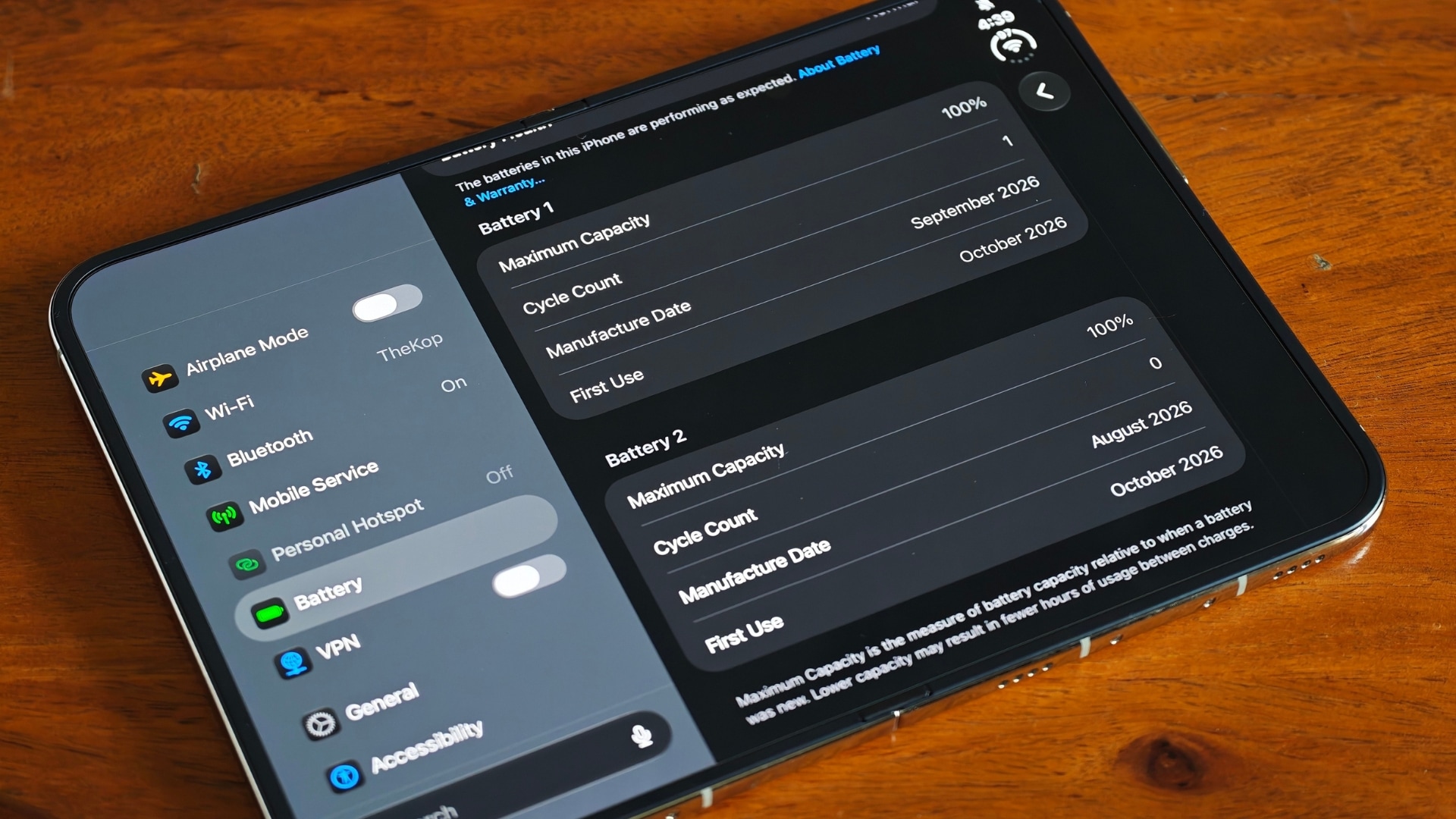
The iPhone Duo uses a split-cell battery architecture, with a primary and a secondary cell combining to offer a capacity of almost 5,000mAh. These are encouraging numbers, particularly because most users should find that the phone gets through a day of heavy use with reasonable ease.
Choices and direction
The wait for a foldable iPhone is finally over. As a complete package, no other foldable quite matches the iPhone Duo. But this is far from an affordable proposition, bringing us back to the original point: this is an aspirational iPhone. Prices in India start at ₹2,99,900, a figure that is not to be taken lightly.
Apple has not simply taken a foldable form factor and installed iOS 27 on it. The company has made a range of software changes, some more visible than others, to make better use of the available display space and improve usability.
This is one of those rare reviews in which I am assessing not just the physical product but also the journey that led to this moment, and the direction Apple might take from here.
The Apple iPhone Duo is the most fun I have had with a foldable phone so far. Android foldables have often leaned towards a more serious approach, attempting to justify the form factor as a category worth paying a premium for. Apple, by contrast, has embarked on its foldable journey with a bold and playful approach.
It is not trying to replace an iPad, nor is it positioning the phone as a substitute for a Mac. That distinction is precisely what makes the iPhone Duo interesting.
The phone has its shortcomings, and that is part of the learning curve for a first-generation product.
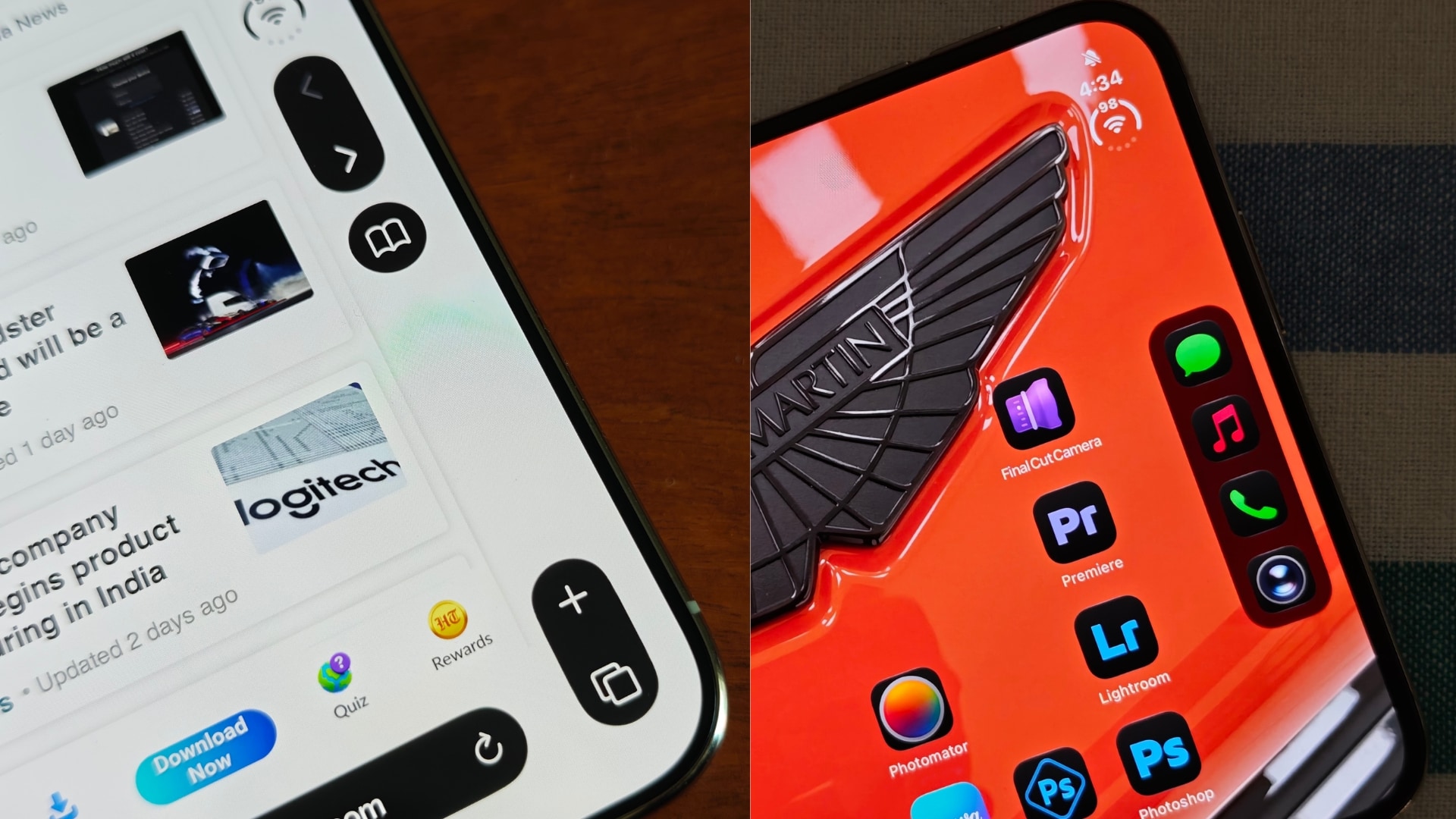
Many third-party apps still need to be optimised for the iPhone Duo’s combination of displays and repositioned interface elements. That is typical of a first-generation product. The phone is also expected to support the Apple Pencil with iOS 27.2, anticipated in about a week’s time.
Ultimately, Apple has made most of the right hardware choices and paired them with software that gives the iPhone Duo a distinct identity. It occupies an interesting space between the iPhone and the iPad mini, offering flexibility without necessarily trying to replicate either device.
The question is whether you can find enough practical utility in that combination to justify carrying it in your pocket, especially at this price.