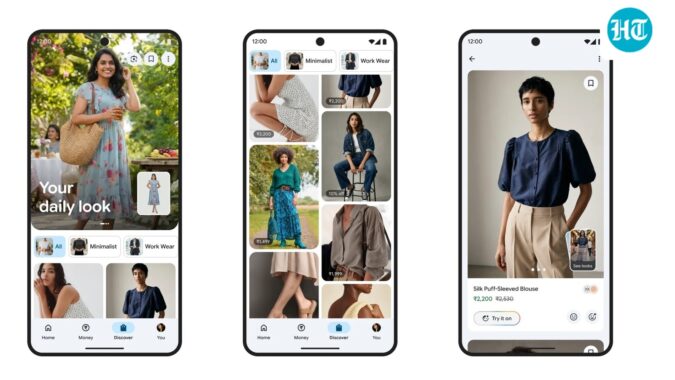
Cognitive warmup. This is interesting. You’d mostly associate Google Pay with digital payments, UPI transactions and if you have the Flex by Google Pay credit card, even more so for bill payments. But Google Pay is adding the discovery of new fashion and style trends as part of the newly added Discover section, alongside Home and Money, to the India app. The personalisation is built on the Gemini models, using the Shopping Graph, visual search and the Virtual Try-On tool—already available to users shopping within the Gemini app—as its foundation.
Google says Shopping Graph now has a database of more than 60 billion products. The idea is to give the user the choice of browsing and searching through pre-curated categories such as Minimalist styles or work wear, or the flexibility of finding similar styles to something you’ve pointed Google Pay to. When you do like a listing, there is a convenient ’Try it on’ option to get a fair sense of how any apparel or clothing item would look on you. There is also the ability to like or downvote a recommendation, to further improve that engine.
“We are beginning to pilot a new personalised fashion and lifestyle experience inside the Google Pay app in India. With this, shoppers will have access to a dedicated space to discover, visualise, and find products and looks tailored to them. The experience is built on the 60+ billion continually updated products in our Shopping Graph, alongside our cutting-edge technologies spanning visual search, virtual try-on, and YouTube videos,” says Sharath Bulusu, Senior Director – Product Management, for Google Pay. This should soon roll out to individual users via an update to the Google Pay app.
Previously, on Neural Dispatch: Claude Code and your Google TV: Vibe coding, and a new lease of life
READ THE RAM ROOM
I was hoping our conversation this week would be on a positive, cheerful note. But then Sam Altman went on a podcast (it’s a fashionable trend with some AI execs, isn’t it) and said something incredibly obnoxious. Yes, more obnoxious than Altman defending AI’s energy requirements by saying humans also consume so much food over a 20-year period of their life to “train” to be a human. Now, after food, he seems to have a problem with having RAM in the computers we use—and that all the RAM should somehow be in his charge. It is quite something when a football club, FC Augsburg takes a dig at you, tweeting “FC Augsburg believes it’s quite terrible to have 17 other Bundesliga clubs sitting on a bunch of the league’s limited supply of points.”
“A lot of people want local inference. And somehow, they assume that the problem is solved now because we are going to have open-source models, we’re going to be able to run them on our computers, and so we’re not going to need all the stuff in the data centre. But from a global allocation perspective, actually, it’s quite terrible to have everybody have a bunch of the world’s limited supply of DRAM sitting in their own computer and being used five percent of the time,” the actual quote from Altman. And herein he managed to (perhaps unknowingly) tell us what the real problem is.
The future of local AI defined by open-source and open-weight models is perhaps the nod to a scenario where AI usage will not be entirely dependent on what AI companies would want to serve up and at whatever cost they deem fit. Enough RAM and computing power in personal computers allows users to run powerful models directly on machines without subscriptions and having to rely on OpenAI or Anthropic or any AI company’s subscription methodology for that matter. Altman may want more RAM for his data centre aspirations (and if suddenly PCs go zero, he’ll probably pay less for those RAM modules), and envisions a centralised AI scenario. Where a handful of AI companies decide which models we access and what subscription and token costs need to be paid for that.
I am old enough to remember that a RAM stick used to be one of the most affordable parts when building a PC (that was a cool thing, at a point in time). Those simple times no longer exist.
The latest, on Wired Wisdom: Smart toys, curious minds and a case for delaying the first phone
A HAIKU FROM SPACE
This is truly an achievement. A few weeks ago, we had a conversation about Google’s Project Suncatcher in our Neural Dispatch edition at the time. Google sent four tensor processing units (TPUs) into space with the primary objective of gathering in-orbit data on how the TPUs handle the physical stress of spaceflight and the radiation and thermal extremes of space. There is good news on that front. The AI hardware powered on, processed a prompt and transmitted a response back to Earth via the satellite it sits aboard.
Google says that during a ground station pass, they uplinked the first prompt to the onboard Gemma 4 open model, asking it to generate a haiku about being in space. As the satellite passed by Svalbard, Norway, the downlinked poem confirmed success. Here’s how the poem goes.
Blue marble below
Data streams in silent grace
Starlight feeds my core. ✨
Google still insists this is a moonshot, an attempt to see whether the aspiration of data centres in space can become a reality. It is still a long road ahead, admits Travis Beals, Senior Director, Paradigms of Intelligence at Google. “Following this initial output, we tested space-themed limericks and telemetry prompts reporting the technical status of the payload systems. Next, we will continue with a series of tests to evaluate how TPUs perform under thermal stress and radiation exposure in orbit. Verifying our TPUs can reliably execute workloads in space paves the way for our next milestone of twin interconnected satellites in 2027,” he says, setting a target to work towards and a milestone that’s waiting to be achieved.
WIELDING THE BRUSH
Another positive from the world of AI this week is the workplace productivity platform Canva’s new vision language model that’s specifically built for design tasks—called Canva Brush. “For years, we’ve been working to make AI feel like a true design partner inside Canva, not something that takes over your work. The first time I used Brush, it finally clicked: super fast, understood what I wanted to change, and kept what I loved intact,” says co-founder and CEO Melanie Perkins.
Canva says Brush understands the design layout, its layers and the attempt to get a particular message across, and contextualises edit options alongside a human working on that design. Be it fixing a line of text or restyling a deck completely or even building from a blank canvas. Canva says Brush is 69% faster with general design editing tasks compared with their previous design agent, and also has a 46% lower cost comparatively.
As for the training process for Brush, Canva explains that it all started with a leading open-weights model, post-trained on real design and editing tasks using a combination of design expertise and anonymised insights from people who opted in to help improve Canva AI. It has been particularly refined in understanding the steps that added up to get a design to the stage it had reached. “We combined post-training with large-scale reinforcement learning, giving the model opportunities to work through complete design and editing tasks, learn from what worked, and continually shape its future behaviour,” they say.
Canva’s Brush model is now available as part of Canva AI to Canva Pro subscribers (this tier is priced at ₹500 per month per user) and the company insists they will widen availability in the coming weeks.