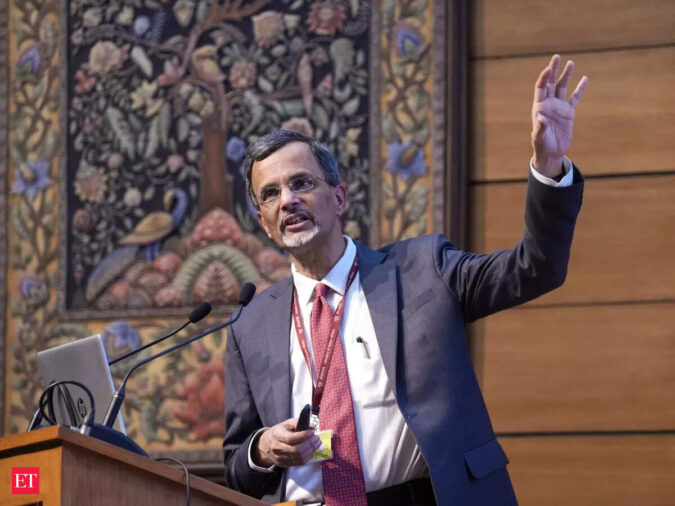
He clarified that the comparison with 1991 was not in terms of a balance of payments crisis, but in the significance of the moment for India’s economic trajectory.
Also read: India only major emerging economy set to reduce debt ratio by 2031, RBI Deputy Governor says
VIDEO | Delhi: 2026 resembles 1991, not in terms of balance of payment crisis, it was an inflection point then, 2025-26 should also be deemed as inflection point; very important inflection point for India right now, says V. Anantha Nageswaran, Chief Economic Advisor.(Full video available on PTI Videos – https://t.co/bIyFWTfmBd)
— Press Trust of India (@PTI_News) October 29, 2026
The global economy has faced a series of disruptions in recent years, including wars and geopolitical conflicts that have affected energy markets, trade flows and supply chains. India’s dependence on imported crude oil adds to its exposure to volatility in international energy prices, while trade-related tensions and disruptions in critical supplies pose further challenges.
“2026 resembles 1991, not in terms of balance of payment crisis. It was an inflection point then. 2025-26 should also be deemed as an inflection point; very important inflection point for India right now,” Nageswaran said, adding that the past six years had witnessed several shocks, with supply-side disruptions being a common factor across them.
“Last six years have seen many shocks with one common element — supply-side shocks,” he said, noting that since the COVID pandemic, followed by the Russia-Ukraine war, and now the war in the Gulf have given rise to the issue of semiconductor chip shortages, and subsequently led to weaponization of some of radars and critical minerals.
Also read: Iran war’s end will be turning point for India, Amundi arm saysHe also highlighted semiconductor chip shortages, tariffs-linked trade retaliation, and vulnerability to crude oil as key hurdles.
Recalling the series of events that have given rise to India being at ‘a critical economic inflection point’, the CEA said, “US President Trump came to office in January last year and initiated a process of tariff as an important trade retaliation measure, but others have also followed suit.”
Speaking on the Middle East war, he said that the conflict has underscored India’s vulnerability, not just with respect to crude oil, but also respect to several other commodities, natural gas, fertilizer, and cooking gas.
The Chief Economic Advisor also mentioned the growing use of artificial intelligence (AI), noting that the techology is “sucking a lot of capital, fresh water and power for data centre build out.”
“So I think the availability of commodities and supplies has become the critical binding constraint for many economies around the world. And now production, more importantly, therefore, behaves like a chain. It is not an additive process; it’s a multiplicative process. So even if one link in the chain goes missing, the production process comes to a halt,” Nageswaran said.