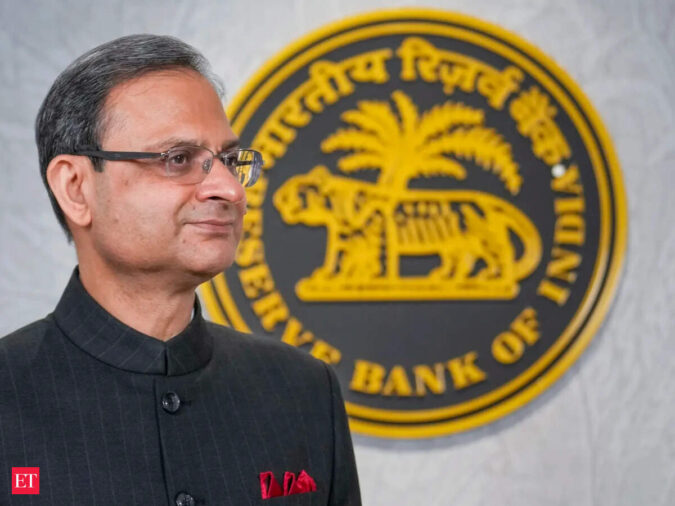
On Wednesday, the RBI raised the repo rate by 25 basis points to 5.50% after 44 months, and with its new “calibrated tightening” stance, borrowing costs could rise further if inflation refuses to cool.
The rate hike was largely expected. But the change in stance is the bigger signal, putting further rate hikes back on the table even as the RBI keeps the timing and extent of any next move open.
Also Read: RBI Inflation FY2026-27: Malhotra & Co raises inflation forecast to 5.2% for FY27
For borrowers and markets, the wording may be as important as the rate hike itself. Ajit Mishra, SVP, Research at Religare Broking, said the stance change was more significant than the rate hike itself.
“The RBI’s 25 bps repo rate hike to 5.50%, coupled with the shift to a calibrated tightening stance, signals a meaningful change in the policy cycle. While the hike itself was largely expected, the change in stance is the more important takeaway, indicating that inflation risks are now taking greater precedence. August CPI at 4.82%, elevated crude prices and weather-related risks have clearly narrowed the room for policy accommodation. Importantly, Q1 FY27 GDP growth at 7.8% suggests that the economy can absorb a modest tightening in financial conditions,” he said.
What the RBI’s calibrated tightening means?
In simple terms, RBI Governor Sanjay Malhotra has clearly signalled that rate cuts are off the table for now. The latest stance marks a clear shift from the neutral stance the RBI had maintained in its previous four policy reviews.The next move can be either a hike or a pause, depending on how inflation and growth scenarios evolve given the global picture. The central bank has not committed to a series of rate increases.
Importantly, there was a 4-2 split on the change in stance. While all six MPC members backed the 25-basis-point repo rate hike, two members, Dr Nagesh Kumar and Prof Ram Singh, wanted the stance to remain neutral instead of moving to calibrated tightening.
The RBI said the duration and extent of any hiking cycle would depend on underlying inflation, how widely price pressures spread, whether supply shocks create second-round effects and how strong demand remains.
Maulik Patel, Head of Research at Equirus Securities, said the change in stance points to further tightening, although he does not expect an aggressive hiking cycle.
“With FY27 GDP growth estimated at 7.1%, the economy has room to absorb tighter policy, and the RBI is right to act as inflation becomes increasingly broad-based. Even after today’s hike, the real policy rate remains negative at around –40 bps, given CPI is projected to average 5.9% over the next two quarters. This points to further tightening ahead. However, we don’t expect it to embark on an aggressive hiking cycle considering elevated yields and liquidity absorption measures, and the central bank will be wary of front-loading hikes into a growth outlook that, while strong, is not immune to external shocks.”
Inflation risks are driving the policy shift
Retail inflation rose to 4.8% in August from 4.5% in July, while core inflation stood at 4.2%. The RBI also noted that the share of CPI items recording inflation above 4% had risen to around 37% in August.
The central bank has raised its FY27 inflation forecast to 5.2%, from 5.1% earlier. It expects inflation at 4.9% in Q2, 6% in Q3 and 5.7% in Q4.
The RBI expects headline inflation to average almost 5.8% over the next three quarters, while core inflation is projected at 4.4% for FY27.
The central bank said monetary policy can limit the second-round effects of supply shocks, such as higher inflation expectations and firms passing higher costs on to consumers. It noted some evidence of elevated inflation expectations and a broadening of inflation, although there are still limited signs that supply-side pressures have become deeply embedded in pricing behaviour.
Growth remains firm, but inflation takes priority
The RBI expects real GDP growth at 7.1% in FY27, after the economy grew 7.8% in the first quarter. It expects growth at 7.2% in Q2, 6.9% in Q3 and 6.8% in Q4, with risks broadly balanced.
The central bank said domestic demand remains resilient, with private consumption, fixed investment, exports and services supporting growth. High-frequency indicators for July and August also showed sustained momentum.
But the RBI flagged risks from global uncertainty, energy and supply-chain pressures, a deficient southwest monsoon and a strong El Niño.
Also Read: RBI GDP Growth 2026: Malhotra & Co raise FY27 GDP forecast to 7.1% from 6.7%
Vikram Chhabra, Senior Economist at 360 ONE Asset, said the policy move showed that inflation was taking precedence over growth concerns.
“The RBI’s 25 bps repo rate hike in the October 2026 policy was the path of least resistance, with the Fed, the ECB and the Bank of Japan all having raised rates within the past month. Equally significant is the shift in stance to ‘calibrated tightening’, which signals that anchoring inflation now takes precedence over supporting growth.”
Chhabra said the decision reflected broadening price pressures and rising upside risks to the inflation outlook. He pointed to the weak monsoon, low reservoir levels and the possibility of elevated energy prices feeding into broader inflation with a lag.
More hikes are now part of the policy outlook
The shift in stance has led economists to expect further tightening, although views differ on how far the RBI will go.
Upasna Bhardwaj, Chief Economist at Kotak Mahindra Bank, said: “The MPC delivered a 25bp rate hike in line with expectations, with a surprise shift in stance towards recalibrated tightening. We continue to see 25-50bp of additional rate hikes going ahead, with further upside if global risks persists.”
Radhika Rao, Senior Economist and Executive Director at DBS Bank, said the stance change reflected the RBI’s focus on preventing inflation risks from becoming entrenched.
“The RBI’s October hike acknowledges that cyclical inflation risks are no longer benign. The change in stance also underscores the RBI MPC’s hawkish intent and is reinforced by upward revisions to growth and inflation forecasts.”
Rao added that the combination of higher inflation forecasts and calibrated tightening should keep front-end rates biased higher.
Chhabra expects another 50 basis points of hikes in the current cycle. “We therefore expect another 50 bps of rate hikes in this cycle,” he said.
Higher borrowing costs could weigh on rate-sensitive sectors
The policy shift also has implications for sectors sensitive to borrowing costs.
Shishir Baijal, International Partner, Chairman and Managing Director, Knight Frank India, said higher rates could create some affordability pressure in real estate, particularly in interest-rate-sensitive and lower-priced segments.
“The RBI’s 25 bps repo rate hike to 5.50% is broadly in line with our expectations, given the challenges posed by weak monsoons, the potential impact of El Niño, heightened geopolitical conditions and global trade and inflationary pressures. The shift to a ‘calibrated tightening’ stance signals that further rate action will remain data dependent,” he said. “For real estate, higher borrowing costs could create some affordability pressures, particularly in interest-rate-sensitive and lower-priced segments, but we do not expect a material disruption to the sector’s broader trajectory in the near future.”
Baijal said the broader real-estate trajectory was unlikely to see a material disruption in the near term, pointing to the RBI’s upward revision of FY27 GDP growth to 7.1% and continued support from private consumption and housing demand.
The RBI has left the door open, not mapped out the whole cycle
The central bank has not specified how many more hikes could follow Wednesday’s move.
Instead, it has said the duration and extent of the hiking cycle will depend on the evolution of underlying inflation, the extent to which price pressures broaden, whether supply shocks produce second-round effects and how demand evolves.
That makes the December 2-4 MPC meeting the next key test for the new stance.
If inflation pressures persist or broaden further, the calibrated tightening stance gives the RBI room to hike again. If pressures ease, the same stance allows it to pause.
For now, the message from the policy is clear: the RBI has moved from a phase where rate cuts were possible to one where the next move can only be a hike or a pause.