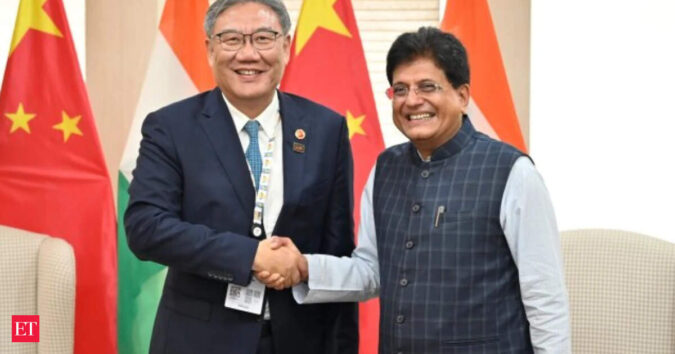
The two leaders, in a bilateral meeting held on Saturday, had agreed to “expand mutually beneficial cooperation in the economic and trade fields, properly address each other’s economic and trade concerns in a balanced manner, and better benefit enterprises and people of both countries,” Spokesperson of Chinese Embassy in India Yu Jing said in post on X.
Also read: Xi-Modi thaw warms up ties at BRICS, but old India-China fault lines remain
The two leaders had a sincere and in-depth exchange of views and reached the important consensus that China and India should be partners.
According to an earlier statement released by Chinese Embassy Spokesperson Xu Feihong, Xi had pointed out that China always approaches and develops its relations with India from a strategic and long-term perspective.
The Chinese president said India and China should view each other as partners rather than rivals, and development opportunities rather than threats, as the two countries seek to place bilateral ties on a steadier footing. He called for an “objective and rational strategic perception” of the relationship, saying both sides should draw on each other’s strengths, support each other and pursue common development.
Xi noted that institutional exchanges between the two countries had gradually resumed over the past two years, while the areas of cooperation had expanded and bilateral trade had reached a new high. He described the progress as having “not come easily” and urged both sides to cherish the current situation.On economic ties, Xi called for development to remain the “greatest common denominator” between the two countries, with greater emphasis on friendly exchanges and mutually beneficial cooperation. He also called for expanding people-to-people exchanges and direct flights to improve public perceptions of bilateral relations, while addressing each other’s economic and trade concerns in a balanced manner.
Also read: Xi Jinping’s five-point BRICS plan puts China’s tech ambitions in spotlight
The Chinese president also linked the future of bilateral ties to progress on the boundary question, calling for “mutual respect and mutual understanding” to resolve irritants. Both sides should pursue parallel and mutually reinforcing progress on the relationship and boundary talks while maintaining peace and tranquillity in border areas, he said.
On the broader global role of India and China, Xi called for greater coordination in multilateral forums, including BRICS, the United Nations, the Shanghai Cooperation Organisation and the G20. He urged the two countries to support each other’s BRICS chairships, work together to address global challenges and uphold what he described as international fairness and justice.
He also framed closer India-China cooperation in the context of the Global South, saying the two most populous countries and important members of the Global South have a responsibility to contribute to world peace, stability, development and prosperity.
During their conversation on the sidelines of the BRICS Summit 2026, PM Modi conveyed to Xi Jinping that peace and tranquillity along the border remains essential for development of India-China relations, emphasising that existing agreements on border management must be strictly observed.
The prime minister highlighted that both sides must be “guided by three aspects — mutual respect, mutual sensitivity and mutual interest” in the ties.