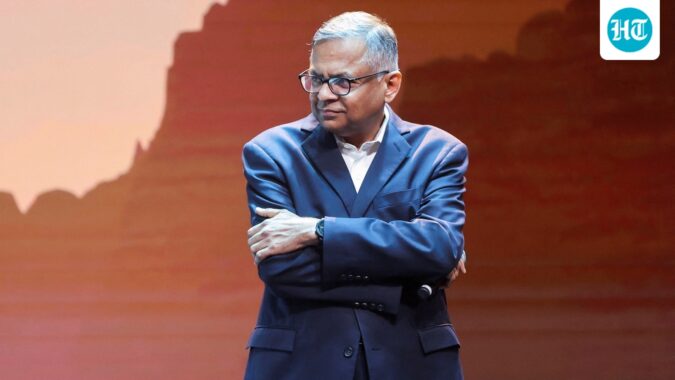
After a 40-year association with the Tata Group, Natarajan Chandrasekaran on Wednesday said he had decided to step down as chairman of Tata Sons when his current term ends, citing lack of unanimous support for his reappointment from the board of the holding company of the salt-to-software conglomerate.
Shares of the group’s listed companies lost $4.5 billion in market value after the announcement. Tata Consultancy Services, slumped 3.9% and was the biggest loser on the Nifty, dragging benchmark indexes lower. Jaguar Land Rover-parent Tata Motors Passenger Vehicles closed down 1.3%, while jeweller Titan and Tata Steel slipped 0.6% and 1.1%, respectively.
Also read: Tata Sons Chairman N Chandrasekaran steps down, says will complete term; firm’s stocks tumble
The decision came days before the Tata Sons annual general meeting, scheduled for 18 August, and caught Tata Trusts chairman Noel Tata and most of the trustees off guard, two executives aware of the development said. Tata Trusts owns 65.9% of Tata Sons.
On Wednesday evening, Chandrasekaran called about two dozen senior Tata Group executives to Starbucks on the ground floor of Bombay House, the corporate headquarters of Tata Sons, according to people aware of the development.
In a 20-minute pep talk, he sought to assuage concerns among employees, telling them that Tata was a revered name with a strong talent pool. He signed off by telling them not to take the interaction as his farewell speech, as he would remain with the Tata Group until February.
Chandrasekaran, who was first appointed chairman of Tata Sons in February 2017, began a second five-year term in 2022. His current term ends on 20 February 2027.
Tata Trusts had agreed in July 2025 to recommend a fresh five-year term for Chandrasekaran. The recommendation was subsequently taken up by the Tata Sons board on 24 February.
However, the proposal was not carried through after Noel Tata sought a clear roadmap for the performance of some of the new businesses launched under Chandrasekaran’s watch, including e-commerce, aviation and semiconductors, according to a person familiar with the matter.
Also read: Chandrasekaran steps down as Tata Sons chairman amid boardroom tussle; stocks tumble
Chandrasekaran cites lack of unanimous board support
In his resignation letter on Wednesday, Chandrasekaran said his decision not to seek another term was linked to the reappointment proposal not receiving unanimous support from the board.
“My current tenure as the Chairman of Tata Sons comes to an end on Feb 20, 2027. Sir Dorabji Tata Trust and Sir Ratan Tata Trust had unanimously resolved and recommended the extension of my next term for a period of five years, which was recorded and recommended by the Tata Sons Nomination and Remuneration Committee and the Board,” Chandrasekaran wrote in his letter.
“Subsequently, the resolution was tabled in the Tata Sons Board on Feb 24, 2026. However, the proposal was not carried through because one of the Board Members did not support it, and in the absence of unanimous support, I chose to defer the decision,” he said.
The Tata Sons board comprises Chandrasekaran, Noel Tata, TVS Motor Company chairman emeritus Venu Srinivasan, Tata Group chief financial officer (CFO) Saurabh Agrawal, and independent directors Harish Manwani and Anita Marangoly George.
The February episode was a rare challenge to Chandrasekaran, who had previously enjoyed the confidence of the Tata Sons board. It also exposed growing differences between the holding company’s board and Tata Trusts.
The two sides continued discussions after the February meeting. Over the past six months, Chandrasekaran and Noel Tata held at least two closed-door meetings to discuss the group’s roadmap, one executive said.
In the last week of June, senior executives from Air India, Tata Electronics and Tata Digital also made presentations to Noel Tata, Chandrasekaran and members of the Tata Sons board, the executive said, adding that the presentations did not resolve Noel Tata’s concerns about the financial performance and longer-term roadmap of the new businesses.
Tata’s new businesses face scrutiny over performance
Tata’s concerns span some of the Group’s biggest bets under Chandrasekaran—from the turnaround of Air India and the creation of an e-commerce platform through Tata Digital to battery manufacturing through Agratas, iPhone assembly for Apple, and semiconductor manufacturing through Tata Electronics.
The four businesses reported a combined loss of ₹29,924 crore in FY26, according to Tata Sons’ annual report. Air India alone reported a loss of ₹22,238 crore, more than double the previous year.
The Tata Trusts have yet to comment on Chandrasekaran’s decision not to seek a renewal.
An email sent to Tata Sons was not immediately answered.
Also read: Tata Sons Chairman N Chandrasekaran steps down, says will complete term; firm’s stocks tumble
The next challenge
Chandrasekaran’s decision not to seek another term now leaves Tata Trusts facing the immediate challenge of finding his successor.
Under Tata Sons’ Articles of Association, the next chairman will be appointed by a five-member selection committee. Three members are jointly nominated by the Sir Dorabji Tata Trust (SDTT) and Sir Ratan Tata Trust (SRTT), one by the Tata Sons board, and one independent member is selected by Tata Sons. The chairman of the selection committee is chosen by SDTT and SRTT from among their three nominees.
SDTT and SRTT own 27.98% and 23.56%, respectively, of Tata Sons. Other Tata trusts own 14.4%, giving the philanthropic entities a combined 65.9% stake in the holding company of the diversified Tata Group. The remaining stakes are owned by the Shapoorji Pallonji Group (18.38%), nine Tata Group companies (12.86%) and seven individuals (2.87%).
Also read: Tata Motors aims for over 20% PV market share by 2030, hints Chairman N Chandrasekaran
Succession process clouded by Tata Trusts dispute
The succession process, however, could be complicated by a separate dispute involving the Tata Trusts. The Maharashtra charity commissioner has prohibited SRTT from taking decisions or holding board meetings, creating uncertainty over the Trust’s ability to participate in Tata Sons’ governance.
The restriction could also affect the Tata Sons AGM scheduled for 18 August. Under section 87 of the Tata Sons Articles of Association, SRTT and SDTT jointly nominate directors representing the majority shareholders who can attend the shareholder meeting.
Since SRTT is currently unable to take decisions, it is unclear how the Tata Trusts will nominate a member for the AGM. If the Trusts are unable to do so, questions could arise over whether the meeting will have the required quorum.
Governance tensions
The governance tensions between Tata Trusts and the Tata Sons board had surfaced earlier as well.
In September 2025, Vijay Singh was removed as a director of Tata Sons after four of the seven trustees opposed his continued nomination by the Trusts. Subsequently, trustee Mehli Mistry’s renewal on the boards of SDTT and SRTT failed to receive unanimous approval.
The differences also spilled into questions over the future structure of Tata Sons. In a surprising turn of events, Venu Srinivasan, a Tata Sons board member and Tata Trusts trustee, advocated listing Tata Sons, a position viewed by some as contrary to the interests of the Tata Trusts.