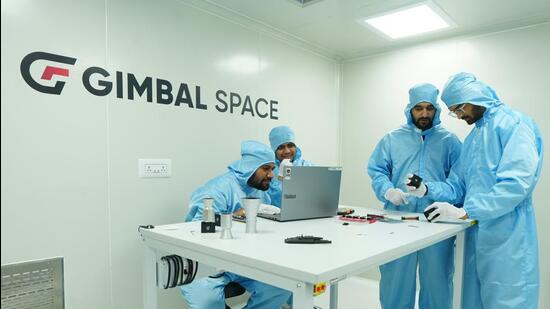
In a three-room lab in North Bengaluru, a small black box of two feet by two feet simulates the space environment. It’s the play lab for Jubin Jacob, Gimbal Space’s optical engineer, who experiments with a star tracker inside it. Jacob’s in his early 20s and this is his first job out of college. The star tracker is a funnel-shaped camera backed by an algorithm. It is the size of a small flowerpot and instructs a spacecraft on which way to point to do its work.
The star tracker looks like a simple design, but has had extensive electrical, mechanical, optical and software work to become something that can map space and instruct a satellite to look at a certain point. “It is one of first India-made star trackers,” says Dhaval Shiyani, founder and chief executive officer, Gimbal Space, excitement palpable in his voice.
Though the star tracker is not yet commercial, Gimbal Space has built a reaction wheel and magnetorquer to sell. All of these three are part of what satellite builders call Attitude Determination and Control System (ADCS), an essential sub-system in space technology that keeps a spacecraft oriented and stable. Somewhat like a steering wheel at its basics or a brain at its most sophisticated, Shiyani tells us. The ADCS instructs a satellite to point its antenna at a ground station, aim its camera at a specific city, or angle its solar panels towards the sun.
Any ADCS system has a combination of hardware and software and Gimbal is building both stacks from scratch. Star trackers are cameras that capture star fields and use them to align the satellite; sun sensors detect the sun, while Earth horizon sensors detect the Earth’s curve to orient a spacecraft. Then there’s magnetorquers that map using Earth’s magnetic field and gyroscopes to track a spacecraft’s angular rotation. The software on board takes input from these sensors, processes it on an in-built ADCS motherboard (which the startup is also building) and instructs the reaction wheels – that are like spinning flywheels – to make the spacecraft turn in a certain direction.
In the mechanical laboratory across from the star tracker room, lie a 3D printer, ultrasonic cleaner and spools of copper wires. On the work table is Gimbal’s new generation magnetorquer which looks like a tiny spool of copper coil. “We are sending out all of these ADCS components on our own satellite in the end of 2026,” explains Shiyani, showing us the startup’s new generation reaction wheel, a compact 300-gram dice-sized cube. After all, in space, weight matters.
Building LEGO blocks for space
Subsystems like ADCS have always been essential to multi-million-dollar instruments spinning in orbit. Legacy players like Lockheed Martin, Airbus and Honeywell build massive, long-lasting, bespoke ADCS systems for large military, government, and deep-space missions.
That’s not the market Gimbal Space is aiming for. The startup’s looking at commercial satellites in Low Earth Orbit (LEO). Instead of massive, expensive geostationary satellites which work for 20-30 years, commercial operators are shifting to cheaper, replaceable SmallSats which are compact, lightweight spacecraft between 50-500kgs and work for around 5-7 years. These satellites are used in the thousands by mega-constellations like SpaceX’s Starlink or Amazon’s Leo.
Gimbal Space is building ready-to-use, low-cost, off-the-shelf ADCS meant for these constellations. “Our aim is an Amazon-like platform for ADCS components which can arrive to your doorstep in a couple of weeks and offer you high-volume components at low cost,” says Shiyani. His team drives the costs down by using industrial hardware that doesn’t need to work beyond seven years so they don’t need to build with hard-to-get, expensive radiation hardware. This makes it cheaper and quicker for them to produce.
“You can just fly new hardware to these constellations very quickly,” he says, adding that their clients are the smaller startups or academics who want to fly a satellite into space, but don’t need expensive ADCS for their work.
Floating in two continents
The glass windows of Gimbal Space’s lab look over a park with tall eucalyptus trees and an open gym where retired Bengalureans swing vigorously. Shiyani, who is from Mumbai, visited Bengaluru in 2024 looking for a second location for his startup and fell in love with this office, perhaps because it was somewhat similar to his office in Silicon Valley, US.
An enthusiastic techie, Shiyani loves science fiction and has always wanted to work on the space frontier. As an aerospace engineer in the USA, he competed in the first Hyperloop competition in 2016 and raised a few hundred dollars. When he couldn’t join SpaceX after graduating because he had Indian citizenship, he worked at Tesla, designing automation on the factory floor for Tesla’s Model 3. From there he moved to Apollo Fusion and then to Astra to work on rockets.
When commercial satellite launch costs started plummeting thanks to SpaceX rideshares, Shiyani noticed that the hardware supply chain in space technology was slow and quite expensive. “If we want to put millions of satellites in space, we can’t do old-fashioned satellite development,” he explains. He quit his job in 2023, bootstrapped Gimbal Space and got a $1.2 million seed round in August 2024. With it, he opened two offices – one in Union City, California, US and one in Bengaluru facing the park. “There’s a lot of scope for industrialisation and re-innovation in this space,” says Shiyani.
Gimbal Space is at around 25 employees right now, some of them contractors, based in both cities. Shiyani, who is 35, calls the company a US-based one with an Indian subsidiary. With indigenous technology and sovereign technology becoming a real challenge to businesses, a two continent legal presence allows Shiyani to be flexible to supply globally, no matter the geopolitical situation or policies. He quickly adds that he wouldn’t work with China. “We will never supply to China, never will, never have,” he explains, surprisingly adamant, saying his global supplies mean to other countries except China.
Being in two continents also helps to get the best of clients, technical expertise, guidance and hardware. For example, though India’s cheaper to do research and development, the US has a more mature used-equipment market to acquire affordable equipment for space technology.
“India’s one of the few countries that can build space hardware to match global demand,” says Shiyani. However, he feels that even his employees in their 20s need encouragement and confidence to know they can redesign and rebuild space technology from scratch. “Everyone’s a human and they build technology with the best of their ability at the time. But tech built one way can easily be bettered,” he says. “Think from first principles, know your field and question everything. That’s how innovation happens.”
Shiyani’s confidence has infected the 20-somethings he has hired straight out of engineering colleges. That’s what’s needed to build a startup that will supply cheap satellite components.
Space industrialisation is here
According to data from Research and Markets, this market is projected to grow from roughly $3.4 billion in 2025 to $8 billion in 2030, a CAGR of 18%. That’s a big market but it’s fast becoming a crowded one. Gimbal Space is one of 150 startups across the world attempting to build components for SmallSats. But they’re confident. After all, space industrialisation, Shiyani tells us, is a given.
One thing Gimbal Space lacks is legacy – proof that their components work well in space. For this, he shows us an ISO-7-compliant clean-room installed in his office, which will hold the startup’s Helmholtz cage. The cage is a laboratory device with electromagnetic coils that simulates zero-gravity magnetic environments of space. Shiyani will build a tiny CubeSat, a satellite of about 2-3 kgs, add components they’ve built and fly them off on a Falcon 9 by the end of the year.
By 2026, Shiyani wants to ready his marketplace that will sell tested battery packs, onboard computers and ADCS components like computers, star trackers, magnetorquer and reaction wheels to satellite startups. In the future, Shiyani wants to offer all aspects of a satellite bus, so an institution or startup that wants to send a satellite in space can order all structural components except their payload and fly it off in a month or so. “This is our mission,” Shiyani says. Globally, except China.