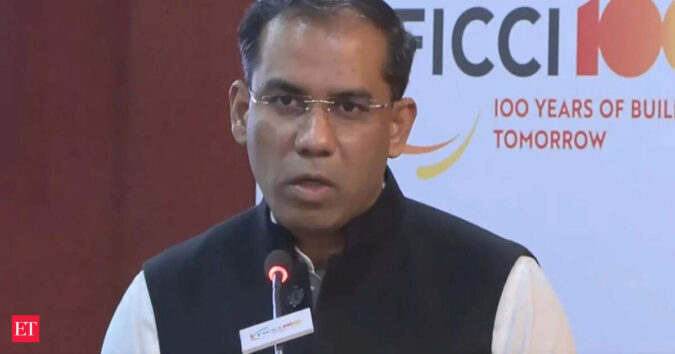
Addressing a stakeholders’ consultation on gig and platform workers at FICCI, Ashutosh Pednekar, Joint Secretary and Director General (Labour Welfare), Ministry of Labour and Employment, said the government is operationalising provisions under the Code on Social Security and setting up dedicated mechanisms for workers in the sector.
“At this point of time, almost about one crore workers are employed here and the potential is to go up to almost 2.5 crores by the end of this decade,” Pednekar said, calling the gig economy a “strategically very important sector” for the country.
He said the government has received approval to operationalise the National Social Security Board for Gig and Platform Workers, which will focus on welfare measures for workers engaged in the sector.
“We are in the process of actually operationalizing the code through our rules and through the various mechanisms like the National Social Security Board for gig and platform workers,” he said.
Pednekar also said a Social Security Fund is being operationalised to finance welfare schemes for gig and platform workers.
Listing the benefits under consideration, he said the government is mandated to ensure protections such as “accidental coverage, old age protection, health benefits, maternity benefits, cash benefits” and support for educational loans and funeral expenses.According to him, the government is currently working on schemes to implement these measures and is consulting fund managers on the framework for delivery.
Pednekar said policymakers are trying to balance workers’ demand for social security with industry concerns over maintaining flexibility in a fast-growing and technology-driven sector.
“There are increasing demands for various kinds of social security measures which have to be taken so that there is adequate protection which is given to them,” he said.
A major part of the government’s strategy is integrating aggregator databases with the e-Shram portal to enable seamless access to welfare benefits.
“You have the databases of the aggregators as well as the e-Shram which will speak to each other,” Pednekar said, adding that the system would allow real-time tracking of benefits availed by workers.
He added that workers would be able to digitally access details of their entitlements and usage through an app-based system.
Drawing a comparison with India’s digital public infrastructure, Pednekar said e-Shram has the potential to transform benefit delivery and improve portability of welfare schemes for workers across platforms.
The Labour Ministry official also urged platform companies to complete integration with the e-Shram portal before June 22, saying the government is working under “very, very tight deadlines” to implement the system.
He said the gig and platform economy has emerged as a major source of employment, especially for India’s youth, and is expected to play a bigger role in the labour market in the coming years.