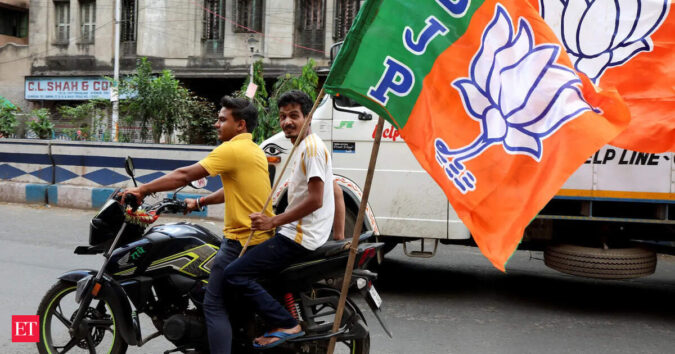
Also Read: How BJP’s well-oiled vote machine breached Mamata’s Bengal fortress
But its win in West Bengal-which has been hit by deindustrialisation and frequent Centre-state rows-remains the most consequential for India’s growth prospects, if the winds of political change lead to a raft of economic reforms, the economists said.
Centre-state ties switching to cordiality from confrontation could bolster the implementation of several growth-supporting and welfare schemes, and draw long-elusive private investors back to Bengal, they said.

Given its long-running, below-par economic performance, the state has greater space to expand faster and aid the national growth rate, they said. Better alignment can streamline tax and other reforms as well at the state level.
“What these elections can change is the economic outlook for Eastern India,” said Sonal Varma, managing director and chief economist, India and Asia ex-Japan, at Nomura. “So far, the southern states and a few of the western states (Gujarat, Maharashtra) have been the economic powerhouses. We could see eastern India gradually become an important driver of India’s overall growth.”Also Read: Mamata Banerjee loses Bhabanipur to Suvendu Adhikari
The BJP’s win marks an expansion of its reach beyond traditional strongholds in the northern and western parts, said Radhika Rao, senior economist and executive director at DBS Bank.
Sectors, including infrastructure, defence, industrial electrification, ports and manufacturing could benefit from this shift, she said.
“Winning parties will be expected to pursue welfare programs as well as growth-oriented policies, while markets will await clarity on concrete changes in the reform framework as well as larger growth strategy,” Rao said.
Eastern India has long faced economic growth and development challenges, said NR Bhanumurthy, director of the Madras School of Economics. “The Bengal result could foster better Centre-state collaboration. This should speed up measures to boost ease of doing business and help invigorate West Bengal’s industrial landscape, which would support the state’s growth,” he said.
Several schemes rolled out by the Centre-especially those for farmers (PM-Kisan), rural employment (MGNREGS), housing (PMAY-G) and healthcare (Ayushman Bharat)–allegedly witnessed brief or faulty implementation in West Bengal, which launched its own programmes in certain instances. The BJP victory may also result in better implementation of some of these schemes, benefiting mainly the poor.
Brightening outlook
Over the medium-term, if the focus shifts to more infrastructure and industrial development-and if West Bengal addresses its investment climate challenges-then big-ticket private investment could start, Nomura’s Varma said.
When the same political party governs both the Centre and a state, it can ease implementation. “But ultimately, the depth and success of reforms depend on how dynamic and adaptive state governments are,” said Sunil K Sinha, professor of economics at the Chandigarh-based Institute for Development and Communication.