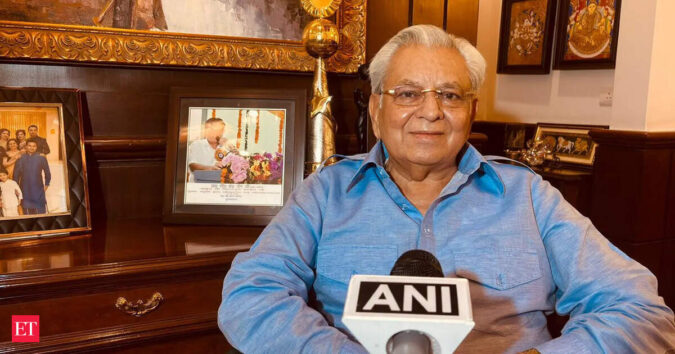
“Our GEMA delegation went to Nepal two days ago. We just heard that Nepal wants to start 10 per cent blending. We suggested that till their domestic industry is set up, they can start taking from India,” Jain said. Countries like Nepal currently lack sufficient feedstock and processing infrastructure, making India a natural supplier in the interim.
Also Read: India proposes new vehicle rules to allow higher ethanol-blended fuels
But the Indian government does not allow export of 1G ethanol as of now. Once these countries come forward, the government may also think of allowing it, he said, adding that “We are working on it to export to SAARC countries so that farmers will get benefited. As much as ethanol is made, rural economy will grow.”
The South Asian Association for Regional Cooperation (SAARC) is a regional intergovernmental organization aims to promote economic, social, and cultural development in its member nations: Afghanistan, Bangladesh, Bhutan, India, Maldives, Nepal, Pakistan, and Sri Lanka.
He added that these combined efforts could significantly reduce India’s dependence on energy imports.
“We cannot replace 100 per cent, but 15-20 per cent import substitution is definitely achievable,” he said, emphasising that agriculture and domestic energy sources will remain central to India’s long-term energy security strategy.On whether ethanol blending benefits like Rs 40,000 crore savings at E20, would increase as India moves to higher blends like E85 and E100, he said, “No, the gains are not proportional. They could rise up to two-and-a-half times, with savings nearing Rs 1 lakh crore at higher blending levels.”
Also Read: Petrol may vanish from your nearby pump, but that would be fine
Jain emphasised that India has the capacity to scale up ethanol production significantly, backed by improvements in agricultural productivity.
However, he noted that India faces pricing challenges in global markets due to relatively higher feedstock costs. Also, the ongoing efforts to improve crop yields and seed quality are expected to bring down costs over time.
Turning to the domestic ethanol programme, Jain said, “E20 means saving Rs 40,000 crore every year in foreign exchange. Out of this, around Rs 40,000-50,000 crore is distributed in the rural economy through grain procurement,” he said.
He added that the proposed transition towards higher ethanol blends such as E85 and E100 would further enhance these gains, although adoption will be gradual.
“You cannot expect that all vehicles will be E85 or E100. There will be a mix–some on E20, some on E50, some on E100. On an average, 40-45 per cent petrol can be replaced,” he said.
Jain said that higher blends will require flex-fuel engines and ecosystem readiness.
“E85 can only be used in flex-fuel vehicles. It cannot be used in current vehicles. It will take time, maybe 2-3 years, as the government is already in discussion with automobile manufacturers and industry bodies,” he said.
On consumer adoption, he said awareness remains a challenge. “Consumers are confused. They don’t know whether mileage loss is due to ethanol or other factors. Technically, ethanol gives 1-2 per cent lower mileage, but the benefits in terms of environment and foreign exchange are significant,” he said.
He further said that pricing will play a critical role in the success of higher ethanol blends.
Giving details on government engagement with the auto industry for launch of flex-fuel vehicles, CK Jain said, “Government is talking to Society of Indian Automobile Manufacturers (SIAM). Government is talking to automobile manufacturers. I am told but not confirmed that they have given a deadline to start introducing flexi-vehicle engines.”