Also Read: West Asia war, rain deficit can hike inflation, drag India’s growth: Finmin
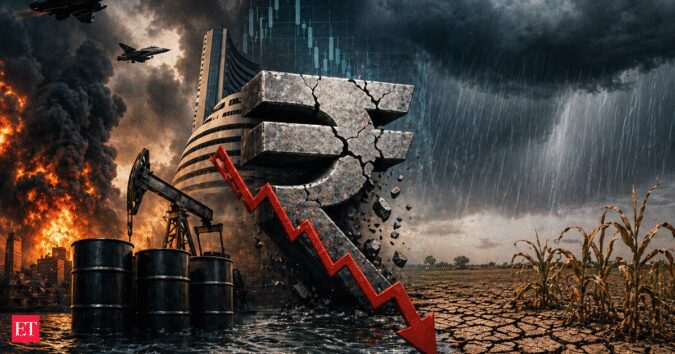
What makes the current moment particularly challenging is not any single shock but their simultaneity. The Iran conflict is driving oil prices higher. Rising oil prices are worsening inflation and the current account. The weakening rupee is amplifying imported inflation. A weak monsoon could push food prices up while dampening demand.
Iran war may resume
Despite the ongoing ceasefire between Iran and the US, big risks loom as talks have failed to yield any results so far. Trump told Axios yesterday he is going to keep Iran under a naval blockade until the regime agrees to a deal that addresses US concerns about its nuclear program. Trump added he saw the blockade as “somewhat more effective than the bombing”.. Axios also reported based on sources that US Central Command (CENTCOM) has prepared a plan for a “short and powerful” wave of strikes on Iran in hopes of breaking the negotiating deadlock. After the strikes, which would likely include infrastructure targets, the US would press the regime to come back to the negotiating table and show more flexibility.”
Also Read: Trump’s team likely planning a ‘short & powerful’ move against Iran
The Finance Ministry’s Monthly Economic Review (MER) places the West Asia conflict at the centre of the current macroeconomic stress. It describes the situation as a supply shock that has already begun to ripple through energy, fertilisers and industrial inputs, raising costs across sectors and weakening trade flows. Disruptions linked to the Strait of Hormuz have increased freight, insurance and logistics costs, sharply hitting exports to key Gulf markets such as the UAE and Saudi Arabia. The ministry warns that if supply disruptions persist, the consequences will extend beyond inflation to wider fiscal and external imbalances. Remittance flows, which are a critical support for India’s external account, may also weaken if labour markets in the Gulf deteriorate. This introduces a second-order risk where external income flows decline even as import costs rise.
The review also highlights a policy dilemma. Governments globally may be tempted to prioritise short-term growth support amid such shocks, but the ministry cautions that this could destabilise inflation, currency and external balances. It stresses that sacrificing long-term macroeconomic stability for immediate relief could set back development goals.
Brent crude touches $126
The most immediate transmission channel of the conflict is crude oil. On Thursday, Brent crude oil touched $126. The MER notes that India’s crude basket has already been elevated, averaging around $113 per barrel in March and nearing $115 through April. With global benchmarks now surging further, the inflationary impulse is intensifying. Higher oil prices are feeding quickly into wholesale inflation, which jumped to 3.88% in March from 2.13% in February, signalling strong cost pressures at the producer level. Retail inflation remains relatively moderate for now, but the ministry emphasises that risks are skewed toward persistent price pressures rather than a quick reversal.
For a net energy importer like India, the implications are broad. Elevated oil prices worsen the current account deficit, strain fiscal balances through higher subsidy burdens and compress household purchasing power. The MER explicitly flags the risk that inflation could rise even as growth slows, a classic stagflationary setup. The oil shock is amplifying upside risks to inflation and downside risks to growth.
Also Read: Crude oil soars 7% to hit highest level since 2022
 ET Online
Rupee tumbles to new low
The fell to a record low on Thursday as investors fretted over the economic risks confronting India from a resurgence in crude oil prices to 2022 highs, threatening the inflation-economic growth balance for the net energy importer and sapping capital flows. The currency fell to 95.3250, down 0.5% on the day, eclipsing its previous all-time low of 95.21 hit in late March.
The weakening rupee adds another layer of vulnerability. As external risks mount and oil import bills rise, pressure on the currency has intensified, pushing it to record lows. The MER links currency stability closely to broader macro fundamentals, warning against policy responses that could undermine external balances. A depreciating rupee increases the domestic cost of imports, especially crude oil, thereby reinforcing inflationary pressures. It also complicates monetary policy, as the central bank must weigh supporting growth against stabilising the currency and containing imported inflation.
The ministry’s emphasis is on maintaining macroeconomic discipline and avoiding short-term fixes that could trigger capital outflows. Investor sentiment is already fragile, and any perception of policy drift could exacerbate the currency slide. At the same time, the report maintains that India’s financial system remains robust, with strong capital adequacy, liquidity and profitability in the banking sector. This resilience provides a buffer, but it does not insulate the economy from external shocks transmitted through capital flows and exchange rates.
The rains risk
The fourth pressure point is the prospect of a below-normal monsoon. India is likely to receive below-normal southwest monsoon rainfall in 2026, with precipitation estimated at 92% of the Long Period Average (LPA), the India Meteorological Department (IMD) has said in its long-range forecast. The MER identifies this as a critical domestic risk that could amplify the external shocks. A weak monsoon typically leads to lower agricultural output, higher food prices and reduced rural incomes.
Also Read: IMD flags below-normal monsoon for 2026
The ministry sees this as part of a dual shock scenario, where weather-related supply constraints coincide with global supply disruptions. This combination could push food inflation higher even as overall demand weakens. Food inflation has already edged up to 3.87% in March, and the trajectory could worsen if rainfall disappoints. Rural demand, which has been a key support for the economy, may soften, affecting consumption and overall growth.
The interaction between monsoon outcomes and inflation is particularly critical for monetary policy. A spike in food prices can limit the central bank’s ability to ease rates even if growth slows, tightening the policy trade-offs further.
Resilience amid turbulence
Despite the convergence of these risks, the MER strikes a cautiously optimistic tone on India’s underlying resilience. It points to strong domestic demand, sustained public investment and a healthy financial system as key stabilisers. The IMF’s upward revision of India’s growth forecast to 6.5% for FY27 reinforces this relative strength. However, the ministry is clear that the risks are asymmetric. Inflation pressures may persist, growth could slow and external balances may deteriorate if the shocks intensify or last longer than expected.
The policy message is one of discipline and strategic focus. Strengthening energy security, avoiding excessive dependence on any single source and continuing to build domestic capacity are seen as essential steps. The review also calls for a broader approach to structural issues such as public transportation to improve energy efficiency and urban liveability.
The MER’s core insight is that the various challenges such as the Iran war, high oil price, weak rupee and below-average rains are interacting, not acting in isolation. Managing them requires balancing short-term stabilisation with long-term growth priorities, a task that becomes harder as uncertainties deepen. India’s economy remains fundamentally strong, but the margin for policy error has narrowed. The coming months will test whether that resilience can withstand a coordinated four-way assault on its macroeconomic stability.