There is a Japanese concept — ma — essentially an empty pause of between notes. While the mere mortals hear emptiness, a practitioner of ma assesses potential to give the music its meaning. Apple seems to be following that strategy with artificial intelligence (AI), though one could argue the pauses between notes are a bit long this time around. For Apple, a new note is about to emerge, with the partnership with Google for Gemini.
“ Advancing AI by collecting huge personal profiles is laziness, not efficiency,” Tim Cook said at a conference in Brussels, earlier this year.
Since November 2022, when OpenAI released ChatGPT for the masses, there has been a rush to build foundational models and AI infrastructure, irrespective of costs. Big tech including Google and Microsoft moved with a frantic energy of a gold rush, to build and ship. Startups bloomed overnight like flowers after rain, but often ephemeral. But where was Apple?
The world believed Apple stalled on the grid, while others had completed half a lap already. But, Apple was watching. Microsoft pumped billions into OpenAI. Google scrambled to embed Gemini into every app possible. Nvidia’s market cap went vertical for a while as Silicon Valley startups fought for H100 chips like they were the last bottles of water in a desert.
A very predator-like behaviour, lurking amidst the tall grass. Traditionally, history has been cruel to those who arrive second. But Apple’s methodology is clear — don’t arrive first, but arrive right. Apple did not invent the MP3 player, but perfected it with the iPod. Apple also didn’t invent the smartphone, but sets an annual benchmark.
Any criticism Apple faced in the past couple of years around AI, is borne from a central misreading of Apple’s competitive psychology—watch the terrain, wait for others to exhaust themselves in the sprint, and then arrive at a considered jog with something that feels like it is simply supposed to be that way. The Apple Watch did not launch until 2015, a good four years after the first Android Wear concepts. But we know what happened then.
The AI chapter is being written in this same hand.
Analysts J.P. Morgan’s 2026 Outlook notes that hyperscalers (Microsoft, Google, Meta, and Amazon) crossed the $1.4 trillion mark in combined R&D and AI infrastructure spending since the ChatGPT boom began. Apple looked at that bill and politely declined. Instead of trying to out-compute Google or OpenAI, or being dependent on other AI companies like Microsoft is to layer Windows, Apple waited for models to become a commodity.
They eventually inked a deal to use Google Gemini for Siri’s heavy lifting for a reported $1 billion a year. The smarter Siri and a more vibrant Apple Intelligence suite, is expected to release anytime in the next few weeks, as part of an iOS update.
“After careful evaluation, Apple determined that Google’s Al technology provides the most capable foundation for Apple Foundation Models and is excited about the innovative new experiences it will unlock for Apple users. Apple Intelligence will continue to run on Apple devices and Private Cloud Compute, while maintaining Apple’s industry-leading privacy standards,” the official statement, from earlier this year.
Apple’s biggest AI advantage is not one model. It is the active user base. It simply will flip the switch with a subsequent update that enables Gemini for almost 2.5 billion (and counting) devices across the iPhone, iPad, Mac and other product lines. That will define user experience. And at that point, many will wonder if it makes sense to par ₹1,900 or so a month to OpenAI or Anthropic for the privilege of an AI chatbot, when the iPhone, iPad or Mac has Gemini for free.
This, while rivals fight to acquire users for their AI assistants one subscription, one app install and one enterprise deal at a time
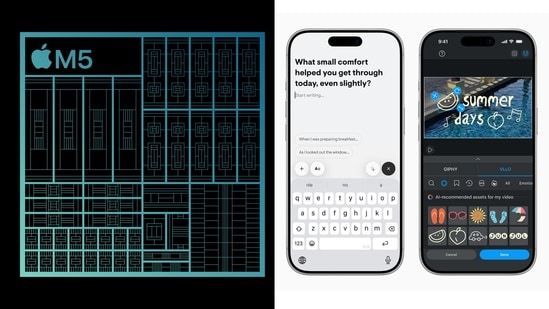
Even as OpenAI struggles to make something cogent of all the ‘AI device’ rumours doing rounds for 12 months now, Apple has released one generation or more of its product lines powered by the chips that the best for AI compute. Every iPhone 17, the affordable MacBook Neo, and every powerful M4/M5 chip powered Mac is effectively an AI computer.
Because Apple designs the silicon, they’ve spent years baking Neural Engines (this part of a chip accelerates AI compute tasks) in chips, even before LLMs were even a household name.
And here’s the long-term cost advantage. Every time you ask ChatGPT, Copilot or Claude a question, it costs them some cents to a dollar to compute on a server somewhere (either rented, or their own after spending billions of dollars). When your iPhone’s Apple Intelligence will summarise an email thread or generate an image, it will cost Apple $0. The compute is paid for by the user when they buy the phone.
The coiled spring will not remain coiled forever. And when it uncoils, it feels natural. That may well be the secret to Apple’s strategy. Widen Apple Intelligence’s scope in ways that feel natural, embedded and purposeful. Ma isn’t silence, it is a preparation for the next note.