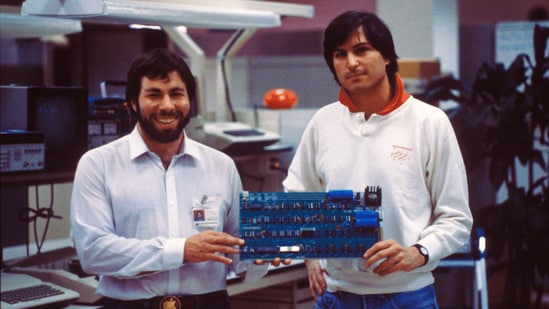
There is something almost too neat about this founding story — a garage in Los Altos, hand-lettered partnership agreement, and the date that reads like a joke. April Fools’ Day, 1976. Steve Jobs, twenty-one. Steve Wozniak, twenty-five. Ronald Wayne, forty, the reluctant elder who drew the original logo and sold his ten percent stake soon after for eight hundred dollars. Three protagonists who set in motion a series of events, which undoubtedly still define the tech we use, 50 years later.
Apple’s way of working has always retained shades of how things began. Not in a flash of corporate strategy decided in a boardroom, no million dollar funding to start off with, but an irrepressible enthusiasm of people who found computers beautiful and couldn’t understand why no one else had made them feel that way. Two college dropouts and an adult voice in the room began a hobbyist’s dream that would fundamentally retool tech for humans. The three complimented each other.
Wozniak was the engineering genius. The Apple I (also called Apple-1 , no relation to the Apple One services subscription) designed by Woz was a masterpiece of elegant design that the industry barely noticed. Jobs was something else. A force of will that turned Wozniak’s brilliance into product, that product into narrative, and in the years after, that narrative into something close to a religion.
Wayne understood, perhaps more clearly than anyone, just how volatile a room it was going to be. That is perhaps the reason he didn’t hang around for too long, though Wozniak has often said that Wayne left after a few months, contrary to a belief that the exit was much sooner. Wayne would later call it the right decision. History has been less certain.
This April marks the 50 year milestone for Apple, and in that time, Apple has succeeded, failed and brick by brick, then built a seemingly unshakable and for other tech companies that attempt to compete, an unattainable fortress for itself. When Tim Cook took over in 2011, skeptics doubted Apple could innovate without Jobs.
“Thinking different has always been at the heart of Apple,” says Apple CEO Tim Cook, in a letter to mark the milestone. Cook’s leadership style was a pivot, to operational brilliance. He didn’t just build products; he built an impenetrable ecosystem in a tough landscape.
“Through every breakthrough, one idea has guided us — that the world is moved forward by people who think different. That’s because progress always begins with someone—an inventor or scientist, a student or storyteller—who imagines a better way, a new idea, a different path. That spirit has guided Apple from the start,” says Tim Cook.
1976—1984: A garage and the counterculture
The early years were defined by Steve Wozniak’s engineering purity and Steve Jobs’ prophetic marketing, and that really set the foundations for Apple.
“I always thought of myself as a humanities person as a kid, but I liked electronics… then I read something that one of my heroes, Edwin Land of Polaroid, said about the importance of people who could stand at the intersection of humanities and sciences, and I decided that’s what I wanted to do,” Jobs once said. Edwin Herbert Land, American scientist and inventor, co-founded the Polaroid company in 1937.
While the Apple I was a circuit board for hobbyists, the Apple II (1977) which followed a year later was the true milestone at its time—the first ‘personal computer’ that didn’t look like industrial equipment. It is believed that during the design stage, Jobs and Woz had an argument about the number of expansion slots—Jobs wanted two, Woz insisted eight was a reasonable number. In the heat of the argument, Wozniak told Jobs to “go get himself another computer”.
They eventually agreed on eight slots, and Apple II went on to be a roaring success. It featured a plastic case and colour graphics, and the first signal that this technology belonged in the living room and office desks, not just the lab. That was succeeded in 1983 by the Apple Lisa, then priced at around $10,000 and commercially not a big success.
Between these two important computing devices, a pivotal moment in the 1980s. Apple went public. The IPO is the largest since Ford in 1956, making hundreds of employees millionaires overnight.
Apple nevertheless started to grow quickly, as an organisation too. This including Jobs convincing Pepsi Cola’s John Sculley to join as Apple’s CEO. Jobs, accounts suggest, asked him, “ Do you want to spend the rest of your life selling sugared water, or do you want a chance to change the world?”
The benchmark was set in 1984 with the Macintosh. In an era of green-text command lines, Apple introduced the Graphical User Interface (GUI). It was a definitive moment that replaced typed code with an interface of folders, trash cans, and a mouse cursor. For Apple at the time, this was a rebellion against the monotony of IBM.
Takes one back to what Jobs had said to the Macintosh development team in 1982, “ It’s more fun to be a pirate than to join the navy.”
Jobs and Sculley’s computing vision was often at odds. Sculley wanted to continue with the model of the Apple II, targeting small businesses, education usage and homes. Jobs wanted Macintosh to compete with IBM, as a business PC.
1985–1997: Wilderness years, and a near collapse
Apple’s success was not linear, and that is where the resilience comes from, something we’ve seen in the past couple of years as Apple held off artificial intelligence (AI) pressure. Some of those tough times were also because the big personalities differed on the choice of direction. Sculley and even Wozniak disagreed with Jobs. Apple had “been going in the wrong direction for the last five years,” Woz is believed to have said at the time, eventually leaving the company and selling his stock.
The respect remains. Wozniak, 75 years, still makes it a point to be part of the iPhone keynote every September—always a memory for those in attendance, alongside him.
Continued internal power struggles led to Steve Jobs’ ousting in 1985. Without its visionary, Apple entered a decade of identity crisis. Not for the lack of trying, but the magic seemingly no longer there. Products like the Newton MessagePad were ahead of their time but failed technically. Alongside, it was proving difficult to convince buyers to splash out for an expensive Macintosh. By 1996, Apple was months away from bankruptcy.
The “struggle” phase taught a vital lesson that Apple holds close even today—engineering without a cohesive vision, is a foundation of irrelevance. For all the allegation of the ‘walled garden’ approach, Apple is at ease the more parts of any sequence are being built in-house.
When Jobs left Apple, he founded NeXT Inc., which made computers and workstations in the years after. The acquisition of Jobs’ company, NeXT, in 1997 wasn’t just a tech buy; it was a soul retrieval for Apple and a homecoming for Jobs. And more importantly, this was a milestone which provided a “Unix-based” foundation for what we now know as macOS and iOS.
1997–2010: The second coming
Jobs’ return ushered in what is perhaps the most prolific era in corporate history. It was clear from the outset that he intended to make up for lost time. And Apple fully intended to create history. The immediate move was to simplify the company’s computing portfolio for the sake of clarity, followed by the iMac G3 in 1998 which proved that computers didn’t have to be beige boxes. The best was yet to come.
In 2001, the iPod digital music player and the iTunes digital music store didn’t just change Apple, it in a way saved the music industry that was otherwise fighting a losing battle to piracy. This tied in with the ‘hub’ strategy, that placed a Mac at the centre for the music player (early iPods needed to connect to a desktop to transfer music). Microsoft and many others tried to compete with the iPod, but failed miserably in execution and distribution.
The iPod portfolio started out with the scroll-wheel iPod (at the time, 5GB and 10GB capacities were considered massive), eventually upgrading to a more refined click-wheel in 2004. Milestones include the iPod Mini (2004), iPod classic (2007), iPod classic inspired iPod nano (2007) alongside the iPod touch which introduced a Safari web browser, YouTube videos and the App Store.
“Design is not just what it looks like and feels like. Design is how it works,” the words of Steve Jobs, in an interview reflecting on the success of the iPod.
The first iPhone in 2007 remains the single most influential consumer electronic device ever made. It effectively marked the physical keyboard with a death target, gave the world the first digital App Store, and turned the internet into a pocket-sized utility. The biggest fallout—Nokia and BlackBerry, set in their ways, could never effectively pivot to the new era.
2011—now: The Tim Cook era
Under Cook’s leadership, Apple has widened focus tremendously. On a visit to India in 2024, Cook emphasised to HT that the environmental goals that the tech giant has set with a 2030 deadline, are non-negotiable. Equally is the focus on education and social initiatives in many countries, including India. Apple, with Cook at the helm, believes in a broader responsibility to the environment and the society.
None of it has taken away any focus from the product portfolios, which in the company’s history, are the most diverse they’ve ever been. A sign of the demanding times, with consumers expecting more from the tech they buy. Where would the post-iPhone growth come from, experts regularly asked. The answer has been resounding.
The Apple Watch and AirPods have defined the wearables category, which is now a Fortune 500-sized business on its own — and most rivals don’t get close to the Watch’s experience in particular. Cook oversaw a gutsy transition from Intel’s chips to Apple’s own Silicon (M-series chips to compliment A-series chips), a benchmark-setting move that gave Macs a decisive lead in performance-per-watt metrics—something Windows PCs powered by Intel, AMD or Qualcomm chips, are still struggling to effectively compete with.
The has also been a painstaking, patient shift toward Services, a collective of Apple Music, iCloud, TV+, Fitness, App Store, Arcade and more. Crucially, Cook foresaw it through the past decade, broadening Apple’s focus towards being a robust, recurring-revenue powerhouse.
“At Apple, we’re more focused on building tomorrow than remembering yesterday,” the clear guidance from Cook, there’s really one direction to look towards.
At no point in this era, has Cook had it easy. There’s constant anti-trust scrutiny. The Competition Commission of India (CCI) found in 2024 that the tech giant abused its position by forcing developers to use its proprietary payment system, something Apple has challenged in courts.
The UK’s Competition and Markets Authority (CMA) designated Apple with “strategic market status” in October last year, subjecting its mobile ecosystem to deeper scrutiny. Japan and Korea are enforcing laws that require Apple to allow alternative billing systems for developers. There’s also a complaint filed in October 2025 by Chinese developers echoes global concerns about App Store monopolies and mandatory in-app purchases.
Where to, from here?
As Apple races towards the 100 year milestone, there are clear signs of brave experimentation. The Apple Vision Pro augmented reality headset marks a first step into spatial computing, attempting to replace screens with a blended reality. There’s also talk of the foldable iPhone, more a matter of when than if, expected to reset experiential benchmarks for that category.
Equally, there’s pragmatism. Apple Intelligence, the AI push, has been underlined by an often frustratingly patient approach. It should bear fruits later this year, with the Google partnership unlocking Gemini as the basis for the next generation Apple Foundation Models. A different approach, rather than trying to compete with AI companies in the race for a frontier model with most parameters, and spending trillions of dollars in the process.
That said, the iPhone will remain the company’s flagship, though it must contend with ever increasing competition from Android — those flagships are genuinely setting new goalposts. Samsung Galaxy S26 Ultra’s Privacy Display tech, and Xiaomi’s Leica partnership for a significant smartphone photography leap, two examples.
The spark of generational evolution with the iPhone 17 Pro series, the chic iPhone Air and potential relevance of a more affordable iPhone 17e, makes this Apple’s most vibrant iPhone refresh collective in years. The September keynote in the 50th anniversary year, should be quite something.
Apple at 50 isn’t merely about a tech giant. After all, it makes a number of tech products that people covet. And few it doesn’t make anymore, (looking at you, iPod). This is a company that has taught related and unrelated industries equally, how to think about design, intuitiveness, ambition, and integration, while also learning, often the hard way, that relevance must be re-earned with every slight shift in technology.
That is perhaps the most remarkable part of Apple’s journey — not that it changed personal computing, music, phones and gave us the relevance of wearables, but that it kept up the stamina to find new ways to matter. Any new chapter, the one for the next 50 years immediately on the agenda, must not be judged on nostalgia or market value alone, but on whether Apple can blend the right mix of intuitiveness, desirability and timing. The troika has always been Apple’s real magic. Fifty years on, the challenge is to prove it still is.