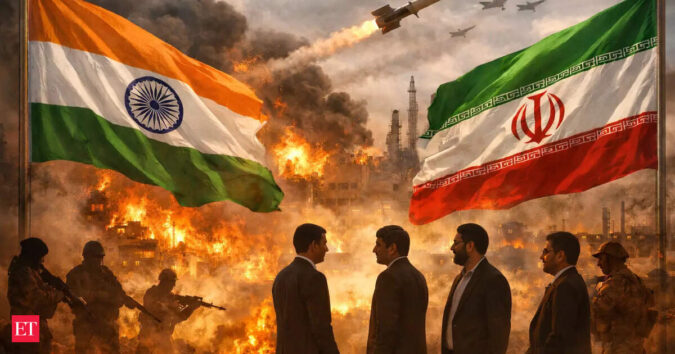
Modi’s government said Saturday it secured the safe transit of two tankers carrying liquefied petroleum gas through the Strait of Hormuz, which has been all but closed for two weeks after the US and Israel launched airstrikes against Iran. India is among only a few nations, including China and Russia, which has had ships pass through the strait safely since the war began.
Click here to track live developments on Iran war
Although initially remaining silent on the strikes against Iran, India is now intensifying its diplomacy as the fighting worsens and panic spreads to energy and financial markets. India is the second-largest importer of LPG in the world and is suffering acute shortages of the fuel, used in cooking gas and industrial processes. India also imports almost 90% of its oil, so crude prices above $100 will push up inflation and pressure the currency, which is already trading at record lows.
At the same time, New Delhi is trying to manage its relations with the US, a close strategic and economic partner. Earlier this month, the US allowed India to buy Russian oil again, reversing its stance from last year when the Trump administration used tariffs to pressure New Delhi to halt the purchases. The US is India’s biggest export market, and the two sides are negotiating a trade deal to lower tariffs.
“India has been trying to balance its ties both with the US and Iran,” said Nitin Pai, founder of Takshashila Institution, a think tank based in Bengaluru. “Passage of ships from Hormuz indicate that the diplomacy is working.”
Also Read: EAM Jaishankar speaks with Iranian counterpart, discusses bilateral ties, BRICS
Modi’s call with Iranian President Masoud Pezeshkian last week was “damage control” and shows New Delhi is trying to “hedge” its position having earlier faced criticism for appearing to side with the US and Israel, said Pai.
“The government has very clearly decided that it is tilting on the side of the US and Israel,” he said. “That is a strategic bet. But when you take a bet like that you also have to hedge. I think the hedging was not done adequately. That hedging has started now.”
Iranian Sailors
India’s Foreign Minister Subrahmanyam Jaishankar spoke to his Iranian counterpart Abbas Araghchi at least four times since the fighting began, while Modi spoke with Iran’s leader on March 12. After the flurry of talks, India announced it secured the safe passage for the two LPG tankers, which had signaled they were Indian government vessels when passing through the strait. Several other vessels remain stuck in the Persian Gulf carrying crude, LPG and liquefied natural gas.
In an interview with the Financial Times on Sunday, Jaishankar said his direct talks with Iran had “yielded some results,” adding that there is no “blanket arrangement” with Tehran for Indian-flagged ships and that “every ship movement is an individual happening.”
New Delhi also agreed to allow about 180 Iranian sailors, who had been docked in the western port city of Kochi, to return to their country. The sailors were aboard the IRIS Lavan when the naval vessel had sought refuge in India because of technical difficulties. A second ship had docked in Sri Lanka, and a third, the IRIS Dena with a crew of more than 100, was destroyed by a US submarine torpedo in the Indian Ocean.
The first test of New Delhi’s diplomatic tightrope will be in the BRICS forum, which India chairs this year. Iran is a member of the group and wants the organization to condemn the military action by the US and Israel. That could prove tricky given the expanded BRICS grouping also includes Saudi Arabia and the United Arab Emirates — two nations that have been targeted by Iranian strikes in the conflict.
Randhir Jaiswal, a spokesman for India’s Ministry of External Affairs, said the involvement of the various parties has made it difficult for BRICS to find consensus on the matter.
“Some members of the BRICS are directly involved in the current situation in the West Asia region, which has impacted forging a consensus on a common BRICS position on the ongoing conflict,” he told reporters on Saturday. “As chair of BRICS, India has been facilitating discussions among members through Sherpa channel.”