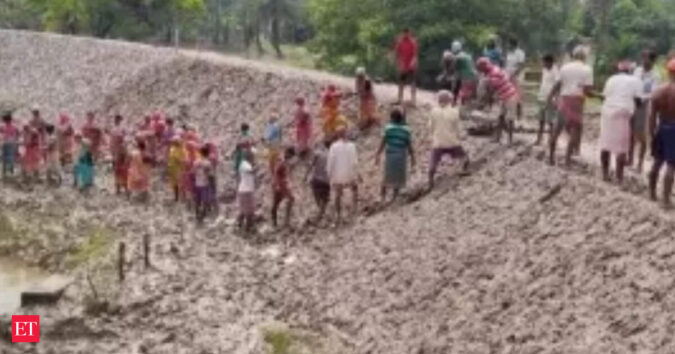
In a written reply, Minister of State for Rural Development, Kamlesh Paswan, said the total pending liabilities across states and Union territories were Rs 9,308.67 crore as of February 9, 2026.
According to the data tabled in the House, Uttar Pradesh had the highest pending liabilities at Rs 1,158.71 crore, followed by Andhra Pradesh at Rs 1,014.60 crore, Karnataka Rs 746.65 crore, Tamil Nadu Rs 729.88 crore, Madhya Pradesh Rs 704.64 crore, Bihar Rs 664.72, Maharashtra Rs 528.28 crore and Assam at Rs 482.51 crore.
The other states with significant pending liabilities included Kerala (Rs 419.09 crore), Odisha (Rs 411.64 crore), Jharkhand (Rs 385.02 crore) and Rajasthan (Rs 383.24 crore).
Responding to concerns about delays in payments under the Mahatma Gandhi National Rural Employment Guarantee Scheme (MGNREGS), the government said the programme is a demand-driven scheme and wage payments are made directly into the beneficiaries’ accounts through the direct benefit transfer (DBT) mode.
“The MGNREGS is a demand-driven wage employment scheme. Under it, wages are directly credited by the Central government into the accounts of the beneficiaries through the DBT protocol,” Paswan said in the reply.
He added that sanctions for wage payments are issued daily through the public finance management system based on fund transfer orders received from the states and Union territories.”At the beginning of each financial year, admissible pending liabilities of the previous years, if any, are duly reimbursed by the government of India.
“Accordingly, all due and admissible pending wage liabilities up to FY 2024-25 have already been cleared (except in the case of West Bengal),” the minister said.
The government also informed the House that during the current financial year, Rs 78,004.59 crore had been released to states and UTs under the scheme as of February 8, including Rs 64,789.49 crore for wages and Rs 13,215.10 crore for material and administrative components.
The reply said the Centre releases funds periodically in tranches depending on factors such as labour budget, demand for work, utilisation of funds and submission of required documents by states.
The government maintained that fund release is a continuous process and that it remains committed to ensuring the availability of funds for the implementation of the scheme based on demand for work on the ground.
It also noted that in 2025-26, about 99.81 per cent of eligible rural households seeking work had been employed under the scheme.