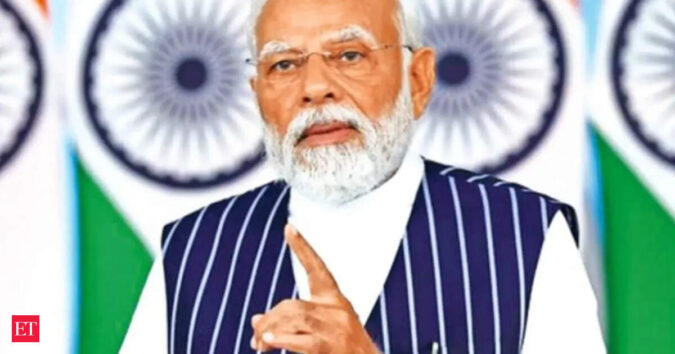
Speaking at the third post-Budget webinar on agriculture and the rural economy, Modi said the government has taken several steps to strengthen the sector and reduce risks for farmers.
Nearly 10 crore farmers have received more than Rs 4 lakh crore under the Pradhan Mantri Kisan Samman Nidhi scheme, he said, adding that various reforms and welfare programmes have helped provide basic economic security to farmers.
“Many such efforts have significantly reduced farmers’ risk and increased the confidence of the agricultural sector,” Modi said, noting that the country is recording high production of food grains, pulses and oilseeds.
The Prime Minister also stressed the need to make Indian agriculture more export-oriented as global demand evolves. “World markets are opening up and global demand is changing. We must take full advantage of our diverse agro-climatic zones,” he said.
Highlighting the role of technology in farming, Modi said the government is expanding digital public infrastructure for agriculture, including the creation of farmer digital identities or Kisan IDs. Around 90 million such IDs have already been generated, while digital surveys of roughly 300 million land parcels have been completed, he said.
Platforms such as eNAM are democratising market access for farmers, while AI-based initiatives like Bharat Vistaar are helping bridge the gap between research institutions and farmers, Modi added.The Prime Minister also highlighted government efforts to strengthen the rural economy through schemes such as Pradhan Mantri Awas Yojana, PM Gramin Sadak Yojana and Swamitva Yojana.
He said the government aims to expand the Lakhpati Didi Abhiyaan, which has already helped create about 30 million “Lakhpati Didis” — rural women earning at least Rs 1 lakh annually — with a target to add another 30 million by 2029.
Modi also called for crop diversification, increased investment in animal husbandry and greater adoption of schemes such as the Govardhan Yojana to boost rural incomes and sustainability.