
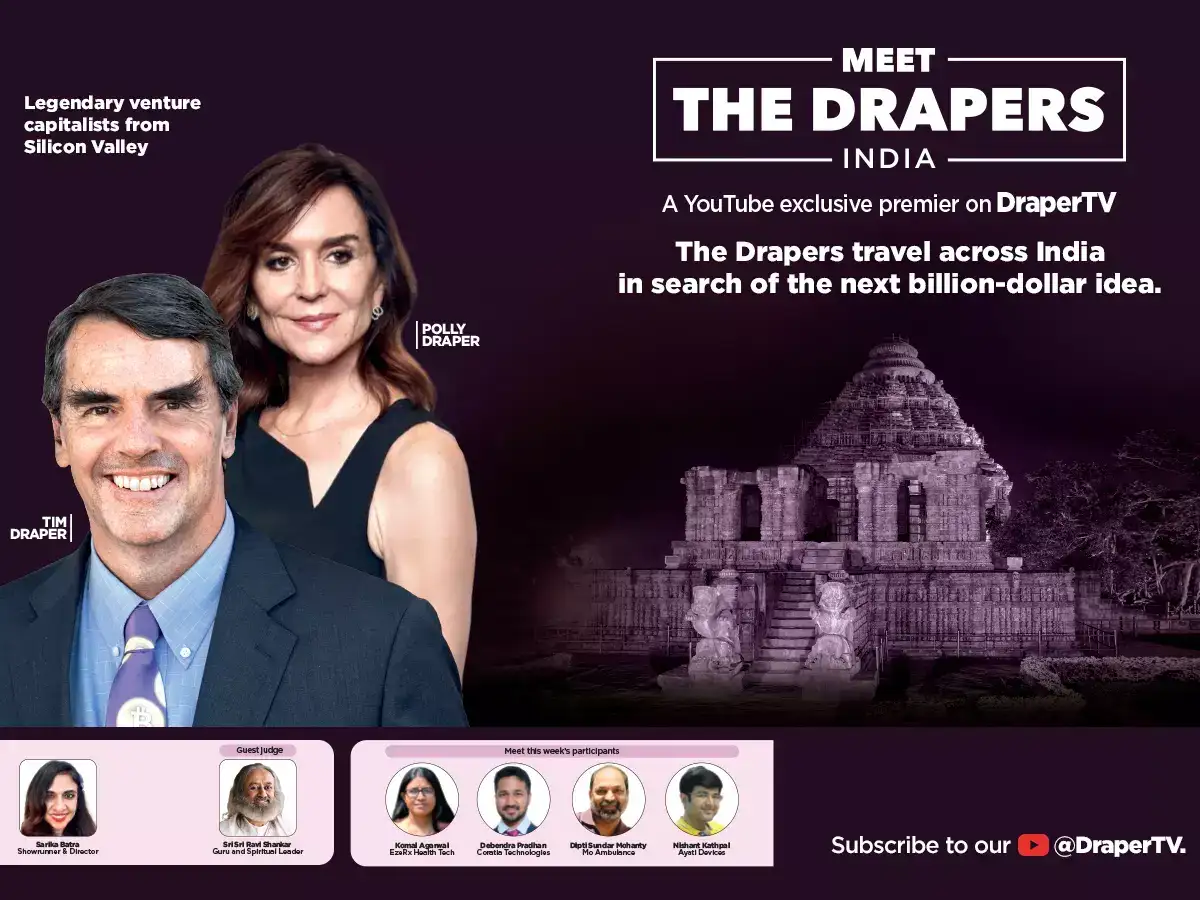
In its Odisha episode, filmed at Sri Sri University in Cuttack, the judging panel included Sri Sri Ravi Shankar, the spiritual leader whose Art of Living Foundation spans 180 countries, as well as Tim and Polly Draper. The combination signals that India’s entrepreneurial landscape isn’t about replicating Silicon Valley; it’s about finding businesses that balance growth with purpose and billion-dollar potential with the ability to serve billions of people.
For Tim Draper, this represents new territory. While other episodes feature judges such as Blume Ventures’ Sanjay Nath or Nykaa founder Falguni Nayar, Odisha brings a different lens. Here, the question isn’t just whether a startup can scale, but how it serves society.
Health tech meets holistic thinking
Four startups took the stage in Odisha, each tackling critical gaps in India’s healthcare and infrastructure. EzeRx Health Tech demonstrated their portable device for screening anaemia without drawing blood, designed for rural settings. Coratia Technologies presented underwater robots for inspecting dams, pipelines, and ports. Clino Health Innovation showcased ambulance technology that streams patient vitals to hospitals in real time. Ayati Devices pitched its early-detection system for diabetic neuropathy.
What tied these pitches together was a shared focus on solving problems faced by millions beyond the metro bubble, where access to dependable healthcare and essential services is still a daily struggle.
Sri Sri Ravi Shankar’s judging style moved beyond conventional startup dynamics to offer perspectives from his unique vantage point. After each pitch, he offered reflections bridging spiritual practice and business pragmatism. Watching EzeRx’s non-invasive anaemia device, he observed, “Blood test many people don’t do, and they don’t know what problems they have. This is good if they add more components to it.”
He praised Coratia’s infrastructure focus and highlighted how Clino Health Innovation’s (Mo Ambulance) real-time data can save lives.
The episode’s most memorable moment came during Ayati Devices’ demonstration. Tim underwent a neuropathy test using VibraSense. After practising Ravi Shankar’s breathing techniques, his follow-up test showed improved sensation. His reaction, “Oh my God, Sri Sri. Thank you,” captured genuine surprise.
It illustrated a point that resonates in India: modern health technology and traditional wellness practices complement each other. For founders building in a market where consumers navigate both modern medicine, commonly referred to with the umbrella term “allopathy,” and wellness practices under the traditional system of ayurveda, this is a market reality.
Earlier in the episode, Ravi Shankar had explained his philosophy on entrepreneurship: “For an entrepreneur, you need so much energy, right? And then you have the intuition. Intuition to take up, like, you pick up the right thing where to invest. You need that intuitive ability and innovative spirit. And of course, these exercises definitely do that.”
Product-market fit in non-metro India
While Delhi episodes showcase government-backed innovation and Bengaluru highlights venture capital concentration, Odisha represents emerging India. States with improving infrastructure and entrepreneurs solving problems for populations beyond Tier-1 cities.
Between pitches, the episode follows founders exploring Odisha’s cuisine and the Sri Sri University campus. These segments provide essential context. Founders building for India need to understand regional diversity and how trust is built differently across states. For Tim Draper, this is education about a market where cultural fluency matters as much as product-market fit.
The judging panel’s deliberations reflected multiple frameworks. Tim pressed Coratia on its business model and questioned EzeRx about the viability of its subscription model. Polly asked about personal motivation. Ravi Shankar considered how each solution addresses genuine human needs.
What the crystal ball revealed
Using Meet the Drapers’ signature crystal ball moment, the judges announced that Coratia Technologies would advance to the semifinals. The decision recognised deep tech that solves infrastructure challenges critical to India’s development. Underwater inspection robots for dams, pipelines, and ports, including defence applications, represent innovation that scales with the country’s infrastructure ambitions. The other three startups were encouraged to continue building and seeking support, a reminder that the show elevates India’s entire startup ecosystem by giving founders a global platform.
When India is the inspiration
What makes the Odisha episode stand out isn’t just that a spiritual leader joined the panel. It’s what his presence signals. Indian entrepreneurs often feel pushed towards Silicon Valley-style goals, such as growth at all costs and a break-things mindset. However, Sri Sri Ravi Shankar’s involvement opens the door to a different kind of conversation, one where success includes more than valuation and where solving problems for rural India matters just as much as winning urban markets.
His reflections on energy and intuition aren’t abstract philosophy; they’re practical lessons for founders navigating bureaucracy and markets, enabling them with an understanding of cultural nuances.
For the Drapers, the episode represented continuing education about India. Instead of Silicon Valley teaching India how to build startups, this fostered mutual learning where venture capital met cultural context, where Hollywood storytelling intersected with philosophical depth.
Meet the Drapers India spans six cities with judges ranging from unicorn founders to spiritual leaders because India’s next unicorn won’t be a copy of an American one. It will be built by founders who understand cap tables and purpose, who can present to venture capitalists and serve customers from rural Odisha to major metros, who measure success in market capitalisation and meaningful impact simultaneously.