
Her work examined how India’s vast informal workforce is organised and where inefficiencies prevent workers and employers from finding each other reliably. One gap that stood out was that despite the scale of the domestic services workforce, households still struggled to find dependable help on demand.
That insight eventually became the foundation for Pronto, the instant house-help platform Sardana launched last year after graduating with a biology degree from Georgetown University in the US. By then, Snabbit had already made an early move into the category, but Sardana believed there was room to build a structured labour network.
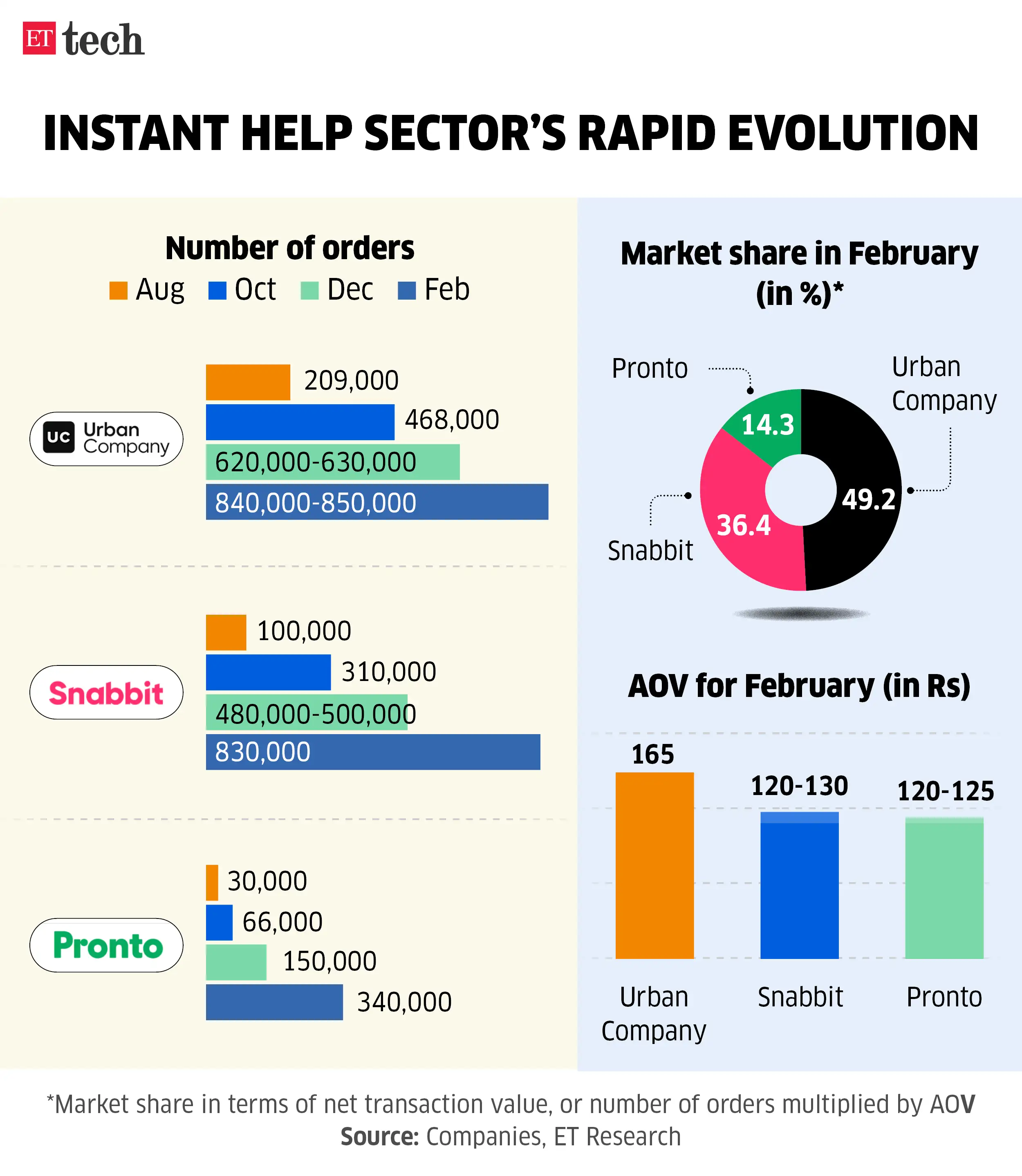
Today, Bengaluru-based Pronto is valued at about $100 million. The company logged around 340,000 orders in February and recently raised $25 million in fresh funding. Being the third in a three-player market, where Urban Company is the leader based on the number of orders fulfilled, is not easy though as cash burn remains high and regular fundraising becomes necessary.
Outside the instant house-help sector, Urban Company, a listed firm, operates in around 51 cities of India. As of October–December 2025, it served about 7.8 million annual transacting users and had nearly 59,000 monthly active service professionals on its network. This has helped the firm quickly extend its heft to the 10-minute house-help segment and cement its market leadership.
Snabbit, founded by Aayush Agarwal, who industry insiders describe as a “fundraising machine” given his stint at quick commerce firm Zepto, has raised almost $60 million since the company’s seed round in May 2024 and is already negotiating its next large financing.
Incidentally, Zepto is led by two 23-year-old Stanford dropouts, Aadit Palicha and Kaivalya Vohra, and investors compare Sardana’s aggressive approach with Palicha’s, who slugged it out with large players like Zomato’s Blinkit and Swiggy’s Instamart in a highly competitive industry.
More than house help
Sardana sees the platform as more than a household services app. In her view, the underlying model could eventually serve as a template for organising informal labour across sectors, including small manufacturing and services.
Raised in the US in a Punjabi family with two brothers, she is the daughter of an IIT-Delhi alumnus who moved to the US and started his own business from which he has since retired. Her mother, who grew up in West Bengal, is a practising doctor. Over the past few days, Sardana has drawn criticism on social media from people who assumed that she is the daughter of Indian-American entrepreneur Raj Sardana, founder of US-based IT services firm Innova Solutions. Several users suggested that her perceived privilege helped her raise funding at a young age. She, however, clarified to ET that Raj Sardana is her uncle, not her father.
Prior to Pronto, Sardana first worked at venture capital firm 8VC, whose portfolio includes companies such as Anduril Industries and Palantir Technologies, and then moved to private equity firm Bain Capital.
Work on Pronto, however, began earlier. Sardana had already started developing the idea in 2024 while still in college. At the time, several startups were quietly exploring the instant house-help model, though most were in stealth mode.
Snabbit was the first to emerge publicly after raising its series A funding from Elevation Capital in January 2025.
“When Snabbit raised (funds) in January, it was effectively the only visible player in the category,” a founder in the space told ET on condition of anonymity.
A month later, Pronto raised its seed round—a $2 million cheque from Bain Capital—and launched operations on April 1, 2025. This triggered competitive intensity in the segment, the founder said.
Urban Company was initially cautious as it was then preparing for a public listing in 2025. “They were largely in a wait-and-watch mode in the early months,” the founder added.
By mid-2025, the category had begun heating up. Both Pronto and Snabbit raised follow-on funding in quick succession, while Urban Company also signalled to public market investors that it planned to bet more aggressively on the segment.
 ETtech
Heavy odds
“This is a brutally execution-heavy business,” according to an investor who said he looked at Pronto but did not invest. “You’re dealing with supply reliability, training, logistics and customer expectations all at once. For a 20-something founder, those are tough variables to manage. Not that we don’t have a precedent, but the real test for Anjali will be whether she can build a dense supply and keep service quality consistent. That’s where most startups in this space struggle.”
Those serving on her board, however, feel she is well-suited to take a crack at the category in terms of founder–market fit.
“The professionals at Pronto who provide domestic services are predominantly women. A big part of what Anjali cares about is creating a pathway to the middle class for them. Her perspective as a woman probably gives her more credibility on that front, and certainly more empathy. That’s an important part of what Pronto is trying to do and central to the company’s mission,” Ajay Agarwal, partner, Bain Capital, told ET.
“It also ties into the kind of service we want to deliver,” he said. “Our professionals should feel they’re part of a team, not just a cog in a machine. The work should provide stability, opportunities for training and learning, and a sense of empowerment. Those things ultimately reinforce each other.”