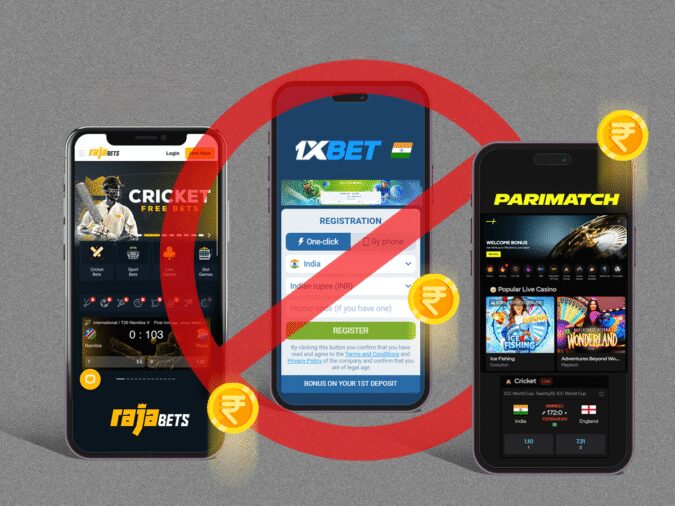
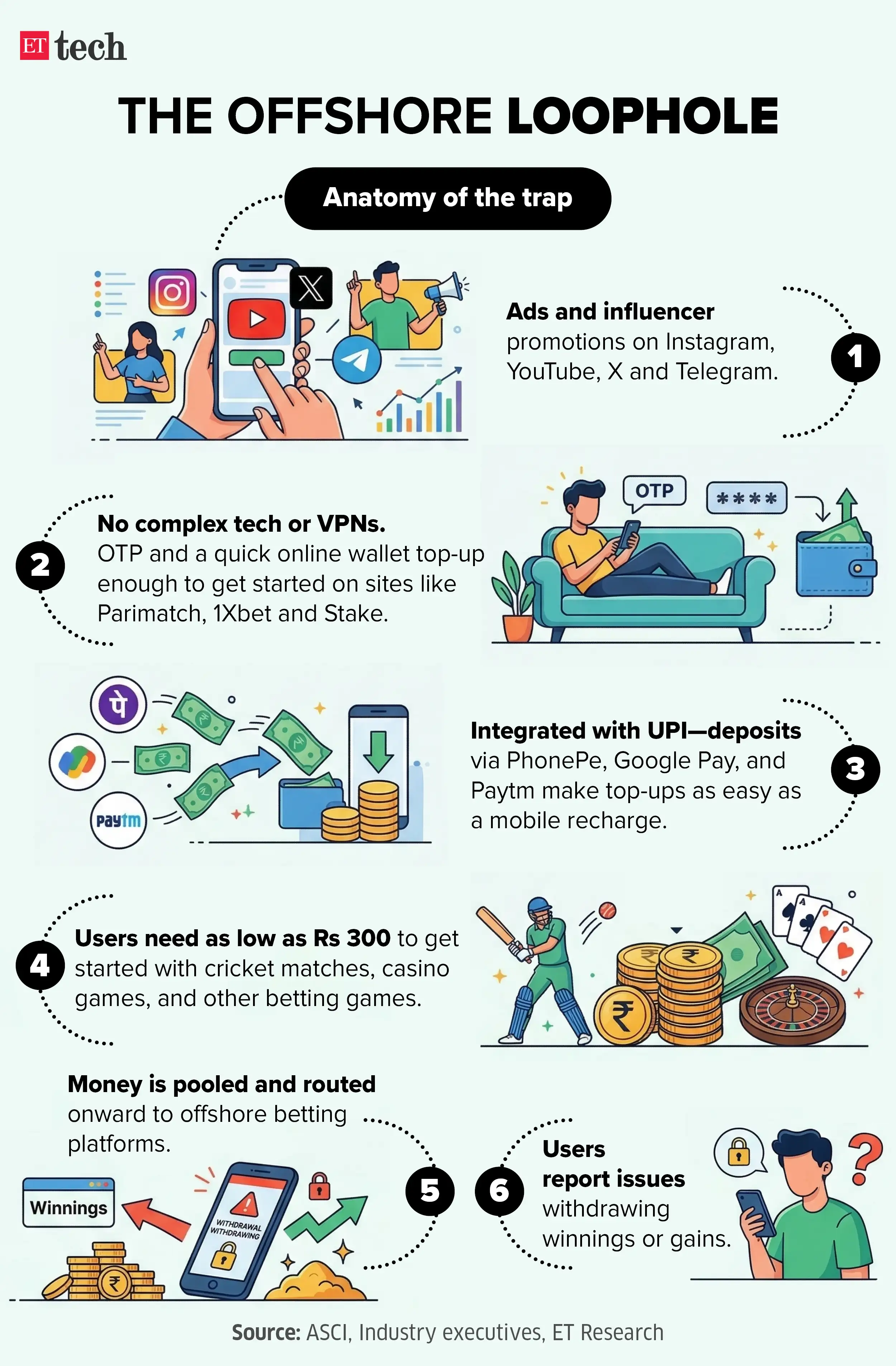
For Indian users, however, the ban has proved largely cosmetic as accessing illegal offshore betting platforms is child’s play. Consumers can register within minutes: a mobile number, an OTP, and a quick wallet top-up is all it takes to get started.
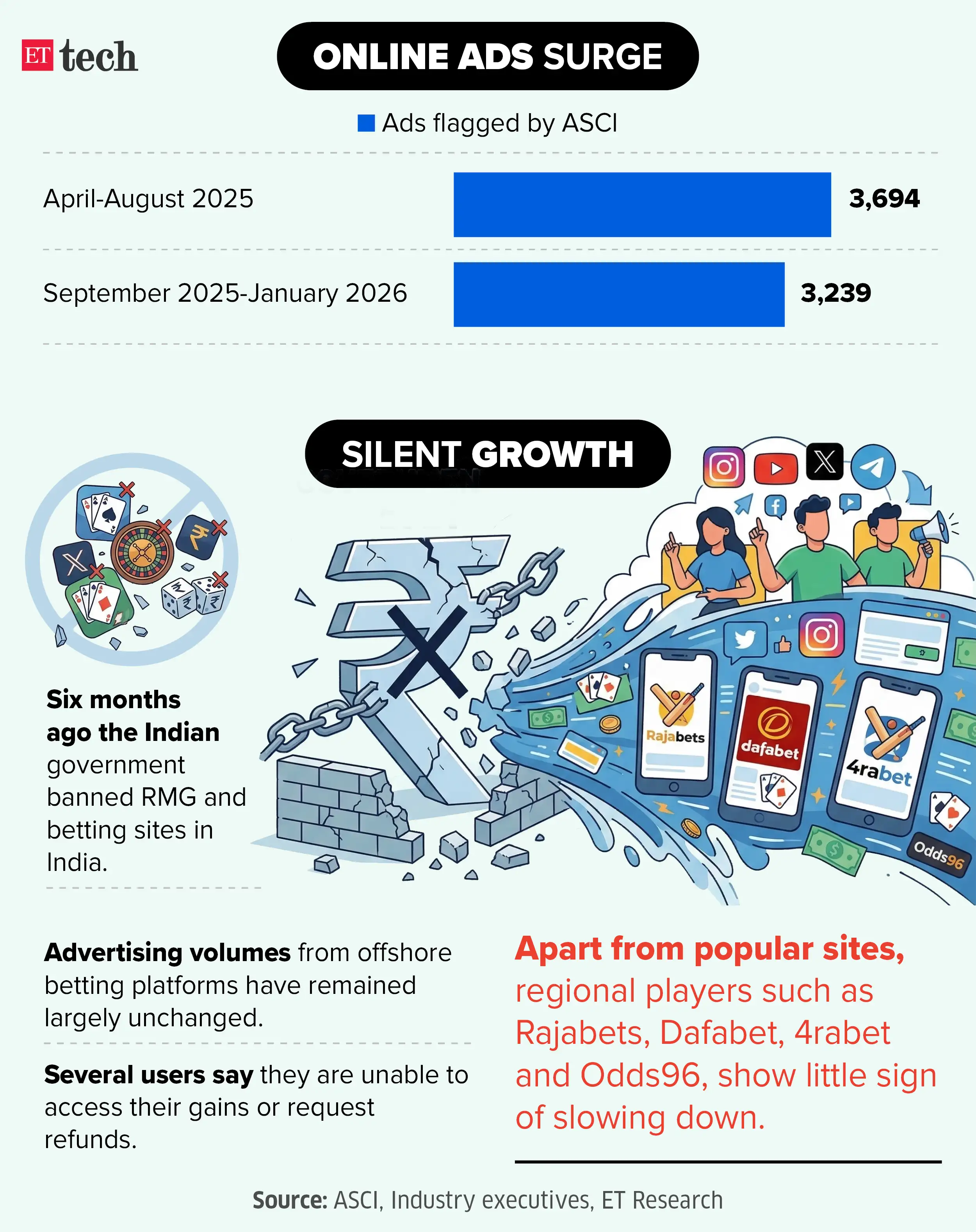
Platforms like Parimatch, 1XBet, and Stake, along with regional players such as Rajabets, Dafabet, 4rabet, and Odds96, show little sign of slowing down, and are aggressively tapping digital ads and micro-influencers for marketing and promotions, industry executives said on condition of anonymity.
An ET investigation found these websites to be easily accessible without any workarounds such as a virtual private network (VPN). They also provide interfaces in Indian languages including Hindi, Marathi, Tamil, and Bengali, signalling a clear focus on users from tier II and tier III cities.
Deposits can be made through the Unified Payments Interface (UPI), net banking, e-wallets, prepaid cards, and even cryptocurrencies. The most common route, however, is UPI, which is linked to a bank account. Mainstream apps such as PhonePe, Google Pay, and Paytm allow users to scan QR codes and transfer funds.
ET has reached out to NPCI, PhonePe, Google Pay, and Paytm for comments.
 ETtech
The volume of digital ads of offshore betting platforms has remained largely unchanged despite the enforcement of the Promotion and Regulation of Online Gaming Act (PROGA), according to the Advertising Standards Council of India (ASCI), a self-regulatory organisation that promotes fair advertising and prevents misleading claims.
Manisha Kapoor, CEO and secretary general, ASCI, said the body flagged 3,694 ads promoting betting sites between April and August 2025. Following the regulatory measures in August, it flagged 3,239 such ads between September 2025 and January 2026.
These ads and influencer-generated content are spread across Instagram, YouTube and X, among others. ET has reached out to Meta, Google and X for comments.
“The ban has made really no difference to offshore betting, which was there before and continues even now,” said Kapoor, adding, “If a category is banned then the advertising for that category cannot happen.”
According to PROGA, advertising or promoting such games can attract a jail term of up to two years and a fine of up to Rs 50 lakh.
 ETtech
The money trail
“Offshore platforms like Parimatch and 1XBet have been around for years. They are now the biggest beneficiaries of the ban,” the founder of a gaming startup that was significantly impacted by the regulatory overhaul said, requesting anonymity. As users flock to them, these websites have ensured that the user experience remains flawless.
“Think of it like a local network,” he added. “Thousands of small shopkeepers and individuals create UPI accounts. You pay Rs 100 to a person. That person aggregates the money and settles it onwards, and so on, till the cash ultimately reaches the betting platform. Winners get paid and everyone else’s money disappears into the system.”
In this structure, offshore platforms do not necessarily collect funds through a formally onboarded Indian merchant. Instead, payments are routed through what the founder described as “mule accounts”, individual UPI IDs acting as collection nodes. A mule account is a bank account used to facilitate financial crimes, including money laundering, fraud, and illicit fund transfers.
Experts say such arrangements can raise red flags around layering, a money laundering risk where funds move through multiple accounts to obscure their origin and destination. Blocking orders of these websites, when issued, can be circumvented through mirror websites, which are identical platforms hosted under new domain names, or by switching URLs faster than authorities can block them.
A payments industry executive said detection is difficult. “You can make payments to offshore platforms because the system often sees it as just a peer-to-peer (P2P) transfer,” the executive said. “If the QR code belongs to an individual, the payment app cannot automatically decipher that it’s linked to a betting site.”
The core issue, the executive added, lies in merchant categorisation. Payment systems typically rely on Merchant Category Codes (MCCs) to identify the nature of a business, whether it is gaming, education, grocery, or travel, allowing payment aggregators and gateways to apply risk filters. In theory, these transactions should carry a specific gaming MCC. But that works only when a merchant is formally onboarded and properly classified.
“If funds are routed through personal UPI IDs, there is no gaming MCC to tag,” the executive said. “It simply looks like a P2P transaction.”
Also Read: From RMG ban to esports glory: India’s gaming rollercoaster in 2025
Winners, but not keepers
Several users have said that they are unable to access their winnings or request refunds. “I made a deposit on February 16, but it has still not been credited to my account. I have already shared the proof multiple times, including screenshots and my bank statement. Please resolve this urgently,” said a user in a post on X. Another user said their withdrawal of Rs 25,000 from Parimatch has been pending for more than two months.
Interestingly, Parimatch also has agents who guide users through the withdrawal process as part of its support system. However, multiple users reported that all they got was an automated reply.
While users have complained on social media about their money being stuck in these offshore platforms and shared their order numbers and transaction details, they have no legal recourse as these platforms don’t fall under the purview of the Indian government.
“Pre-ban, a large number of users used to play fantasy or rummy games. A significant chunk of these appear to have shifted to illegal betting sites, which have grown 2-3X over the past six months. With shady offshore betting apps there is no transparency about the ownership structure or corporate entity, hence players cannot be sure whether they’ll get back their deposits or winnings, but many unfortunately continue to fall prey to such illegal operations,” said gaming lawyer Jay Sayta.
He added that the mule accounts through which payments are routed typically belong to individuals such as small vendors or labourers, who rent out their bank accounts.
In an interview with ET on August 26, 2025, Dream Sports CEO Harsh Jain called the RMG legislation a “knockout punch” for the company, saying it wiped out 95% of the group’s revenue and 100% of its profits overnight. The company has since shut its real money operations and pivoted.
Other gaming firms have exited India or scaled down operations. For instance, Hike shut down its RMG app Rush, Winzo exited the segment, and MPL halted all cash gaming in India, with founder Sai Srinivas telling employees that 50% of the group’s revenue vanished overnight due to the new law.
Several gaming companies have reported sizeable write-downs on their India-linked assets in the quarter following the regulatory ban on RMG.
US-headquartered Flutter Entertainment booked an impairment of $556 million in the September quarter of FY26 after its India unit, Junglee Games, halted money-based rummy operations. Canada-based private equity firm Clairvest wrote off its investment in Head Digital Works, the operator of A23 Rummy. Domestic player Nazara Technologies also recorded an impairment of Rs 914.7 crore on its investment in Moonshine Technologies, the parent entity of PokerBaazi.
As for the government, it’s been actively going after such operations. In January, it blocked more than 242 illegal betting and gambling websites, and overall, authorities have taken down 7,800 such platforms. Section 69A of the Information Technology Act empowers the government to block access to unlawful websites and links.
Nonetheless, betting, especially when mated with India’s national passion cricket, remains a heady cocktail and prohibition hasn’t been able to achieve much more than a change of address, with the punters playing on platforms just beyond India’s regulatory reach.