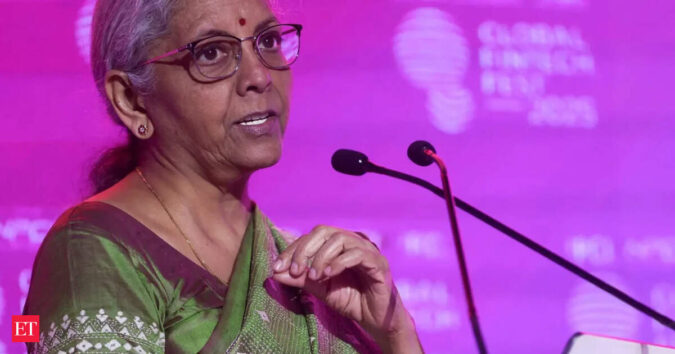
India’s deft economic management over the past decade has enabled it to retain space to keep up its elevated capital expenditure, cut interest rates, offer targeted support to affected sectors amid external headwinds, Sitharaman said. The country also has the lowest debt-to-GDP ratio (81%) among major economies, barring Germany.
In contrast, many countries, with high debt and large deficits, don’t have much room to manoeuvre, she said, highlighting the need for prudent policy-making in public finance.
Also Read | RBI MPC Meeting: India seen holding rates as ‘Goldilocks’ phase gives way to stress
“This is the dividend of a decade of fiscal discipline. This is the strategic value of fiscal prudence that pays dividends across decades,” she said.
The minister was delivering the inaugural address at the golden jubilee celebrations of the National Institute of Public Finance and Policy in the national capital.
The current year is even more challenging than 2025, as the world moves “from a landscape of shocks to one of permanent volatility”, she said.A prudent fiscal policy is not just about ‘austerity’ or cutting back expenditure, it is also about spending the resources in an efficient and transparent manner on time, she said.
Also Read | FD rates set to rise? RBI repo decision may bring good news for investors
“It is also important to note that a good public finance policy improves the counter-cyclical capacity of fiscal policy — especially the ability to ‘lean against the wind’ in economic downturn,” the minister said.
India on strong footing
While global debt has hit 95% of global GDP, India’s general government debt is to the tune of 81% of its GDP, the minister said. It’s also the only major economy where the debt ratio, according to the International Monetary Fund, is projected to fall significantly — to 75.8% by 2030.
At the same time, the debt outlook for the advanced economies such as the US, China, Germany, and others is projected to exacerbate.
India’s external debt-to-GDP ratio stands at just 19.1% as of September 2025, among the lowest in the emerging market world. India’s foreign exchange reserves of over $688 billion offer healthy import cover of roughly 11 months.