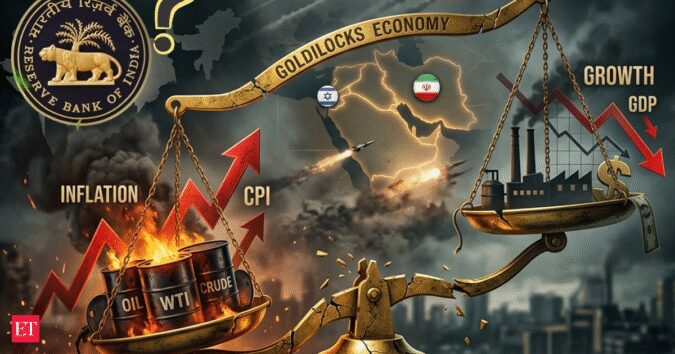
That sense of balance is now under strain. The Iran war and the resulting surge in oil prices and disruption of supply chains have begun to unsettle the macroeconomic environment. As risks to both inflation and growth rise simultaneously, the RBI finds itself confronting the classic central banking dilemma it had briefly managed to avoid — choosing between supporting growth and containing inflation.
Also read: India’s economy shows early strain; CEA warns of ‘significant’ hit to growth, inflation, balances in March review
The fading of a rare sweet spot
Only a few months ago, the macroeconomic landscape appeared unusually favourable. Growth was strong, inflation was subdued, liquidity conditions were supportive and financial stability risks seemed contained.
That equilibrium is now under strain. The sharp rise in global crude prices, triggered by disruptions in a key energy-producing region, has introduced immediate inflationary pressures. At the same time, early signs of slowing economic momentum suggest that growth may not remain as resilient as before. The so-called Goldilocks period is giving way to a far more uncertain environment.
The most direct channel of disruption is energy. With crude prices breaching psychologically significant levels and supply chains strained by geopolitical tensions, India faces a classic imported inflation shock. Higher oil prices feed into transportation costs, manufacturing inputs and eventually retail inflation.
However, the inflation story is more complex than oil alone. As highlighted in recent commentary, longer trade routes and supply disruptions are pushing up the prices of intermediate goods. These pressures tend to seep gradually into wholesale prices before reaching consumers. The timing and intensity of this pass-through remain uncertain, complicating the RBI’s forecasting exercise.
This uncertainty is critical. Monetary policy works with lags, but the current environment makes it difficult to estimate both the magnitude and duration of inflationary pressures. The risk is not just higher inflation, but volatile inflation.
Also read: Explained: How RBI’s safety net to protect falling rupee could mean Rs 4,000 crore shock for banks
Growth risks in an interconnected world
While inflation risks are rising, growth is simultaneously facing headwinds. India’s economic momentum remained firm through early 2026, supported by domestic demand and public investment. Yet, high-frequency indicators are beginning to show moderation.
The transmission channels are clear. Higher input costs compress corporate margins. Supply disruptions affect production cycles. Global uncertainty dampens investment sentiment. External demand may weaken if the global economy slows under the weight of higher energy prices.
This creates a difficult situation for policymakers. Tightening monetary policy to control inflation could amplify the slowdown. Holding back to support growth risks allowing inflation expectations to drift upward.
Also read: India unleashes curbs on rupee bets as intervention costs swell
The policy dilemma sharpens
The RBI’s challenge lies in navigating this dual shock. If inflation rises meaningfully above its comfort zone, maintaining the current policy rate could result in real interest rates turning too low. On the other hand, a premature rate hike may signal panic and undermine growth at a fragile moment.
There is also a question of interpretation. Should the central bank treat the current episode as a transitory supply shock or as the beginning of a more persistent inflation cycle? This distinction is crucial. A supply shock typically calls for looking through temporary price spikes, while persistent inflation demands a firmer policy response.
The upcoming monetary policy decision, on April 8, thus becomes a test of judgment under uncertainty.
Exchange rate pressures and external vulnerabilities
Beyond inflation and growth, the external sector presents another layer of complexity. Rising oil prices widen the current account deficit by increasing the import bill. At the same time, global risk aversion can trigger capital outflows, putting pressure on the currency.
A weaker currency, in turn, makes imports more expensive, reinforcing inflationary pressures. This feedback loop forces the RBI to remain active in foreign exchange markets, even as it calibrates domestic monetary policy.
Managing the balance of payments becomes especially important. Sustained outflows or weak inflows could require a combination of policy tools, ranging from forex interventions to measures aimed at boosting dollar inflows through investment channels and remittances.
Limits of conventional policy tools
What makes the current situation particularly challenging is the limited effectiveness of traditional policy responses. Monetary tightening cannot produce more oil or unclog supply chains. At best, it can moderate demand and anchor expectations.
Similarly, maintaining accommodative conditions may support growth, but risks exacerbating inflation if supply shocks persist. The central bank must therefore rely on a broader toolkit, including liquidity management, forex operations and coordination with fiscal authorities.
Government actions, such as absorbing part of the fuel price shock, can provide temporary relief. But such measures have fiscal implications and cannot be sustained indefinitely.
A test of credibility and communication
In times of uncertainty, central bank communication becomes as important as policy action. The RBI must indicate that it remains committed to its inflation mandate while acknowledging growth risks. Striking this balance is essential to anchor expectations in financial markets and among consumers.
Any perception of indecision or delayed response could unsettle markets. Conversely, an overly aggressive stance could trigger unnecessary tightening of financial conditions. The challenge lies in conveying flexibility without appearing reactive.
The end of the Goldilocks phase marks the beginning of a more demanding period for monetary policy in India. The RBI is no longer operating in a stable, predictable environment. Instead, it faces overlapping shocks, uncertain transmission channels and limited policy clarity. The path ahead is unlikely to be linear. Policy may need to shift quickly as new data emerges. What will matter most is not a single decision, but the ability to adapt without losing sight of long-term stability.