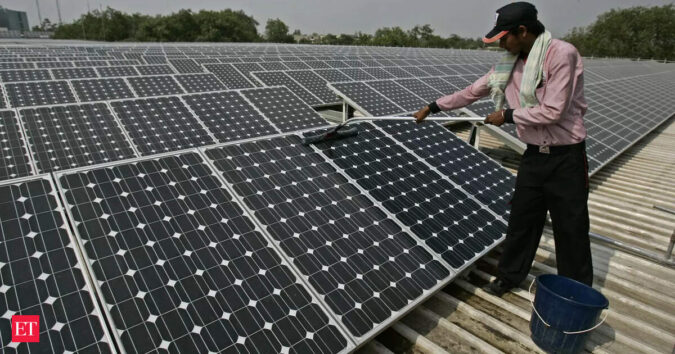
With tariffs set to fall to 18% from 50%, companies are drawing up plans to export higher-value products such as battery energy storage systems (BESS), inverters, and transformers, apart from modules and cells, the experts added.
Indian companies such as Waaree Energies, Vikram Solar and Saatvik Solar have been investing to diversify their product portfolios over the past year, expanding into battery storage, inverters and transformers alongside modules.
The US has been India’s largest market for solar equipment exports such as modules and cells despite lower volumes. The trade deal could meaningfully improve market access for Indian electricity sector equipment suppliers, beyond just solar modules, said Sumant Sinha, founder, chairman and CEO of ReNew.
“The grid build-out in the US market is already large and accelerating, given the increasing electricity demand for data centres, computing needs and electrification,” Sinha said. “This is, in turn, driving the need for components such as inverters, transformers, other power electronics and even batteries.”

With tariffs set to fall to 18% from 50%, companies are drawing up plans to export higher value products.
Compliance with US standards
Sinha also highlighted that capturing this opportunity will require certifications, compliance with stringent US standards, and stronger after-sales and local partnershipsIn FY25, India exported solar modules worth $1.12 billion, of which the US accounted for 97%. Similarly, solar cell exports to the US accounted for around 93% of the total $32 million. “It significantly enhances the cost-competitiveness of Indian-made solar cells and modules. This improvement will make projects more profitable for US developers and create a substantial new demand for high-efficiency, made-in-India products in the coming years,” said Saatvik Green Energy CEO Prashant Mathur.
Vikram Solar has earmarked ₹4,371 crore of capital expenditure to install a 5 gigawatt-hour (GWh) BESS manufacturing facility in Tamil Nadu, to be commissioned by FY27. Waaree Energies, the country’s largest solar module maker, is expanding into BESS, inverters and green hydrogen and investing nearly ₹10,000 crore in a 20 GWh BESS facility by FY28. Saatvik Green Energy also plans to foray into BESS, transformers and cables as part of its transition into a fully integrated clean energy solutions provider.
The diversified product portfolio is likely to help them tap export opportunities in the US market.
American scope
The North American BESS market is projected to rise to $49.3 billion by 2031 from an expected $24 billion in 2026 at a compounded annual growth rate (CAGR) of 15.5%, according to Mordor Intelligence.