A day earlier, Washington issued an order imposing a temporary global 10% imports surcharge from Tuesday on all goods entering the US. This is after the US Supreme Court struck down Trump’s global tariffs.
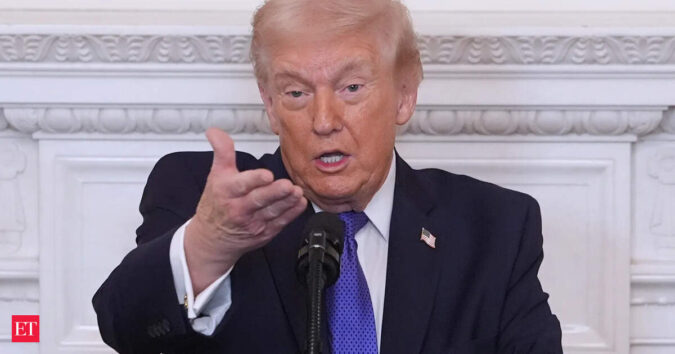
Trump said on Truth Social that after a review of the “extraordinarily anti-American decision” by the court to rein in his tariff programme, the administration was hiking the import levies “to the fully allowed, and legally tested, 15% level.” This levy is permissible for the next 150 days, and the US President said his administration will work on new and “legally permissible” tariffs in that period.
“We have noted the US Supreme Court judgment on tariffs,” a statement from the commerce and industry ministry said before the increase to 15%.

‘Retribution’ Levy
The ministry also noted the US President’s press conference, and was considering implications even as the increase was announced. In his post, Trump said the 15% rate would apply to countries he accused of having “ripped” off the US for decades, and framed the move as a response to the US apex court’s decision on tariffs.
The US Supreme Court had ruled that the tariffs by Trump were illegal and that he had exceeded his authority in imposing them. Trump then made a proclamation, saying, “I impose, for a period of 150 days, a temporary import surcharge of 10% ad valorem on articles imported into the US, effective February 24.”“The (10%) across-the-board tariff relies on Section 122 of the Trade Act of 1974 but use of section 122 is also on weak legal footing and likely to be challenged,” said a trade expert.
The US can also use Section 338 of the Tariff Act of 1930, which permits retaliatory tariffs if countries discriminate against American exports, but it requires strong proof and has never been used in modern practice.
Trump has also threatened the use of Section 301 of the Trade Act of 1974, which targets unfair trade practices. But it requires lengthy investigations before tariffs can be imposed.
Washington had imposed a reciprocal tariff of 25% on India in August, which was then raised to 50% for buying Russian oil. The 25% penal tariff was done away with earlier this month when the two sides announced a framework for an interim deal.
The February 6 joint statement proposed lowering the reciprocal tariff to 18%, but the change has not yet been implemented — it would be in the legal text. An Indian delegation is expected to leave for Washington on Sunday for three days of talks to finalise the legal agreement.
Ajay Sahai, director general of the Federation of Indian Export Organisations, said the latest hike was expected as a statute allows him to raise tariffs up to 15%.
Pankaj Chadha, chairman of the Engineering Exports Promotion Council echoed this, adding, “It needs to be seen with whom the US bargains first. A global tariff is only paid by the customer. Unless there is a delta among countries, only the end customer will land up paying the tariff.”
Sanjay K Jain, chairman of the Indian Chamber of Commerce’s National Textile Committee, said, “As far as India is concerned, we are almost at the agreed 18%, as even without reciprocal tariff, we are at 15% with the new tariff.”
On the 10% tariffs, Ajay Srivastava, founder of the Global Trade Research Initiative, opined that New Delhi should reevaluate the interim trade deal with the US as the reciprocal tariffs apply only on 55% of the value of Indian exports to the US and about 40% of goods are in the exempted categories.
Not Yet Fully Clear
However, the sectoral tariffs (steel, aluminium, copper at 50%, and a few auto components at 25%) will continue, according to a fact sheet issued by the White House. These have been imposed under Section 232 of the Trade Expansion Act of 1962 that allows import restrictions on national security.
Trump has said the trade deal with India is on, and nothing changes on that front. “We made a deal with India. That stands. They are paying the tariffs now. We are not paying. We did a little flip… India deal is on,” he said.
“In a separate executive order, the President also reaffirmed and continued the suspension of duty-free de minimis treatment for low-value shipments, including goods shipped through the international postal system, which will also be subject to the temporary import duty imposed under section 122,” the US said.
It argued that the widening balance of payments deficit and growing reliance on imports pose significant risks to the US economy and that tariffs will continue to be a “critical tool” to protect American businesses and workers.
Some goods will not be subject to the temporary import duty because of the needs of the US economy or to ensure that the duty more effectively addresses the fundamental international payments problems it faces.